
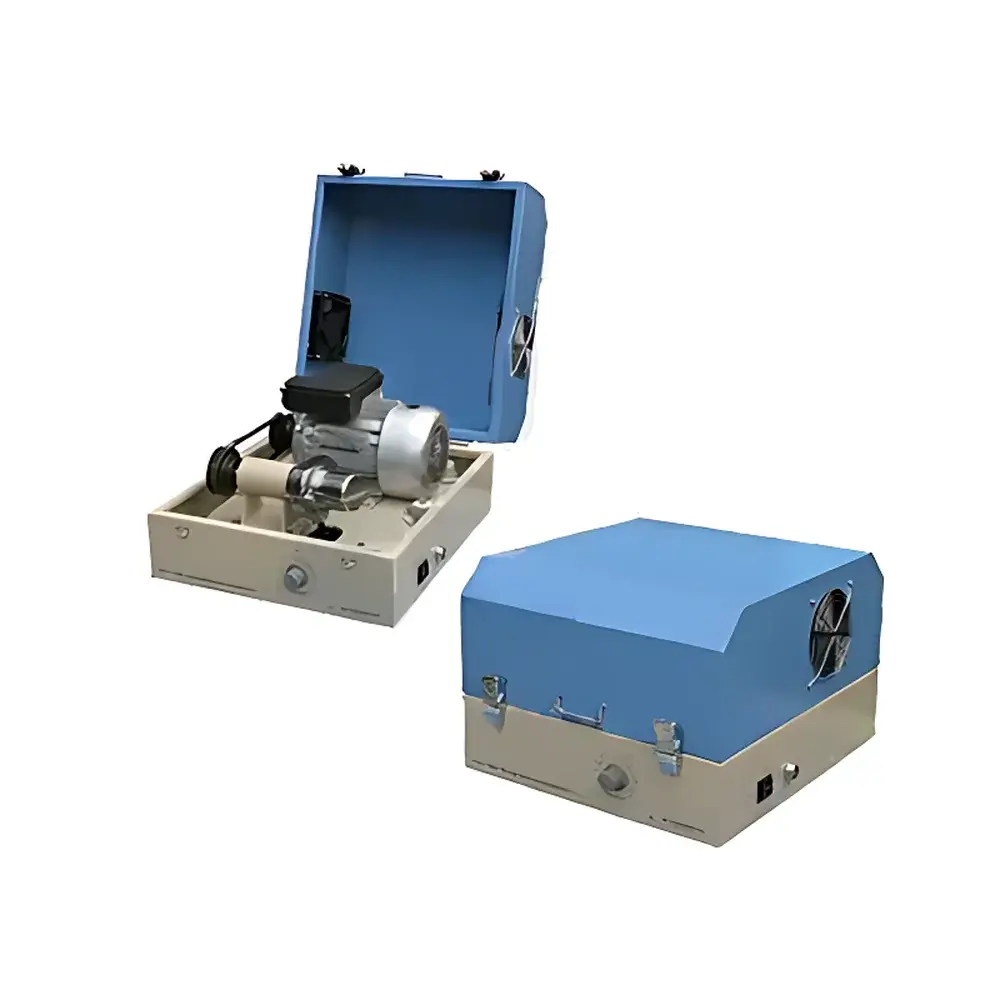
KJ GROUP SFM-3 High-Speed Vibratory Mixer
| Brand | KJ GROUP |
|---|---|
| Origin | Liaoning, China |
| Manufacturer Type | Authorized Distributor |
| Country of Origin | China |
| Model | SFM-3 |
| Quotation | Upon Request |
| Rated Voltage | AC 220 V |
| Rated Power | 180 W |
| Timer Range | 0–120 min |
| Vibration Frequency | 1200 cycles/min |
| Milling Jar Capacity | 50–80 mL |
| Maximum Loading Volume | ≤1/3 of jar capacity |
| Feed Particle Size | <1 mm |
| Final Particle Size | down to 0.1 µm |
| Dimensions (L×W×H) | 405 × 265 × 260 mm |
| Net Weight | 15 kg |
| Standard Jars | One 80 mL stainless steel jar, one 80 mL nylon jar, assorted grinding media |
| Optional Jars | Customizable ceramic, PTFE, agate, or zirconia jars (~50 mL) |
| Safety Note | Not compatible with argon atmosphere when operated inside gloveboxes |
Overview
The KJ GROUP SFM-3 High-Speed Vibratory Mixer is an engineered laboratory-scale mechanical processing system designed for rapid and reproducible size reduction, homogenization, and solid-state reaction initiation via high-frequency vibrational energy transfer. Unlike conventional planetary ball mills or rotary tumblers, the SFM-3 employs a precisely balanced eccentric oscillating shaft driven by a brushless AC motor. This architecture generates controlled three-dimensional vibrational motion—comprising vertical oscillation, lateral swing, and rotational inertia—thereby intensifying collision frequency and impact energy between grinding media and sample particles. The result is accelerated comminution kinetics and enhanced mixing uniformity, particularly suited for small-batch (mg–g scale) preparation in materials science, powder metallurgy, battery electrode development, and ceramic precursor synthesis.
Key Features
- Compact benchtop footprint (405 × 265 × 260 mm) and lightweight design (15 kg), enabling flexible integration into fume hoods, gloveboxes (with inert gas compatibility restrictions), or shared instrumentation labs.
- Adjustable digital timer (0–120 min) with automatic shutdown, supporting unattended operation under defined process windows for repeatability and protocol standardization.
- Stable 1200-cycle-per-minute vibration frequency ensures consistent energy input across batches; motor rated at 180 W delivers sufficient torque without thermal overload during extended runs.
- Dual-standard jar configuration: includes one 80 mL stainless steel jar (for robust, non-reactive milling) and one 80 mL nylon jar (for low-contamination, soft-material processing); both conform to ISO 8502-3 surface cleanliness requirements post-cleaning.
- Optimized loading protocol—maximum fill volume limited to one-third of jar capacity—maintains optimal free-fall trajectory of grinding media while minimizing wall adhesion and heat accumulation.
Sample Compatibility & Compliance
The SFM-3 accommodates dry powders, wet slurries, and viscous pastes across diverse material classes: metallic alloys (e.g., Fe–Al, Mg–Ni), oxide ceramics (LiCoO₂, ZnO), polymers, pharmaceutical excipients, and geological specimens. Feed particle size must not exceed 1 mm to ensure uniform energy coupling; final particle distributions routinely achieve D₅₀ ≤ 0.1 µm after optimized milling cycles. While not certified to IEC 61000-6-3 or UL 61010-1 as a standalone unit, the device complies with general CE-marked electrical safety principles when used with grounded AC 220 V supply. Users performing GMP-aligned R&D (e.g., cathode active material qualification) are advised to document jar traceability, cleaning validation, and batch-specific vibration amplitude calibration per internal SOPs.
Software & Data Management
The SFM-3 operates as a stand-alone electromechanical instrument with no embedded firmware or data logging capability. All operational parameters—including timer setting, start/stop sequence, and manual jar installation verification—are recorded manually or integrated into lab notebook systems (e.g., LabArchives, Benchling) via user-defined metadata fields. For audit readiness in regulated environments (e.g., preclinical battery material development under ASTM F3048), users may pair the mixer with external time-stamped video capture or IoT-enabled power monitors to reconstruct process duration and runtime integrity.
Applications
- Mechanical alloying of immiscible metal systems (e.g., Cu–Ti, Al–Mg) for metastable phase formation and nanocrystalline structure refinement.
- Homogenization of cathode/anode composite slurries prior to rheological characterization or electrode coating trials.
- Preparation of ultrafine ceramic precursors for sintering studies, where submicron particle size distribution directly influences green density and grain growth kinetics.
- Rapid dispersion of carbon nanotubes or graphene flakes into polymer matrices for conductivity mapping and percolation threshold analysis.
- Small-scale mechanochemical synthesis (e.g., metal–organic framework nucleation) under solvent-free or liquid-assisted grinding (LAG) conditions.
FAQ
Can the SFM-3 be operated inside an argon-filled glovebox?
No. The motor’s internal brush system generates localized arcing; operation in argon atmospheres poses explosion risk. Use only in air or nitrogen-purged enclosures.
What is the recommended grinding media-to-sample mass ratio?
A 10:1 to 20:1 ratio (media:sample) is typical for efficient energy transfer; optimal values depend on material hardness and desired fineness—empirical calibration is advised.
Is jar temperature monitored during operation?
No real-time temperature sensing is built-in. For exothermic reactions, intermittent cooling pauses or cryo-jar adaptation (e.g., stainless steel with external coolant jacket) is required.
How often should the eccentric shaft bearing be lubricated?
Under normal use (≤2 hr/day), re-lubrication with NLGI #2 lithium grease is recommended every 6 months or after 500 operating hours.
Does KJ GROUP provide IQ/OQ documentation packages?
Yes—customized installation and operational qualification templates compliant with ISO/IEC 17025 and USP are available upon request for regulated laboratories.



