
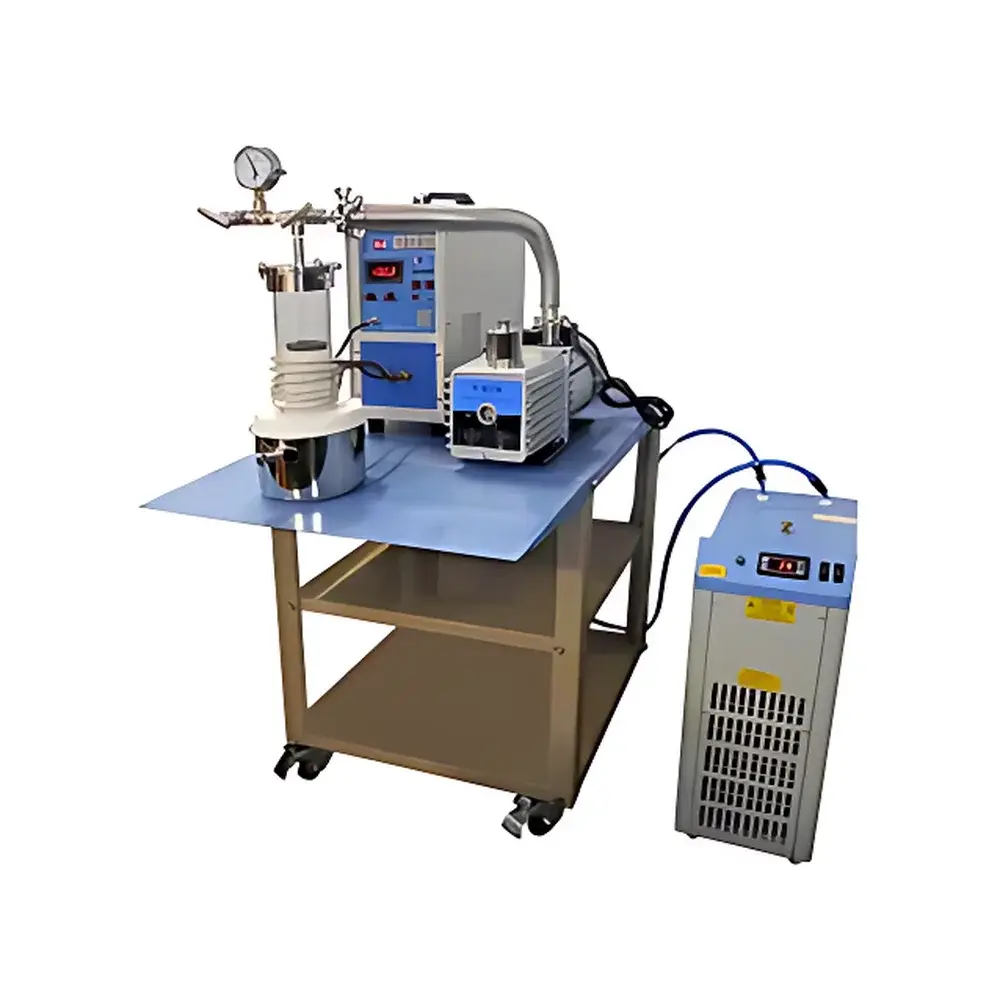
KJ GROUP SP-15VIM Vacuum Induction Melting Furnace
| Brand | KJ GROUP |
|---|---|
| Origin | Anhui, China |
| Manufacturer Type | Authorized Distributor |
| Origin Category | Domestic (China) |
| Model | SP-15VIM |
| Quotation | Upon Request |
| Heating Power Range | 2–15 kW |
| Operating Frequency | 30–110 kHz |
| Crucible Capacity | 79 mL |
| Quartz Tube Dimensions | Ø60 mm OD × Ø57 mm ID × 250 mm L |
| Vacuum Flange | KF25 |
| Cooling Water Flow Rate | 4 L/min |
| Chiller Temperature Range | 5–35 °C |
| Vacuum Pump Speed | 226 L/min |
| System Weight | 105 kg |
| Overall Footprint (Heater + Chiller + Pump + Trolley) | ~1500 mm × 600 mm × 700 mm |
Overview
The KJ GROUP SP-15VIM Vacuum Induction Melting Furnace is a compact, laboratory-scale induction melting system engineered for controlled atmospheric processing of small-batch metallic alloys under high-vacuum or inert-gas conditions. It operates on the principle of electromagnetic induction heating: an alternating current passing through a water-cooled copper coil generates a time-varying magnetic field, inducing eddy currents within electrically conductive metallic charge placed inside a quartz crucible. This results in rapid, volumetric, and contactless heating—enabling precise thermal management without contamination from external heating elements. Designed specifically for research and development environments—including university metallurgy labs, national institutes, and advanced materials R&D centers—the SP-15VIM supports iterative alloy formulation, phase diagram validation, and rapid prototyping of intermetallics, amorphous metals, and reactive alloys (e.g., Ti, Zr, Mg, and rare-earth-containing systems). Its integrated vacuum and argon-purged chamber ensures oxygen partial pressures below 10⁻³ Pa, minimizing oxidation and enabling reproducible microstructural outcomes.
Key Features
- Integrated safety architecture: real-time monitoring of cooling water pressure, inlet/outlet temperature differential, and coil overtemperature; automatic shutdown triggered by coolant flow interruption or thermal excursion beyond preset thresholds.
- Dual-stage protection logic: hardware-based power cutoff when output exceeds 15 kW or duty cycle exceeds 80%, complemented by software-configurable ramp/soak profiles with programmable heating (1–99 s) and cooling (1–99 s) durations.
- Ceramic refractory assembly fabricated entirely from high-purity alumina (Al₂O₃ ≥ 99.5%), including crucible support base, crucible holder, and sealing lid—providing thermal stability up to 1700 °C and chemical inertness against molten reactive metals.
- Modular subsystem design: SP-15A RF induction heater (30–110 kHz), KF25-compatible vacuum chamber with quartz tube (Ø60 × 250 mm), 4 L recirculating chiller (5–35 °C, 4 L/min), two-stage rotary vane vacuum pump (226 L/min, ultimate pressure ≤ 5 × 10⁻² Pa), and mobile stainless steel trolley (800 × 600 × 597 mm).
- Electrical interface compliant with IEC 61000-3-12; requires dedicated AC380 V, 50 Hz supply with 63 A circuit breaker and verified earth grounding (< 4 Ω resistance) per IEC 60364-5-54.
Sample Compatibility & Compliance
The SP-15VIM accommodates sample masses up to 100 g (dependent on density and crucible fill ratio), with typical use cases involving Fe-, Ni-, Co-, Al-, Cu-, Ti-, and Mg-based alloys. The quartz crucible (Ø58 × 78 mm, 79 mL volume) permits direct observation of melt behavior and facilitates post-solidification extraction for metallographic analysis. Argon backfilling (≥99.99% purity) is mandatory for oxygen-sensitive melts and satisfies ASTM E8/E8M requirements for tensile specimen preparation under controlled atmosphere. Vacuum integrity conforms to ISO 2859-1 sampling plans for leak-check validation, while operational parameters support GLP-compliant documentation when paired with external data loggers recording time-stamped temperature, power, and vacuum level.
Software & Data Management
The SP-15VIM operates via front-panel digital controls with LED indicators for power status, vacuum level, coolant flow, and fault codes. While no proprietary PC software is bundled, analog outputs (0–10 V DC) are provided for external integration with SCADA systems or LabVIEW-based acquisition platforms. All critical operational events—including power-on sequence, vacuum pump activation, heating initiation, and emergency shutdown—are timestamped and stored in non-volatile memory for audit trail reconstruction. For regulated environments, optional RS485 Modbus RTU interface enables connection to centralized MES systems supporting FDA 21 CFR Part 11 electronic record requirements when validated with appropriate access controls and electronic signatures.
Applications
- Rapid alloy screening for high-entropy alloys (HEAs) and bulk metallic glasses (BMGs) requiring short dwell times at peak temperature.
- Preparation of master alloys for subsequent arc-melting or directional solidification studies.
- Thermophysical property calibration samples (e.g., for DSC, TMA, or dilatometry) where compositional homogeneity and minimal segregation are critical.
- Small-scale recycling trials of scrap metallic feedstocks under reducing or inert atmospheres.
- Teaching laboratories demonstrating electromagnetic heating principles, vacuum technology fundamentals, and reactive metal handling protocols.
FAQ
What vacuum level can the SP-15VIM achieve with the included pump?
The integrated 550 W two-stage rotary vane pump achieves a base pressure of ≤ 5 × 10⁻² Pa after 30 minutes of pumping from atmosphere; performance may vary depending on system cleanliness and ambient humidity.
Is the quartz tube replaceable, and what is its expected service life?
Yes—quartz components are consumables. Under standard operation (≤ 1500 °C, no thermal shock), the tube typically endures 50–80 melt cycles; replacement frequency increases significantly with rapid quenching or repeated exposure to alkali-metal vapors.
Can the system be upgraded to include mass spectrometry or optical pyrometry?
The KF25 flange allows installation of auxiliary viewports or feedthroughs; however, OEM integration of calibrated pyrometers or residual gas analyzers requires custom mechanical and electrical interfaces not supplied as standard.
Does the chiller require deionized water exclusively?
Yes—use of deionized or ultrapure water (resistivity ≥ 1 MΩ·cm) is mandatory to prevent scaling and galvanic corrosion in the copper coil and chiller heat exchanger.
What maintenance intervals are recommended for the vacuum pump oil?
Oil should be replaced every 200 operating hours or quarterly—whichever occurs first—to maintain pumping efficiency and avoid hydrocarbon backstreaming into the process chamber.
Related Products



