
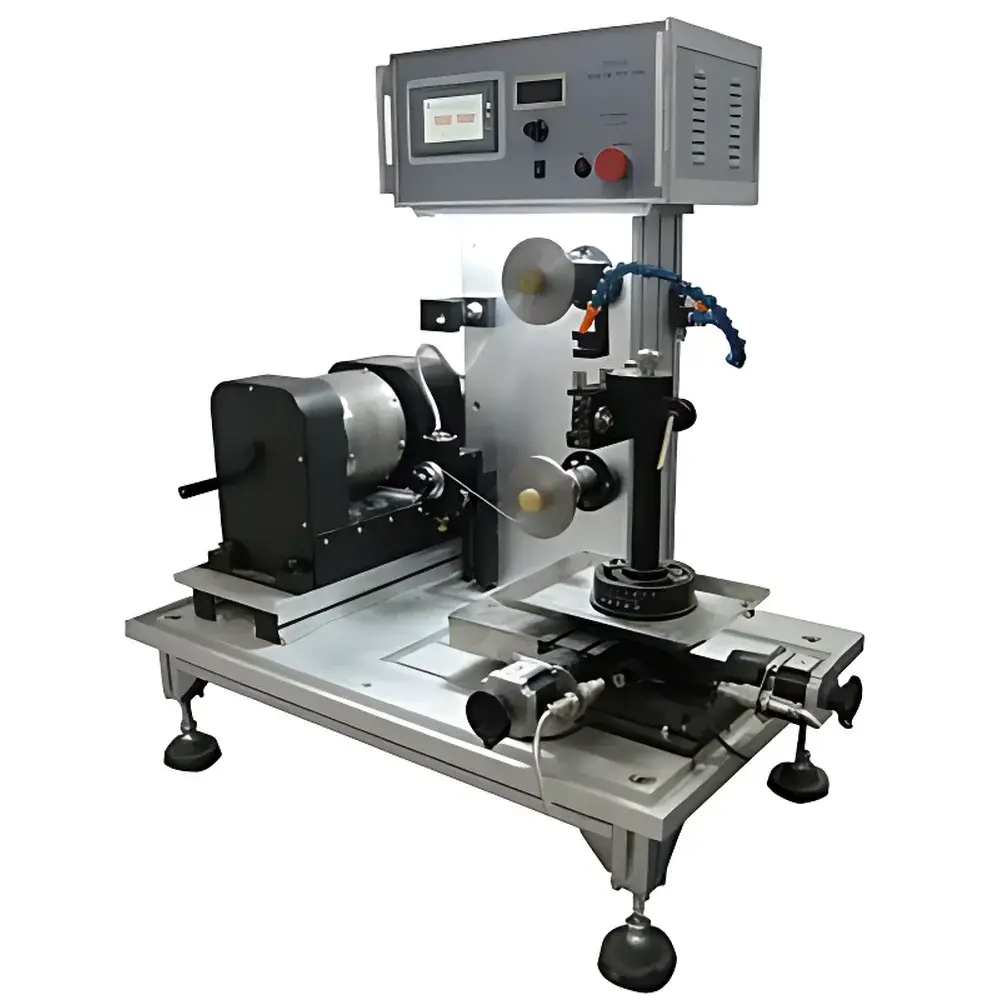
KJ GROUP STX-402 Benchtop Diamond Wire Saw
| Brand | KJ GROUP |
|---|---|
| Origin | Liaoning, China |
| Model | STX-402 |
| Instrument Type | Precision Diamond Wire Saw |
| Power Supply | AC 220 V, 50 Hz |
| Max. Power Consumption | < 250 W |
| Total Wire Length | 100 m |
| Adjustable Wire Speed | 0–2 m/s |
| X-Axis Travel Range | 1–110 mm |
| Y-Axis Travel Range | 0.01–110 mm |
| Positioning Resolution (X/Y) | 0.01 mm |
| Angular Accuracy of 2D Adjustable Fixture | ±10′ |
| Max. Sample Dimensions | Ø100 mm × 100 mm |
| Machine Dimensions (W×D×H) | 810 × 700 × 910 mm |
| Net Weight | 110 kg |
| Operating Environment | Altitude < 1000 m |
| Compliance | Designed for GLP-compliant lab environments |
Overview
The KJ GROUP STX-402 Benchtop Diamond Wire Saw is an engineered precision cutting system designed for controlled, low-damage sectioning of brittle and heterogeneous materials in research laboratories and small-scale production settings. It operates on the principle of abrasive wire sawing, where a continuous diamond-impregnated monofilament wire reciprocates at precisely regulated linear velocity while the sample advances incrementally under computer-assisted motorized feed control. This mechanism minimizes thermal stress, mechanical chipping, and subsurface damage—critical for preserving crystallographic integrity, interfacial morphology, and microstructural fidelity in high-value specimens. Unlike rotary or abrasive-wheel cutters, the STX-402 applies distributed, low-normal-force abrasion across the entire kerf, enabling reproducible slicing of fragile single crystals (e.g., BBO, YAG, ZnO), optically transparent substrates (e.g., ZnS, Ge, Si), and composite laminates without delamination or edge cracking. Its benchtop footprint and modular architecture support integration into cleanroom-adjacent workflows and ISO/IEC 17025-accredited material characterization labs.
Key Features
- Reciprocating diamond wire drive with fully adjustable linear speed (0–2 m/s) via closed-loop stepper motor control, ensuring consistent kerf width and surface finish across diverse hardness profiles.
- Spring-loaded tensioning system with high-stiffness helical springs maintains constant wire tension throughout extended cutting cycles—eliminating slack-induced vibration, tracking deviation, or premature wire breakage.
- Motorized dual-axis (X/Y) translation stage with 0.01 mm digital resolution and programmable travel limits (X: 1–110 mm; Y: 0.01–110 mm), enabling precise depth-of-cut definition and repeatable multi-slice protocols.
- 2D angularly adjustable sample fixture with ±10′ precision in both horizontal and vertical planes—essential for orientation-specific cleaving of anisotropic crystals and epitaxial wafers per ASTM F1351 or IEC 60747 standards.
- 80–100 m total diamond wire capacity supports uninterrupted multi-hour operation; compatible with standard diamond wire diameters (0.125–0.42 mm) and alternative slurry-based cutting modes using metal wires and abrasive suspensions.
- No coolant pump required for dry-cutting applications; optional integrated recirculating oil delivery system available for heat-sensitive or hygroscopic samples.
Sample Compatibility & Compliance
The STX-402 accommodates a broad spectrum of inorganic, organic, and hybrid materials with Mohs hardness ≤ 9.5—including technical ceramics (Al2O3, ZrO2, SiC), semiconductor ingots (Si, Ge, GaAs), optical crystals (LiNbO3, CaF2, CsI), geological specimens (granite, basalt, meteoritic iron-nickel alloys), biomedical hard tissues (cortical bone, dental enamel, calcified vascular plaques), and polymer-matrix composites (CFRP, GFRP). All mechanical and electrical subsystems conform to IEC 61000-6-2/6-4 EMC requirements. The system supports audit-ready documentation practices aligned with FDA 21 CFR Part 11 (when paired with validated third-party data acquisition software), GLP Annex 15, and ISO/IEC 17025 clause 7.7 on sampling and preparation traceability.
Software & Data Management
While the STX-402 operates via intuitive front-panel controls, it features RS-232 and USB interfaces for external parameter logging and remote operation. Users may integrate it with LabVIEW™, MATLAB®, or Python-based automation scripts to log feed rate, wire speed, cycle count, and cumulative travel distance—enabling full metrological traceability per ISO 14253-1. Optional KJ-DataLink software provides real-time graphical monitoring of motor current draw (proxy for cutting resistance), enabling adaptive feed-rate modulation based on material heterogeneity. All configuration files are stored in plain-text CSV format for long-term archival and cross-platform compatibility.
Applications
- Preparation of TEM lamellae and SEM cross-sections from brittle electronic ceramics and thin-film stacks.
- Sectioning of thermoelectric ingots (Bi2Te3, PbTe) for Seebeck coefficient mapping and carrier mobility analysis.
- Production of geologic thin sections (30 µm) from metamorphic and igneous rocks under controlled strain conditions.
- Cutting of infrared-transmitting optics (ZnSe, Ge) for FTIR spectroscopy and laser cavity alignment.
- Serial sectioning of mineralized biological tissues for micro-CT correlation studies and histomorphometric quantification.
- Wafering of photovoltaic silicon bricks and sapphire substrates prior to epitaxial growth or polishing.
FAQ
What types of diamond wire are compatible with the STX-402?
Standard electroplated or resin-bonded diamond wires with diameters of 0.125 mm, 0.25 mm, 0.35 mm, and 0.42 mm are supported. Custom wire specifications can be accommodated upon request.
Is the machine suitable for cutting conductive materials like metals?
Yes—non-ferrous metals (Cu, Al, Ti alloys) and ferrous alloys (low-carbon steel) may be cut using appropriate wire selection and feed rate optimization. For highly ductile metals, slurry-assisted cutting with metal wire and SiC suspension is recommended.
Does the STX-402 require water cooling or external exhaust?
No water connection is needed. However, local fume extraction is required when cutting oil-lubricated samples or generating fine particulate dust (e.g., from graphite or soft ceramics).
Can the system be validated for GMP-regulated environments?
The base unit meets mechanical and electrical safety prerequisites for IQ/OQ protocols. Full GMP validation requires supplementary documentation packages, including calibration certificates for linear encoders and torque verification reports—available through KJ GROUP’s Qualified Service Division.
What is the typical kerf loss and surface roughness achievable?
Kerf width ranges from 120–180 µm depending on wire diameter and feed rate. As-cut Ra values typically fall between 0.4–0.8 µm for crystalline silicon and 0.6–1.2 µm for polycrystalline alumina, without secondary polishing.



