
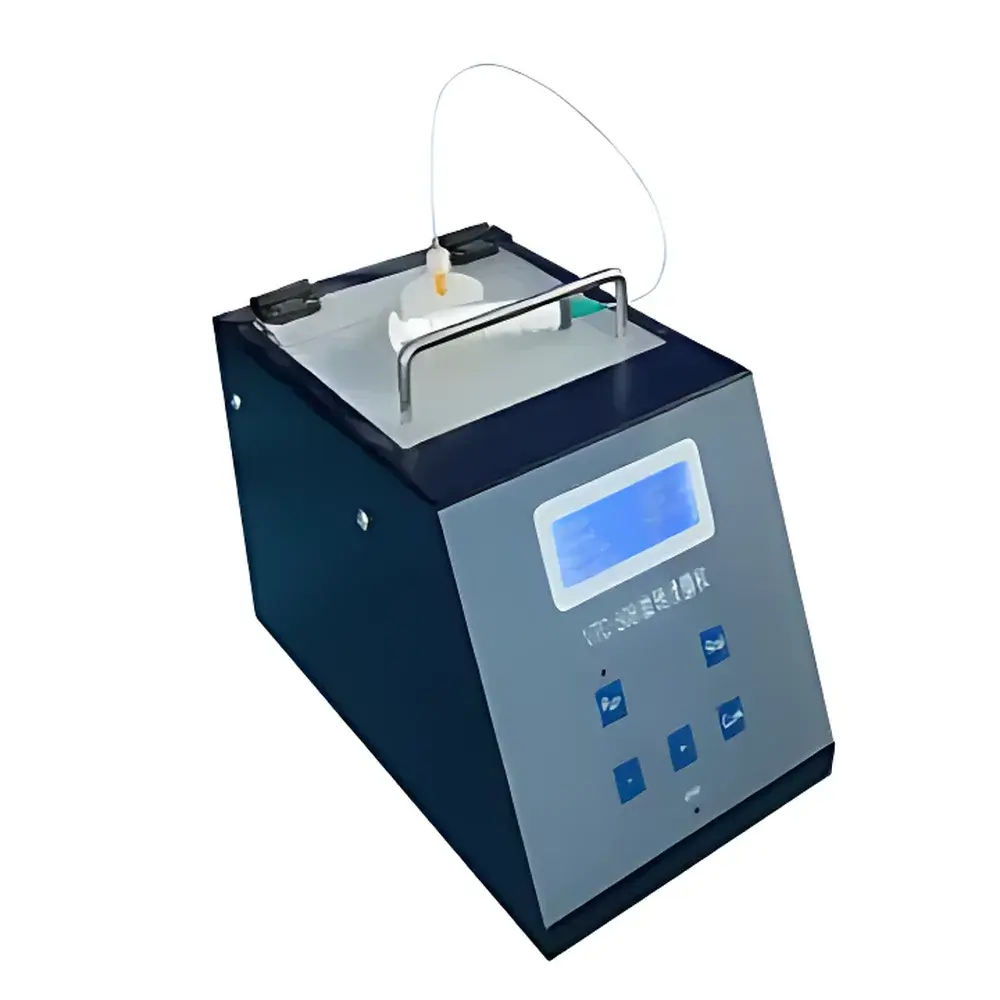
KJ GROUP VTC-50B Benchtop Spin Coater
| Brand | KJ GROUP |
|---|---|
| Origin | Liaoning, China |
| Manufacturer Type | Direct Manufacturer |
| Model | VTC-50B |
| Power Supply | AC 220/110 V, 50/60 Hz |
| Rated Power | 150 W |
| Speed Range | 100–6000 rpm |
| Speed Stability | < ±1% |
| Speed Resolution | 1 rpm |
| Time Resolution | 1 s |
| Programmable Steps | 9 per program, up to 6 stored programs |
| Sample Holder Diameter | 90 mm |
| Max Substrate Size | 2-inch (50.8 mm) |
| Rotation Direction | Counter-clockwise |
| Chuck Runout (Axial) | ±2.5 µm |
| Chuck Runout (Radial) | ±1 µm |
| Operating Temperature | 5–40 °C |
| Relative Humidity | ≤85% RH |
| Dimensions (L×W×H) | 174 × 285 × 163 mm |
| Weight | 3 kg |
| Enclosure Material | Cast aluminum body with acrylic lid |
| Control System | Embedded microcontroller with EMI-resistant design |
| User Interface | English-language LCD touchscreen |
| Sample Fixation | Slot-based polypropylene chuck (no vacuum or adhesive required) |
| Environmental Requirement | Altitude ≤1000 m, ambient temp. 25 ±15 °C, humidity 55 ±10% RH |
| Noise Level | Low-noise operation via vibration-damping mounting |
Overview
The KJ GROUP VTC-50B Benchtop Spin Coater is an engineered solution for precise, repeatable thin-film deposition via rotational fluid dynamics. Based on the principle of centrifugal force-driven solvent evaporation and viscous shear thinning, the system accelerates substrates to controlled angular velocities—ranging from 100 to 6000 rpm—to induce uniform radial dispersion of liquid, sol-gel, or low-viscosity paste precursors across flat surfaces. Its compact footprint (174 × 285 × 163 mm), 3 kg mass, and 24 V logic-compatible control architecture enable seamless integration into inert-atmosphere gloveboxes (O₂/H₂O < 1 ppm), making it suitable for air-sensitive material processing including perovskite precursors, conductive inks, photoresists, and metal-organic frameworks. The device operates without compressed gas, water cooling, or exhaust ducting, fulfilling minimal infrastructure requirements for academic labs, R&D pilot lines, and QC environments.
Key Features
- Cast aluminum chassis with transparent acrylic viewing lid—enables real-time optical monitoring of spin dynamics and meniscus behavior during coating.
- EMI-hardened microcontroller-based speed regulation ensures < ±1% rotational stability even at 6000 rpm, critical for thickness reproducibility across wafer-scale or small-format substrates.
- Slot-configurable polypropylene chuck eliminates reliance on vacuum chucks or epoxy fixation—prevents substrate warping, edge chipping, or thermal stress-induced deformation in brittle wafers (e.g., Si, glass, ITO, flexible PET).
- Two-stage programmable protocol: independent control of dispense timing, acceleration ramp, dwell time, and deceleration profile—optimizes film uniformity by managing edge-bead formation and solvent drying kinetics.
- English-language LCD interface with intuitive menu navigation; supports storage of six multi-step recipes (up to nine discrete speed/time segments per program).
- Vibration-isolated base mount and balanced rotor assembly reduce operational noise to <55 dB(A), meeting ISO 140-5 acoustic standards for shared laboratory spaces.
Sample Compatibility & Compliance
The VTC-50B accommodates rigid and semi-rigid planar substrates up to 2 inches (50.8 mm) in diameter, including silicon wafers, fused silica slides, quartz crystals, ceramic plates, and polymer films. Its chuck runout specifications—axial ±2.5 µm and radial ±1 µm—meet ASTM F39-22 tolerances for spin-coating equipment used in microelectronics fabrication. The absence of vacuum ports or high-temperature zones ensures compatibility with temperature-sensitive resists (e.g., PMMA, SU-8) and organic semiconductors. While not certified to IEC 61000-6-3 (EMC) or UL 61010-1 out-of-box, its embedded controller complies with basic functional safety principles aligned with GLP documentation practices for non-GMP research use. All materials in contact with substrates (PP chuck, resin base pad) are RoHS-compliant and non-outgassing under inert conditions.
Software & Data Management
The VTC-50B operates as a standalone instrument with no external PC dependency. All parameter sets—including speed profiles, dwell durations, and acceleration rates—are retained in non-volatile memory with timestamp-free recall. Though it does not support FDA 21 CFR Part 11 electronic signatures or audit trails, its deterministic firmware architecture enables full traceability of executed protocols when paired with lab notebook documentation. Optional accessories—including temperature-calibrated viscometers, precision syringe pumps, and post-bake hotplates—can be synchronized manually to establish end-to-end process workflows compliant with ISO/IEC 17025 method validation guidelines.
Applications
- Academic thin-film research: fabrication of perovskite solar cell layers, graphene oxide coatings, and antireflective sol-gel films.
- Microfabrication prototyping: photoresist spinning for maskless lithography, MEMS release layer deposition, and dielectric passivation.
- Materials science labs: uniform coating of battery electrode slurries (LiCoO₂, NMC), catalyst inks (Pt/C), and hydrogel precursors.
- Quality control: repeatability testing of inkjet-printed conductive traces using spin-assisted planarization.
- Teaching laboratories: hands-on demonstration of Newtonian/non-Newtonian fluid behavior under centrifugal fields.
FAQ
Is the VTC-50B compatible with nitrogen-purged gloveboxes?
Yes—the unit operates on isolated 24 V DC logic power and contains no outgassing elastomers or lubricants, enabling safe deployment inside Class 1000 or better inert-atmosphere enclosures.
Can I coat substrates larger than 2 inches?
No—the 90 mm chuck diameter and mechanical clearance limit maximum supported substrate size to 2-inch (50.8 mm) wafers or equivalent square formats.
Does the system support automatic dispensing?
No—dispensing is manual via supplied syringe; however, the two-stage program logic allows precise synchronization of spin initiation with operator-triggered deposition.
What maintenance is required?
Annual inspection of chuck concentricity using dial indicator (recommended), cleaning of acrylic lid with isopropanol, and verification of grounding continuity per IEC 60335-1 Annex G.
Is firmware upgrade capability available?
Firmware updates are performed via USB port using KJ GROUP’s proprietary utility; version history and release notes are provided upon request for internal validation records.



