
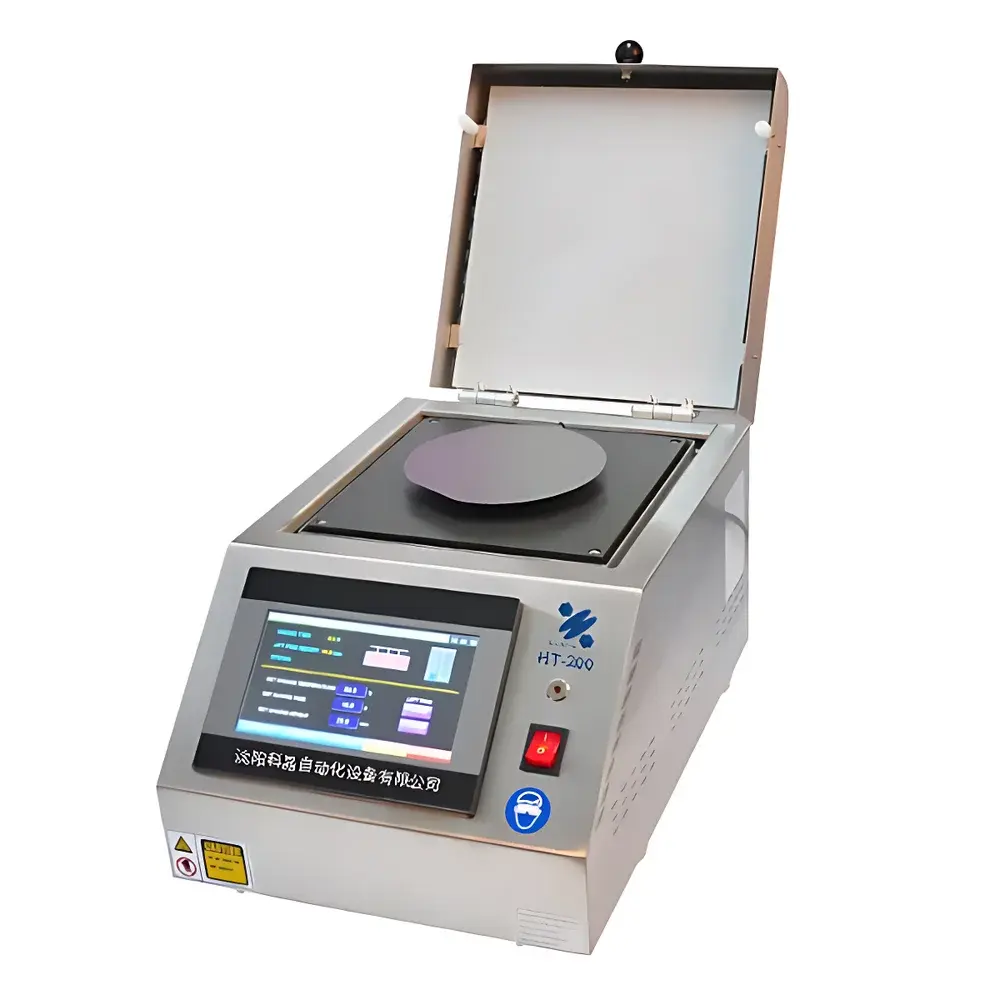
KJ GROUP HT-200 Precision Programmable Hot Plate for Photoresist Baking
| Brand | KJ GROUP |
|---|---|
| Origin | Liaoning, China |
| Model | HT-200 |
| Max. Temperature | 300 °C |
| Temp. Accuracy | ±0.2 °C |
| Temp. Resolution | 0.1 °C |
| Surface Uniformity | <±1% |
| Timer Range | 0–100,000 s |
| Time Resolution | 0.1 s |
| Chuck Size | 220 mm × 220 mm |
| Lift Pin Travel | 0–30.0 mm |
| Lift Resolution | 0.1 mm |
| Heating Power | 1000 W |
| Program Storage | 100 recipes × 5 stages each |
| Compatible Substrate Diameter | ≥40 mm |
| Touch Interface | 7″ Full-Color TFT LCD |
| Construction | Stainless Steel Frame + Hard-Anodized Aluminum Heating Plate |
| Optional Features (HT-200B) | Vacuum Chuck, Radiant Heat Shield, Linear Ramp Control |
Overview
The KJ GROUP HT-200 Precision Programmable Hot Plate is an engineered thermal processing platform designed for repeatable, traceable, and process-critical photoresist baking in semiconductor R&D, microfabrication, MEMS development, and academic cleanroom environments. It operates on resistive heating principles with closed-loop PID temperature control, delivering stable thermal profiles across the entire 220 mm × 220 mm hard-anodized aluminum heating surface. Unlike conventional hot plates, the HT-200 integrates programmable lift-pin actuation—enabling proximity-mode heating that minimizes thermal lag during wafer loading/unloading while preserving edge uniformity. Its architecture supports both standard thermal soak protocols and multi-stage ramp-hold profiles, making it suitable for novolac, DNQ, and chemically amplified resists requiring precise thermal history control.
Key Features
- High-stability heating system with 1000 W power delivery and proprietary thermal insulation design, ensuring minimal heat loss and long-term heater element longevity
- Hard-anodized aluminum heating plate (220 mm × 220 mm) rated for substrates up to 8-inch (200 mm) diameter wafers; surface finish optimized for low particulate generation and chemical resistance
- Motorized lift-pin mechanism with 0–30.0 mm travel range and 0.1 mm resolution; programmable for up to five discrete height positions per recipe
- 7-inch full-color capacitive touchscreen interface with intuitive graphical workflow navigation; supports real-time parameter monitoring and error logging
- Stainless steel chassis with reinforced structural rigidity and vibration-damped mounting—designed for integration into Class 100–Class 1000 cleanrooms
- Standard HT-200A configuration includes basic ramp-hold programming; HT-200B variant adds vacuum chuck compatibility, radiant heat shielding, and linear temperature ramping capability
Sample Compatibility & Compliance
The HT-200 accommodates rigid planar substrates with minimum diameter of 40 mm—including silicon, quartz, glass, sapphire, and ceramic wafers—as well as patterned or coated carriers used in lithography process flows. Its thermal uniformity specification (<±1% across the active zone) meets common internal fab qualification criteria for pre-bake and post-exposure bake (PEB) steps. While not certified to ISO/IEC 17025, the instrument’s temperature calibration traceability aligns with NIST-traceable reference standards when used with external verification probes. The device supports GLP-compliant operation through timestamped recipe execution logs and user-accessible audit trails (HT-200B firmware version 2.3+). All electrical components comply with IEC 61010-1 safety requirements for laboratory equipment.
Software & Data Management
The embedded control firmware enables storage of 100 independent recipes, each containing up to five sequential thermal stages with independently defined setpoints, dwell times, ramp rates (HT-200B), and lift-pin positioning logic. Recipes are saved non-volatilely and retain integrity during power cycling. Data export is supported via USB 2.0 port in CSV format, including time-stamped temperature readings, stage transitions, and lift-pin actuation events. Optional Ethernet connectivity (via add-on module) permits remote monitoring and integration into MES or LabVantage systems using Modbus TCP protocol. Firmware updates are delivered via signed binary packages to ensure system integrity and prevent unauthorized modification.
Applications
- Pre-bake (soft bake) of spin-coated photoresist layers prior to exposure
- Post-exposure bake (PEB) for acid-catalyzed chemically amplified resists (CARs)
- Thermal curing of dielectric films (e.g., SiO₂, SiNₓ precursors) and polymer-based encapsulants
- Dehydration and stress-relief annealing of thin-film metal stacks on semiconductor substrates
- Process development and DOE studies requiring reproducible thermal boundary conditions across multiple substrate batches
- Calibration and validation of inline thermal sensors in pilot-line fabrication workflows
FAQ
What is the maximum substrate size supported by the HT-200?
The heating surface accommodates substrates up to 200 mm (8-inch) diameter; the lift-pin mechanism requires a minimum substrate diameter of 40 mm for stable mechanical engagement.
Does the HT-200 support vacuum chuck functionality?
Vacuum chuck capability is exclusive to the HT-200B model and requires optional vacuum pump integration and compatible backside venting on the substrate carrier.
Can temperature ramps be programmed with variable slopes?
Yes—linear ramp control is available on HT-200B units, allowing users to define custom heating/cooling rates between stages in °C/min.
Is the lift-pin height adjustable manually or only via software?
Height adjustment is fully automated via motorized actuation and controlled exclusively through stored recipes or real-time touchscreen input.
How is temperature uniformity verified across the heating plate?
Uniformity is validated using a 9-point thermocouple grid per SEMI E18 standard methodology; factory calibration reports include measured deviation maps referenced to center-point setpoint.



