
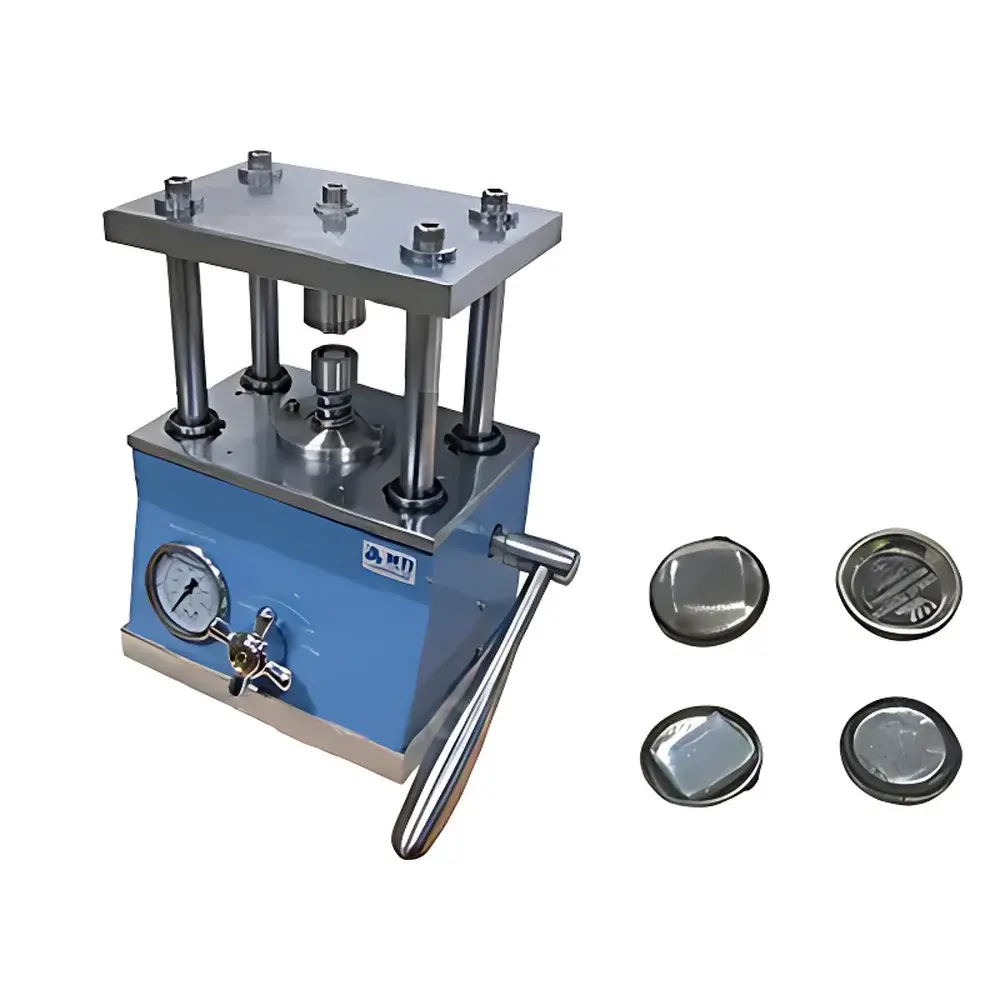
KJ GROUP MSK-110D Manual Hydraulic Button Cell Debonding Press
| Brand | KJ GROUP (MTI Corporation OEM) |
|---|---|
| Origin | Liaoning, China |
| Manufacturer Type | Authorized Distributor |
| Country of Origin | China |
| Model | MSK-110D |
| Pricing | Upon Request |
| Construction Materials | Alloy Aluminum Frame + Hardened Chrome Steel Components (Eco-Friendly Electroplated & Powder-Coated Surface) |
| Dimensions (W×D×H) | 228 mm × 176 mm × 330 mm |
| Weight | 25 kg |
| Standard Tooling | CR20-Series Die Set (CR2032 / CR2025 / CR2016) |
| Operating Pressure Range | 50–200 kg/cm² (calibrated gauge, factory-set default ~1000 kg/cm² limit |
| Integrated Features | Embedded Analog Pressure Gauge, Adjustable Safety Relief Valve, Precision-Machined Die Cavity with Edge-Protection Geometry |
| Compliance | Designed for inert-atmosphere glovebox integration (ISO 14644 Class 5 compatible footprint), GLP-aligned mechanical traceability via pressure gauge reading |
Overview
The KJ GROUP MSK-110D Manual Hydraulic Button Cell Debonding Press is an engineered solution for controlled, non-destructive disassembly of commercial and prototype lithium-based coin cells—primarily CR20-series formats (e.g., CR2032, CR2025, CR2016). Developed under technical collaboration with MTI Corporation (USA), the device operates on a manually actuated hydraulic principle: force is transmitted through incompressible hydraulic fluid to generate precise axial load between upper and lower die plates. This mechanism enables reproducible separation of cathode/anode laminates from stainless steel or nickel casings without thermal degradation, solvent exposure, or mechanical shearing—critical for post-mortem analysis in battery R&D, failure investigation, and electrode material recovery workflows. Its compact footprint (228 × 176 × 330 mm) and low electromagnetic signature permit seamless integration into argon- or nitrogen-purged gloveboxes (ISO 14644-1 Class 5 compliant environments), supporting strict moisture/oxygen control required for air-sensitive chemistries such as lithium metal anodes or sulfur cathodes.
Key Features
- Compact, glovebox-compatible design with fully enclosed hydraulic chamber and zero external fluid leakage risk.
- Structural frame fabricated from aerospace-grade alloy aluminum and hardened chrome steel—surface-treated via RoHS-compliant electroplating and epoxy-polyester powder coating for corrosion resistance and static dissipation.
- Manually operated lever system coupled with optimized hydraulic ratio, reducing operator effort by >60% compared to direct mechanical presses at equivalent output force.
- Embedded analog pressure gauge (0–250 kg/cm² range, ±1.5% FS accuracy) provides real-time visual feedback during compression, enabling repeatable force application across users and sessions.
- Factory-calibrated safety relief valve limits maximum system pressure to ~1000 kg/cm²; user-adjustable threshold allows safe operation up to 200 kg/cm² (≈80 kN / 8 metric tons) when required for high-retention seal configurations.
- Dies are CNC-machined from tool steel with tapered cavity geometry and chamfered edge profiles—designed to maintain casing roundness and prevent rim deformation or electrode delamination during separation.
Sample Compatibility & Compliance
The MSK-110D supports standardized CR20-series button cells per IEC 60086-3 and ANSI C18.1 specifications. Its die set accommodates nominal diameters of 20.0 ± 0.1 mm and heights ranging from 1.6 mm (CR2016) to 3.2 mm (CR2032), with tolerance-controlled depth stops ensuring consistent compression stroke. All metallic components meet ISO 10993-5 cytotoxicity requirements for incidental contact with battery electrolytes. The unit complies with CE machinery directive 2006/42/EC (as applied to laboratory-scale mechanical equipment) and supports GLP documentation protocols via pressure gauge logging—enabling audit-ready traceability of disassembly parameters in regulated QC/QA labs.
Software & Data Management
As a fully manual, analog-operated instrument, the MSK-110D does not incorporate embedded electronics, firmware, or digital interfaces. No software installation, driver dependencies, or network connectivity are required. All operational parameters—including applied pressure (via gauge reading), stroke count, and die configuration—are recorded manually in lab notebooks or LIMS-compatible electronic logbooks. For laboratories adhering to FDA 21 CFR Part 11 requirements, handwritten entries may be supplemented with time-stamped photographs of gauge readings and annotated disassembly reports to satisfy ALCOA+ data integrity principles.
Applications
- Post-cycling electrode morphology analysis (SEM/TEM sample preparation).
- Electrolyte residue quantification and gas chromatography–mass spectrometry (GC-MS) sampling.
- Separator integrity assessment after overcharge or thermal abuse testing.
- Recycling process development: isolation of intact cathode films for hydrometallurgical recovery.
- Quality assurance of cell sealing integrity during pilot-line manufacturing.
- Academic research involving solid-state electrolyte interface (SEI) layer characterization via XPS or ToF-SIMS.
FAQ
Can the MSK-110D be used outside a glovebox?
Yes—it functions reliably in ambient lab conditions; however, inert-atmosphere operation is strongly recommended for Li-metal, Li-S, or Na-ion chemistries to prevent oxidation or side reactions during disassembly.
Is die customization available for non-CR20 formats (e.g., BR2032, LR44)?
KJ GROUP offers custom die design services upon request; lead time and NRE charges apply. Dimensional drawings and material compatibility specifications must be submitted prior to quotation.
What maintenance is required for long-term hydraulic performance?
Annual inspection of O-rings and hydraulic fluid (ISO VG 32 mineral oil) is advised. Fluid replacement is recommended every 24 months or after 500 operational cycles, whichever occurs first.
Does the unit include calibration certification?
A factory-issued pressure gauge verification certificate (traceable to NIST standards) is included with each shipment. Optional third-party calibration with ISO/IEC 17025 accreditation is available at additional cost.
Related Products



