
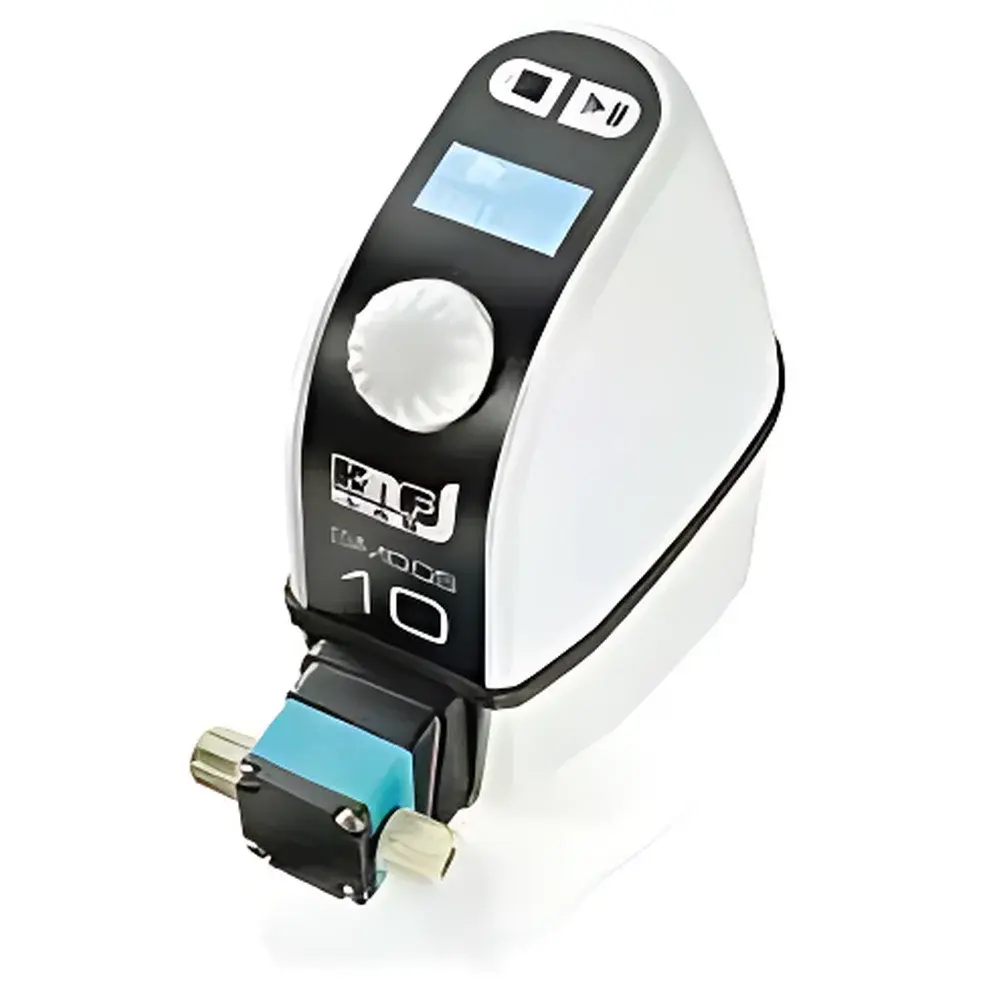
KNF SIMDOS FEM1.10 Diaphragm Liquid Transfer Pump
| Brand | KNF |
|---|---|
| Origin | Germany |
| Model | SIMDOS FEM1.10 |
| Pump Type | Diaphragm Pump (Not Peristaltic) |
| Flow Rate Range | 1–100 mL/min |
| Self-Priming Height | 3 mWg |
| Maximum Discharge Pressure | 6 bar |
| Ingress Protection Rating | IP65 |
| Operating Temperature (Liquid) | 5–80 °C |
| Operating Temperature (Ambient) | 5–40 °C |
| Fluid Viscosity Limit | ≤150 cSt |
| Accuracy | ±2% of setpoint (1–100% range) |
| Repeatability | ±1% |
| Weight | 1.5 kg |
| Dimensions (L×H×W) | 134 × 93 × 145 mm |
| Power Supply | 99–264 VAC, 50–60 Hz |
| Analog Control Inputs | 0–5 V, 0–10 V, 0–20 mA, 4–20 mA |
| Digital Interface | RS232 |
| Dry-Run Capable | Yes |
| Materials (Standard Configuration) | Pump Head – PP, Diaphragm – PTFE-coated, Valves – FFKM |
Overview
The KNF SIMDOS FEM1.10 is a precision-engineered, electronically controlled diaphragm liquid transfer pump designed for laboratory-scale fluid handling where chemical compatibility, long-term reliability, and metering accuracy are critical. Unlike peristaltic pumps—which rely on mechanical compression of tubing—the FEM1.10 employs a reciprocating PTFE-coated diaphragm actuated by an integrated brushless DC motor and precision cam mechanism. This positive displacement architecture eliminates tube fatigue, pulsation-induced inaccuracies, and contamination risks associated with elastomeric tubing degradation. The pump operates via gas-tight sealed chambers, enabling safe, leak-free transport of aggressive solvents (e.g., concentrated acids, halogenated organics, strong bases), high-purity reagents, and temperature-sensitive formulations. Its self-priming capability (up to 3 mWg suction lift) and ability to run dry indefinitely make it suitable for intermittent or continuous operation in automated synthesis platforms, environmental monitoring stations, and analytical sample introduction systems.
Key Features
- Chemical-resistant wetted path: Standard configuration features polypropylene (PP) pump head, PTFE-coated diaphragm, and perfluoroelastomer (FFKM) valves—validated for compatibility with >95% of common laboratory solvents and corrosive media.
- High metrological fidelity: Achieves ±2% full-scale accuracy across the 1–100 mL/min flow range and ±1% repeatability under constant operating conditions—no routine recalibration required.
- Flexible control architecture: Supports manual knob adjustment, analog voltage/current input (0–10 V / 4–20 mA), and bidirectional RS232 serial communication for integration into LabVIEW, Python-based control suites, or PLC-driven workflows.
- Robust mechanical design: IP65-rated enclosure ensures dust-tight and water-jet resistant operation in demanding lab environments—including fume hoods and wet-bench settings.
- Dry-run tolerance and continuous duty cycle: Engineered for 24/7 unattended operation without lubrication or cooling requirements; no risk of diaphragm seizure during air-pumping phases.
- Integrated safety functions: Built-in overpressure protection (6 bar max discharge), thermal cut-off, and automatic stall detection prevent system damage during line blockage or backpressure events.
Sample Compatibility & Compliance
The FEM1.10 is compatible with aqueous, organic, and mixed-phase liquids having viscosities up to 150 cSt and temperatures between 5 °C and 80 °C. It meets IEC 61000-6-3 (EMC emission) and IEC 61000-6-2 (immunity) standards. While not certified for hazardous area use (ATEX/IECEx), its spark-free motor and non-metallic wetted materials render it appropriate for Class I, Division 2 environments when installed per NEC Article 500 guidelines. For regulated applications, audit trails generated via RS232 logging—when paired with compliant host software—support alignment with FDA 21 CFR Part 11 data integrity requirements. The pump’s mechanical design conforms to ISO 8573-1 (compressed air purity class 0 optional) and supports GLP-compliant documentation through timestamped operational logs.
Software & Data Management
The FEM1.10 does not include embedded firmware-based data storage; instead, it delivers real-time operational telemetry—including flow rate setpoint, actual motor speed, fault status, and runtime hours—via ASCII protocol over RS232. KNF provides a Windows-compatible configuration utility (SIMDOS Control Software v3.x) for parameter setup, waveform profiling (e.g., ramped start/stop, timed cycles), and event-triggered output pulses. Third-party integration is supported via open command syntax documented in KNF Application Note AN-FEM1.10-EN. When deployed in validated systems, the pump’s deterministic response time (<100 ms from command to flow onset) and linear analog control behavior enable traceable, repeatable dosing sequences compliant with ASTM D7217 (liquid metering accuracy testing) and ISO 5725 (trueness and precision of measurement methods).
Applications
- Precise reagent delivery in automated parallel synthesis reactors—replacing gravity-fed dropping funnels or low-stability peristaltic systems.
- Continuous feed of calibration standards or spiked samples into ICP-MS, HPLC, or ion chromatography systems requiring pulse-free, low-dead-volume introduction.
- Circulation of aggressive cleaning solutions (e.g., piranha, aqua regia) in semiconductor wafer rinse modules or electroplating bath maintenance loops.
- Controlled eluent supply in low-pressure flash chromatography and preparative LC systems where backpressure stability and solvent compatibility are limiting factors.
- Environmental sampling: Deployment in autonomous water quality monitors for timed, depth-resolved nutrient or heavy metal extraction from stratified reservoirs.
- Materials science: Metered addition of monomers or catalysts into polymerization reactors under inert atmosphere, minimizing oxygen ingress via zero-leak diaphragm sealing.
FAQ
Is the SIMDOS FEM1.10 a peristaltic pump?
No. It is a motor-driven, mechanically actuated diaphragm pump. Peristaltic pumps compress flexible tubing; the FEM1.10 uses a sealed, chemically inert diaphragm—eliminating tubing wear, particle shedding, and flow distortion.
Can it handle hydrofluoric acid (HF) or molten salts?
Standard PP/PTFE/FFKM construction resists HF at room temperature and concentrations ≤40%. For molten salts or elevated-temperature halides, consult KNF Material Compatibility Guide v4.2 and consider optional PVDF or PTFE-only configurations (e.g., FEM1.10FT.18RC).
What is the minimum controllable flow rate with analog input?
With 16-bit DAC resolution on external 0–10 V control, the effective minimum step size is ~0.006 mL/min—enabling stable delivery down to 1 mL/min with <±0.5% deviation over 1-hour intervals.
Does it require periodic maintenance beyond diaphragm replacement?
No scheduled maintenance is specified. Diaphragms are rated for ≥10,000 hours of continuous operation. Valve service is recommended only after 5 years or upon observed flow drift exceeding ±3%—documented in KNF Service Bulletin SB-FEM1.10-2023.
How is overpressure protection implemented?
A spring-loaded pressure relief valve opens at 6.2 ±0.3 bar, venting excess discharge pressure to atmosphere via a dedicated port. Relief activation triggers a latching fault signal on the RS232 interface and halts motor operation until manual reset.



