
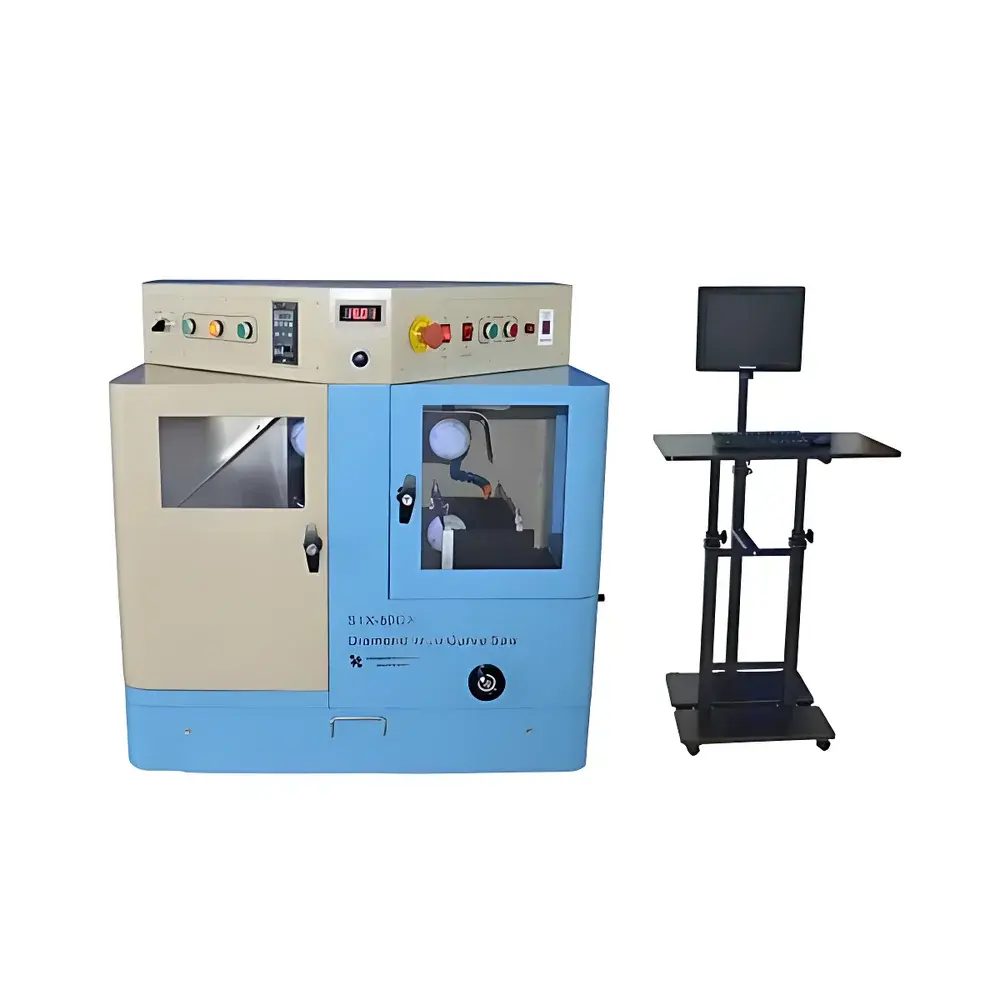
KJ GROUP STX-50QX Diamond Wire Curve Cutting Machine
| Brand | KJ GROUP |
|---|---|
| Origin | Liaoning, China |
| Manufacturer Type | Authorized Distributor |
| Country of Origin | China |
| Model | STX-50QX |
| Instrument Category | Precision Diamond Wire Cutting System |
| X-Axis Travel | 100 mm |
| Y-Axis Travel | 150 mm |
| Max. Cutting Thickness | 50 mm |
| Positioning Accuracy | 0.01 mm |
| Wire Speed | 0–15 m/s |
| X/Y Axis Feed Rate | 0.06–6 mm/min |
| Worktable Dimensions | 140 × 275 mm |
| Max. Sample Size | 100 × 150 × 50 mm |
| Wire Tensioning | Motorized Automatic Tensioning |
Overview
The KJ GROUP STX-50QX Diamond Wire Curve Cutting Machine is a CNC-controlled precision cutting system engineered for non-contact, low-damage contour slicing of brittle and high-value materials. Unlike conventional abrasive or blade-based cutters, it employs a continuously moving diamond-impregnated wire under controlled tension and programmable multi-axis motion to execute freeform 2D trajectories—enabling accurate sectioning of complex geometries without mechanical chipping or thermal distortion. Its core principle relies on precise synchronization between motorized X/Y translation stages and real-time wire feed control, allowing the diamond wire to follow user-defined vector paths generated via integrated CAD-like graphical interface. Designed specifically for laboratory-scale sample preparation, the STX-50QX addresses critical challenges in fabricating tensile test specimens, petrographic thin sections, optoelectronic wafers, and histological blocks where dimensional fidelity, edge integrity, and subsurface damage minimization are paramount.
Key Features
- CNC-driven XY-stage with 0.01 mm positioning resolution ensures repeatable geometric accuracy across repeated cuts.
- Motorized diamond wire tensioning maintains consistent cutting force throughout operation, reducing wire breakage and improving kerf uniformity.
- Adjustable wire speed (0–15 m/s) and feed rate (0.06–6 mm/min) enable process optimization for diverse material classes—from soft polymers to sapphire and tungsten carbide.
- Graphical path programming interface supports import of DXF/SVG files or direct on-screen drawing of arbitrary closed 2D profiles—including airfoils, ellipses, asymmetric polygons, and custom biomedical outlines.
- Robust cast-iron frame and vibration-damped base minimize mechanical drift during extended cutting cycles, supporting stable operation at sub-millimeter tolerances.
- Integrated coolant delivery system ensures continuous lubrication and debris removal, extending wire life and preserving surface finish on sensitive optical or electronic substrates.
Sample Compatibility & Compliance
The STX-50QX accommodates a broad spectrum of hard-to-machine materials including technical ceramics (Al2O3, ZrO2, SiC), single crystals (Si, Ge, GaAs, CsI), infrared optical materials (ZnSe, ZnS, CaF2), geological specimens (granite, basalt, meteorites), composite laminates (CFRP, GFRP), and bio-mineralized tissues (bone-implant interfaces, calcified vasculature). It complies with standard laboratory safety protocols per IEC 61000-6-2 (EMC immunity) and ISO 13857 (safety distances). While not certified for GMP environments out-of-the-box, its deterministic motion control, audit-ready parameter logging, and reproducible toolpath execution support GLP-aligned workflows when integrated into validated SOPs. Optional accessories include vacuum chucks, rotary fixtures, and cryogenic cooling mounts for enhanced stability during ultra-thin sectioning.
Software & Data Management
The machine operates via proprietary Windows-based control software featuring intuitive vector sketching tools, real-time wire trajectory simulation, and stepwise process validation prior to execution. All cutting parameters—including coordinates, feed rates, wire speed, tension setpoints, and coolant flow duration—are timestamped and exportable as CSV or XML for traceability. The software supports batch job queuing and macro scripting for repetitive tasks such as serial sectioning or standardized tensile bar fabrication. Audit trail functionality records operator ID, session start/stop times, and parameter modifications—facilitating compliance with FDA 21 CFR Part 11 requirements when deployed with appropriate IT infrastructure and user access controls.
Applications
- Preparation of ASTM E8/E21-compliant tensile specimens from ceramic matrix composites and intermetallic alloys.
- Fabrication of geologically representative thin sections (30–50 µm) for transmitted light microscopy and electron microprobe analysis.
- Sectioning of thermoelectric modules (Bi2Te3, PbTe) for cross-sectional SEM-EDS characterization without delamination.
- Production of IR-transmissive windows and lens blanks from polycrystalline ZnS or monocrystalline Ge with minimal subsurface damage.
- Microtomy-equivalent slicing of embedded human bone-implant constructs for histomorphometric evaluation under ISO 13356 and ASTM F1185 standards.
- Custom-shaped electrode substrates for battery R&D, including segmented current collectors and patterned solid electrolyte membranes.
FAQ
What types of diamond wire are compatible with the STX-50QX?
The system accepts standard electroplated or resin-bonded diamond wires with diameters ranging from 0.1 mm to 0.35 mm. Recommended wire selection depends on material hardness and desired kerf width; typical configurations use 0.25 mm wire for general-purpose ceramic and crystal cutting.
Can the STX-50QX perform angled or beveled cuts?
No—the STX-50QX is configured for orthogonal (90°) vertical cutting only. For angular sectioning, samples must be mounted on optional tilt stages or pre-oriented jigs.
Is offline path programming supported?
Yes. Users may generate and validate cutting paths using the included desktop software prior to connecting to the instrument. DXF imports allow integration with third-party CAD platforms.
What maintenance intervals are recommended?
Wire tension calibration should be verified monthly; linear guide rails require greasing every 200 operational hours; coolant filters must be replaced after each 50-hour cutting cycle or sooner if particulate loading increases.
Does the system support automated thickness measurement during cutting?
Not natively. However, optional laser displacement sensors can be retrofitted for in-process thickness monitoring and closed-loop depth control via custom API integration.



