
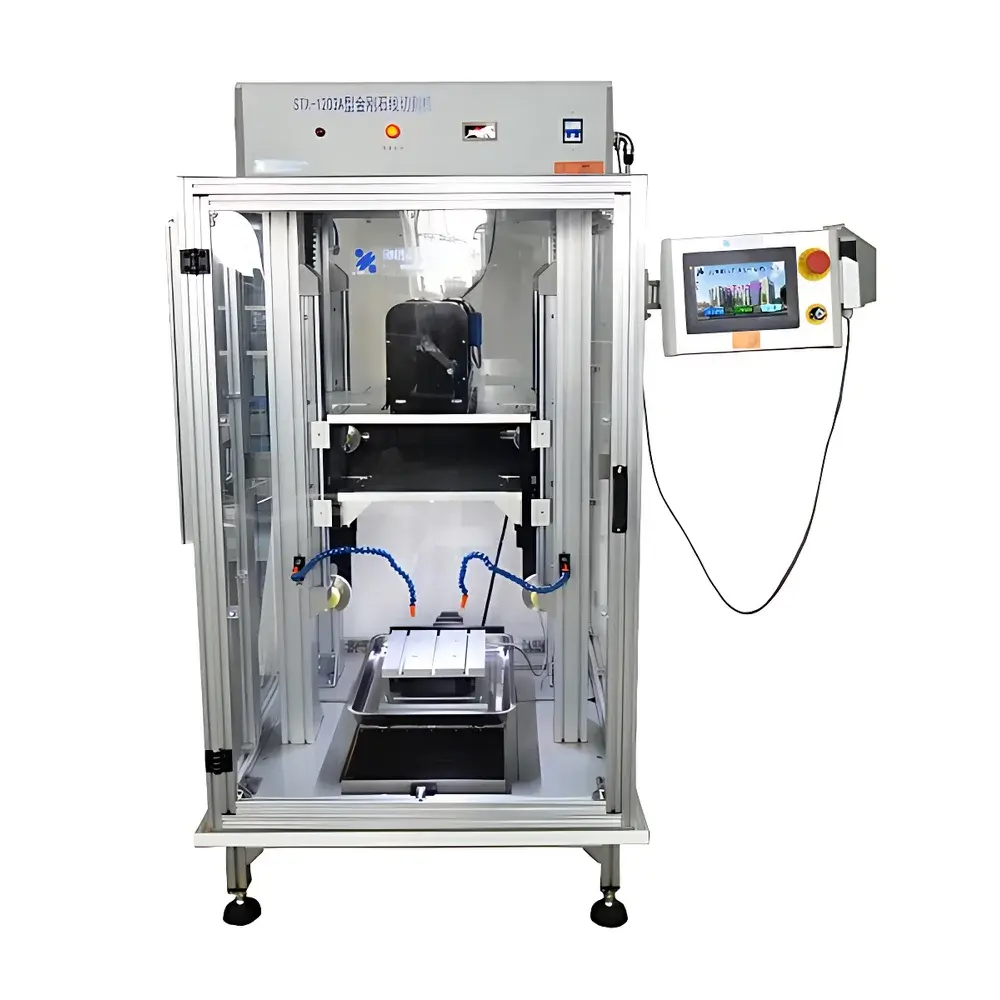
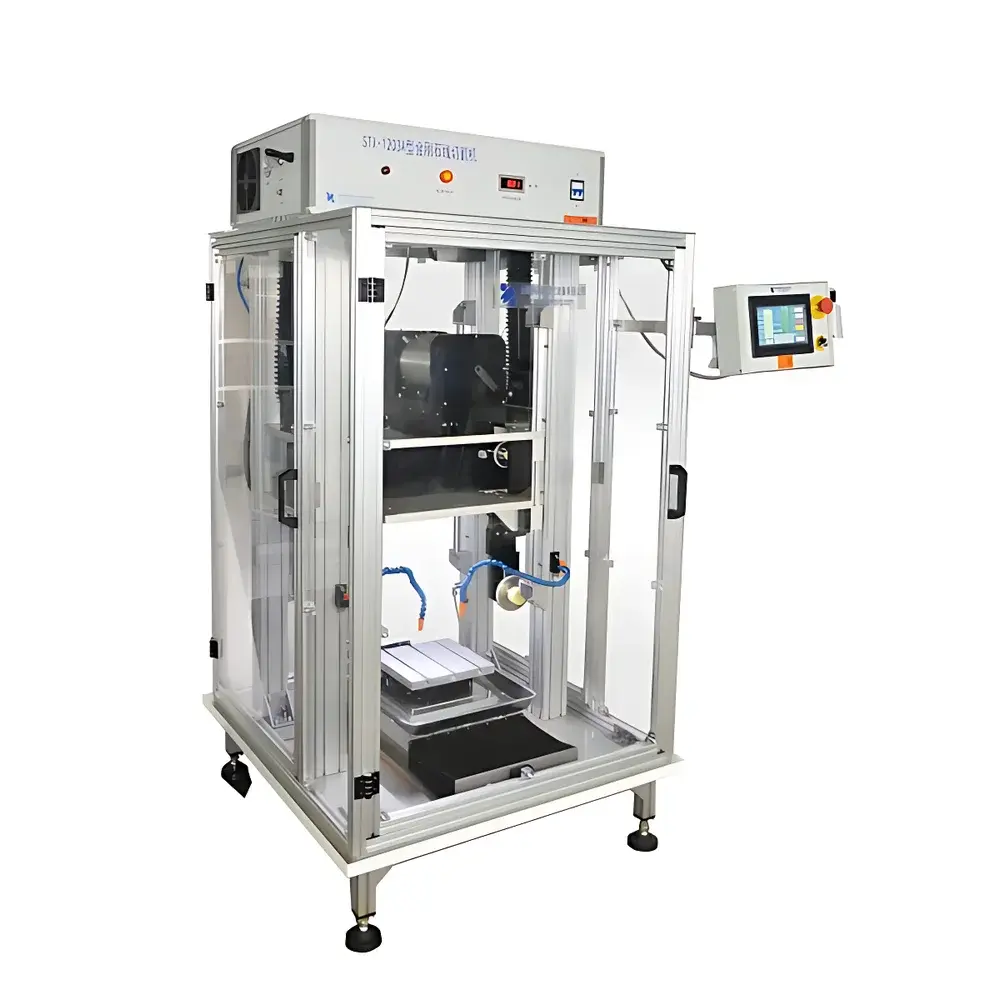
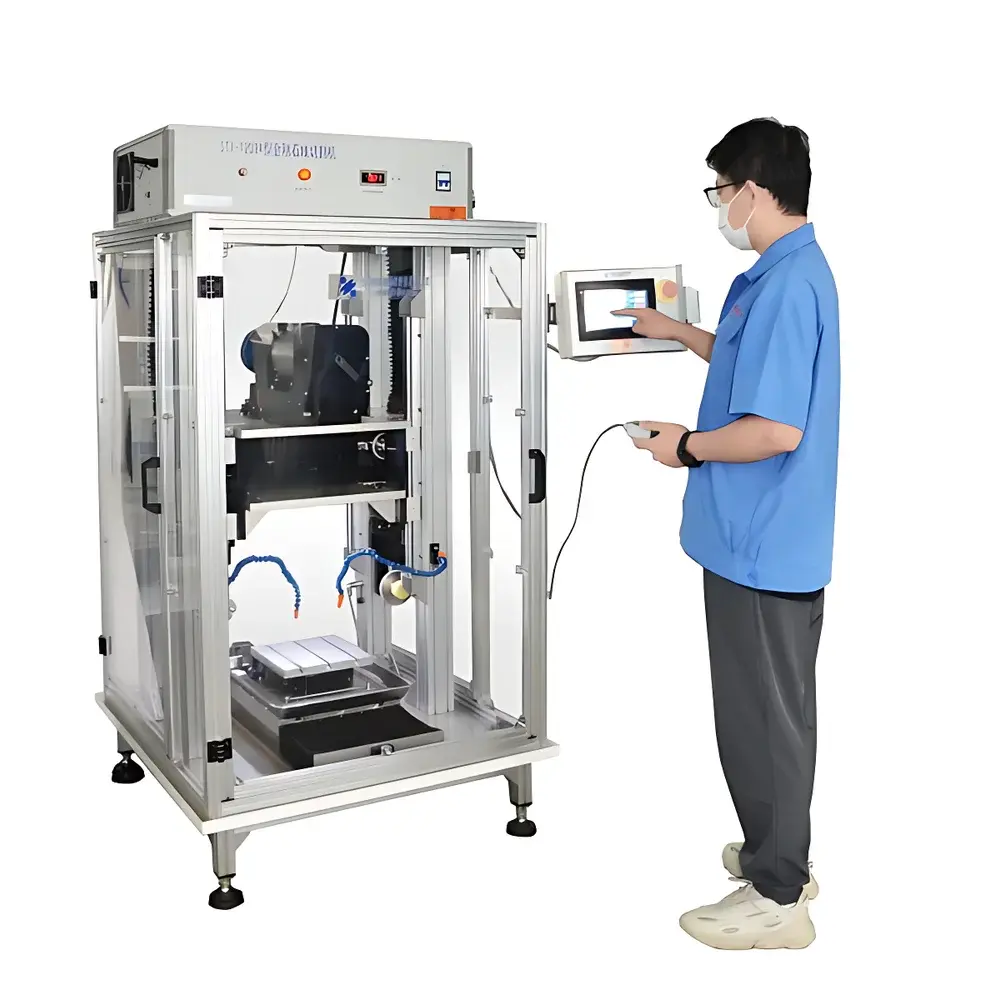
KJ GROUP STX-1203B Fully Automated Diamond Wire Saw
| Brand | KJ GROUP |
|---|---|
| Origin | Liaoning, China |
| Manufacturer Type | Authorized Distributor |
| Instrument Category | Domestic |
| Model | STX-1203B |
| Instrument Type | Precision Diamond Wire Saw |
| Cutting Wire Speed | 0–15 m/s |
| Max. Workpiece Diameter & Length | Φ300 × 300 mm |
| Z/Y-Axis Travel | ≤300 mm each |
| Positioning Accuracy (Z/Y/R) | 0.01 mm |
| Wire Tensioning | Pneumatic (0–1 MPa) |
| Wire Length | ≤150 m |
| Wire Diameter | ≤0.45 mm |
| Worktable Load Capacity | ≤20 kg |
| Power Supply | AC 220 V / 50 Hz |
| Total Power Consumption | ~620 W |
| Net Weight | ~340 kg |
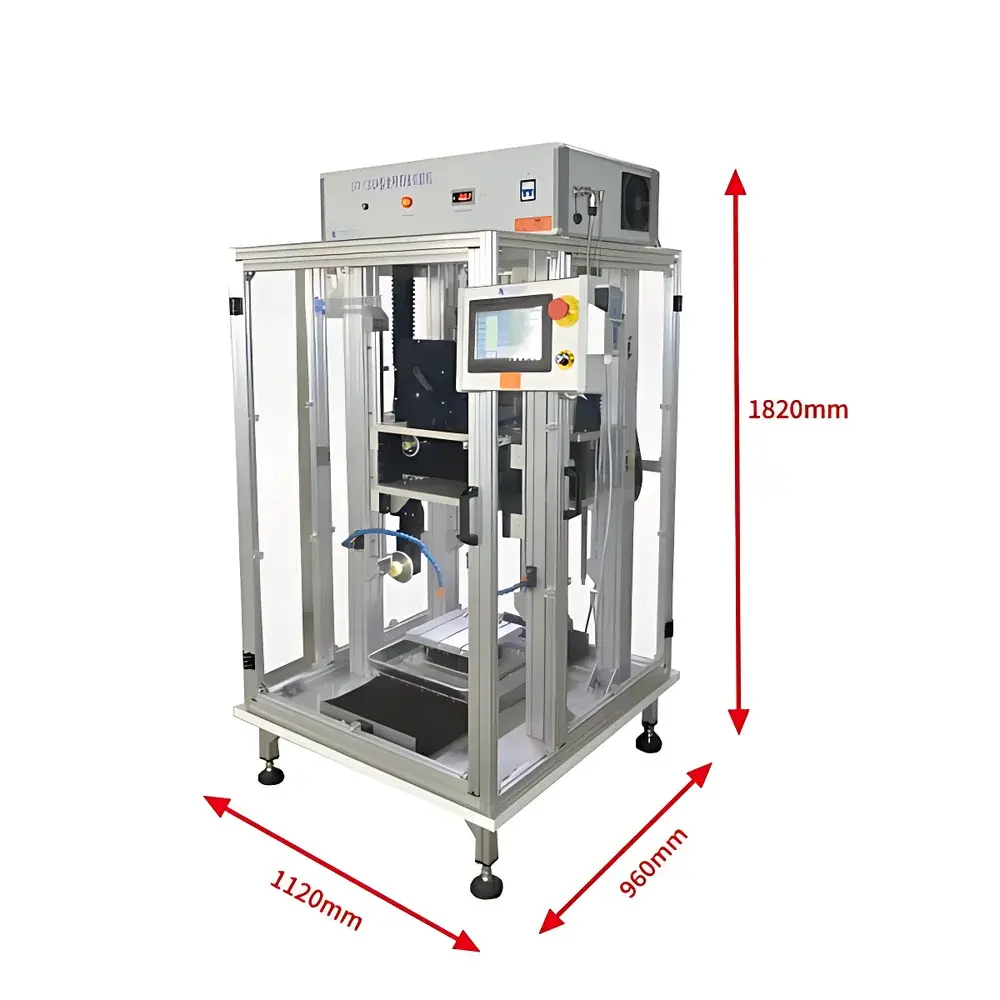
| Dimensions (L×W×H) | 1120 × 960 × 1820 mm |
| Environmental Requirements | Altitude <1000 m, Temp. 10–40 °C, RH 45–65 % |
| Safety Features | Wire-break auto-stop, emergency stop, acrylic safety enclosure |
| Control System | PLC + 7-inch touchscreen HMI |
| Motor Configuration | 370 W AC frequency inverter motor (main drive), precision stepper motors (Y/Z/R axes) |
Overview
The KJ GROUP STX-1203B Fully Automated Diamond Wire Saw is an industrial-grade, programmable precision cutting system engineered for high-accuracy sectioning of brittle, hard, and heterogeneous materials in research laboratories and quality control environments. It operates on the principle of abrasive wire sawing—utilizing a continuously moving diamond-impregnated wire under controlled tension to achieve low-stress, kerf-minimized material removal. Unlike rotary or abrasive wheel systems, this wire-based method eliminates thermal damage, mechanical chipping, and subsurface deformation—critical for preserving microstructural integrity in crystallographic, geological, and biomedical specimens. The STX-1203B supports both straight-line and oscillating (via optional swing/rotary-swing modules) feed geometries, enabling optimized cutting performance across a broad hardness spectrum—from soft polymers and biological tissues to ultra-hard ceramics (e.g., SiC, Al₂O₃), single crystals (Si, Ge, sapphire), and geologically dense samples (meteorites, jade, basalt). Its maximum work envelope of Φ300 × 300 mm accommodates large-format wafers, rock cores, and composite laminates, while sub-10 µm dimensional repeatability ensures compliance with metrological requirements for thin-section preparation in SEM, TEM, and XRD sample workflows.
Key Features
- Programmable CNC-style motion control: Y- and Z-axis linear stages driven by high-resolution stepper motors (0.01 mm positioning accuracy), with optional R-axis (360° rotary table) for angular alignment of anisotropic specimens.
- Pneumatic wire tensioning system using industrial-grade solenoid valves and pressure regulators (0–1 MPa range), ensuring consistent line force throughout extended cuts—minimizing wire breakage and improving surface finish reproducibility.
- High-speed wire drive: Dual-spool winding mechanism with variable-frequency AC motor delivering stable wire velocities from 0 to 15 m/s, significantly reducing cycle time without compromising cut quality.
- Integrated safety architecture: Full acrylic transparent enclosure compliant with IEC 61000-6-2/6-4 EMC standards; automatic wire-break detection circuitry triggers immediate motor shutdown and audio-visual alert; dual-channel emergency stop circuit meeting ISO 13850 requirements.
- Human-machine interface: 7-inch resistive touchscreen HMI with intuitive icon-based navigation, real-time parameter monitoring (tension, speed, position, runtime), and password-protected recipe storage for GLP/GMP traceability.
- Modular tooling ecosystem: Standard M6/T-slot worktable accepts custom fixturing; optional accessories include swing mechanism (STX-1200-YB), rotary-swing module (STX-1200-A), heated stage (MTI series), and electric wire threading unit (STX-2500).
Sample Compatibility & Compliance
The STX-1203B is validated for use with materials having Mohs hardness below that of diamond (≤10), including but not limited to: oxide ceramics (Al₂O₃, ZrO₂, YSZ), semiconductor substrates (Si, Ge, GaAs), optical crystals (CsI, KDP, ZnS, ZnSe), infrared transmissive materials (Si, Ge, CaF₂), geological specimens (granite, basalt, quartzite, meteoritic iron-nickel alloys), bio-ceramics (hydroxyapatite, zirconia dental implants), and soft-hard tissue composites (bone-implant interfaces, calcified vascular plaques). All operational parameters adhere to ISO 12100 (risk assessment), ISO 13849-1 (safety-related control systems), and meet general requirements for laboratory equipment per EN 61010-1. When configured with audit-trail-enabled software (optional upgrade), it supports FDA 21 CFR Part 11 compliance for regulated life science applications.
Software & Data Management
The embedded PLC-based controller stores up to 99 user-defined cutting protocols, each containing multi-segment velocity profiles, tension setpoints, feed rates, and dwell times. All executed jobs are timestamped and logged locally with operator ID, date/time, and final positional coordinates. Exportable CSV reports include total wire consumption, cumulative runtime, and fault event history—facilitating preventive maintenance scheduling and ISO/IEC 17025 documentation. Optional Ethernet/IP or RS-485 communication enables integration into centralized lab information management systems (LIMS) or MES platforms for automated workflow orchestration and digital twin synchronization.
Applications
- Geosciences: Preparation of petrographic thin sections (30 µm) from igneous, metamorphic, and sedimentary rocks; precision slicing of ore samples for SEM-EDS mineralogical mapping.
- Materials Science: Kerf-loss minimization in photovoltaic wafer dicing (multi-/mono-crystalline Si); cross-sectional slicing of thermoelectric modules (Bi₂Te₃, PbTe, SiGe) for interfacial analysis.
- Electronics: PCB de-lamination studies; slicing of advanced packaging substrates (LTCC, HTCC); failure analysis of bonded die stacks.
- Biomedical Engineering: Sectioning of osseointegrated titanium implants with surrounding bone tissue; serial slicing of decalcified human mandibles for histomorphometric quantification.
- Optics & Photonics: Fabrication of AR-coated optical lens blanks; cleaving of nonlinear optical crystals (LiNbO₃, BBO) with minimal edge chipping.
FAQ
What types of diamond wire are compatible with the STX-1203B?
Standard configurations support wires with diameters of Ø0.125 mm, Ø0.25 mm, Ø0.35 mm, and Ø0.42 mm. Custom wire specifications (bond type, grit size, concentration) can be accommodated upon request.
Is coolant circulation integrated, and what fluid is recommended?
Yes—the system includes a built-in recirculating pump and reservoir. We recommend using non-ionic, low-foaming synthetic cutting fluid (e.g., Blaser Swisslube Vasco 700 series) to prevent corrosion and ensure optimal wire life.
Can the machine operate unattended for overnight runs?
Yes—provided environmental conditions remain within specification and the wire supply is sufficient. The auto-stop function activates upon wire breakage, power loss, or timeout, preserving specimen integrity and operator safety.
Does the STX-1203B support ASTM or ISO standard-compliant sectioning procedures?
While the instrument itself is not certified to a specific standard, its dimensional accuracy (±10 µm), repeatable feed control, and documented process parameters enable full adherence to ASTM E3, ISO 14725, and USP guidelines for specimen preparation when operated per validated SOPs.
What maintenance intervals are recommended for pneumatic and motion components?
Inspect air filter/regulator monthly; lubricate linear guides every 200 operating hours; verify tension calibration quarterly; replace wire-guide bearings annually or after 5000 km of wire travel—whichever occurs first.
Related Products



