
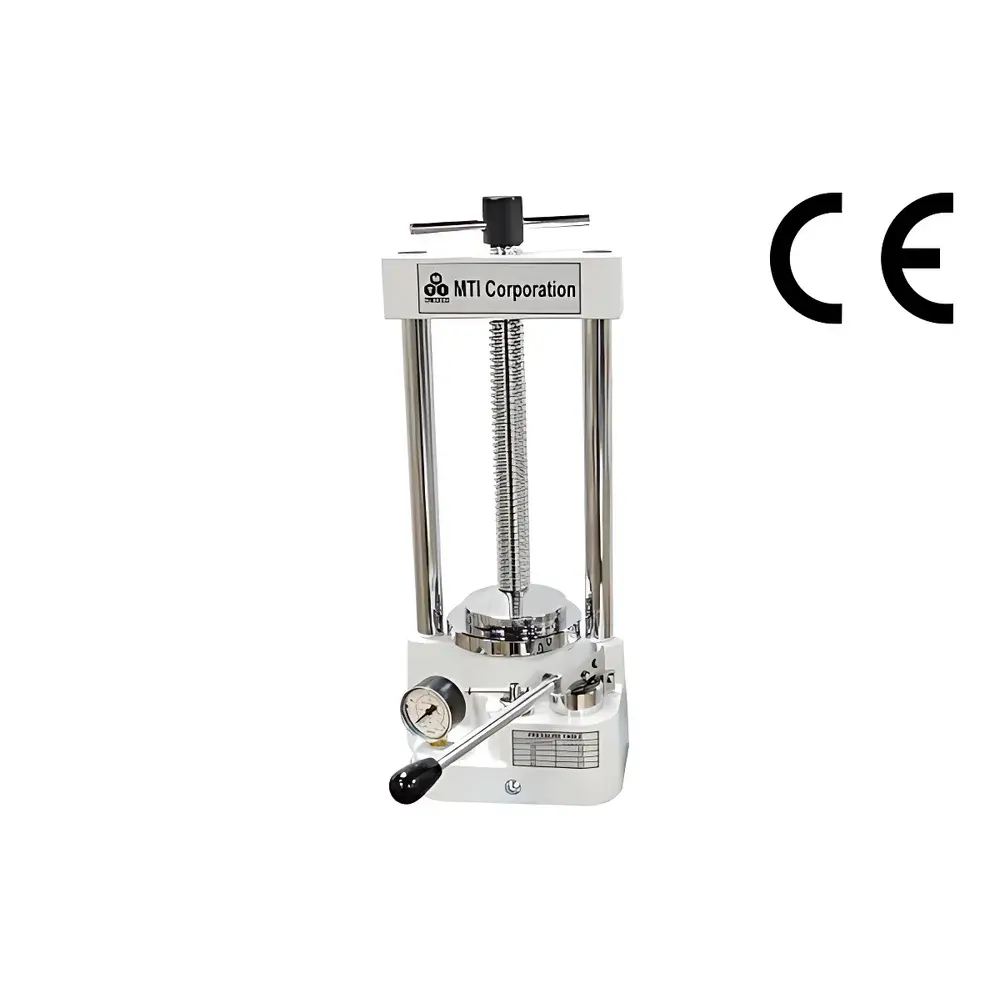
KJ GROUP YLJ-15T-LD Manual Hydraulic Pellet Press
| Brand | KJ GROUP |
|---|---|
| Origin | Liaoning, China |
| Model | YLJ-15T-LD |
| Type | Manual Hydraulic Pellet Press |
| Max Operating Pressure | 15 T (7 T continuous, ≤1 hr at 15 T) |
| Pressure Gauge | Dual-scale (Bar & PSI), calibrated to sample load (3.8–15.3 T) |
| Bottom Cylinder Stroke | 13 mm |
| Top Support Screw Adjustment Range | 220 mm |
| Dimensions (L×W×H) | 200 × 330 × 480–715 mm |
| Base Diameter D1 | 120 mm |
| Upper Column Diameter D2 | 70 mm |
| Die Cavity Diameter D3 | 125 mm |
| Height H1 | 260 mm |
| Height H2 | 220 mm |
| Net Weight | 20 kg |
| Compliance | Designed for inert-atmosphere integration (glovebox-compatible) |
Overview
The KJ GROUP YLJ-15T-LD Manual Hydraulic Pellet Press is an engineered solution for precise, low-footprint sample compaction under controlled atmospheres. Based on fundamental hydraulic force multiplication principles—where manual input force is amplified via incompressible oil transmission—the press delivers repeatable uniaxial compression up to 15 metric tons (147 kN) with mechanical lockout and pressure gauge feedback. Its compact vertical architecture (200 mm depth, 330 mm max width) enables seamless integration into standard glovebox antechambers (transition ports ≥350 mm diameter), supporting oxygen- and moisture-sensitive material processing including solid-state battery electrode fabrication, air-sensitive catalyst pelletization, and inert-gas sintering precursor preparation. Unlike motorized or pneumatic systems, the fully manual operation eliminates electrical hazards and electromagnetic interference—critical for use inside Faraday-caged or ultra-high-purity gloveboxes. The device operates without external power, relying solely on hand-operated hydraulic lever actuation and integrated pressure-holding valves.
Key Features
- Glovebox-compatible footprint: Overall height adjustable from 480 mm (retracted) to 715 mm (fully extended); base diameter limited to 120 mm for port transit.
- Dual-scale analog pressure gauge: Calibrated in both bar and PSI, with direct load correlation (e.g., 400 bar ≈ 15.3 T actual compressive force on die surface), enabling traceable force application per ASTM E9-09 standards for compression testing apparatus verification.
- Mechanically stabilized loading path: Rigid steel frame with hardened top support screw (220 mm vertical adjustment range) ensures parallel platen alignment within ±0.05° across full stroke—minimizing shear stress during green body formation.
- Controlled stroke limitation: Bottom cylinder travel capped at 13 mm to prevent over-compression and die damage; includes positive mechanical stop and visual stroke indicator.
- Oil-lock safety system: Integrated hydraulic valve must be manually tightened prior to transport—preventing inadvertent piston extension and fluid leakage during relocation.
- Modular die interface: Standardized 125 mm cavity diameter (D3) accommodates interchangeable stainless-steel, tungsten carbide, or borosilicate glass dies—compatible with KJ GROUP’s ISO 9001-certified die catalog (sold separately).
Sample Compatibility & Compliance
The YLJ-15T-LD supports dry and solvent-free powder compaction of inorganic ceramics (e.g., LiCoO₂, BaTiO₃), metallic alloys (Ni, Fe, Cu powders), polymer composites, and MOF precursors. It meets mechanical requirements for ISO 14644-1 Class 5 cleanroom-compatible handling when used inside nitrogen- or argon-purged gloveboxes (O₂ < 1 ppm). While not intrinsically rated for hazardous area use, its non-sparking construction (no electronics, no motors) complies with IEC 60079-0 general requirements for equipment in explosive atmospheres. For regulated QC labs, the pressure gauge permits manual audit trails aligned with GLP documentation practices; however, full 21 CFR Part 11 electronic record compliance requires external data logging (not built-in).
Software & Data Management
This is a fully manual, analog instrument with no embedded firmware, display, or digital connectivity. All operational parameters—including applied load (via gauge reading), stroke position (visual scale), and dwell time—are recorded manually by the user. For laboratories requiring traceability, KJ GROUP recommends pairing the press with calibrated external load cells (e.g., Omega LCM Series) and third-party acquisition software (LabVIEW, MATLAB Data Acquisition Toolbox) for time-stamped force-displacement profiling. No proprietary drivers or cloud services are involved; raw gauge readings map directly to NIST-traceable calibration curves provided in the Certificate of Conformance (shipped with unit).
Applications
- Electrode pellet fabrication for lithium-ion and solid-state batteries (e.g., NMC cathodes, Li₇La₃Zr₂O₁₂ electrolytes) under Ar atmosphere.
- Preparation of XRF and XRD sample discs from geological, metallurgical, or environmental powders—ensuring homogeneous density for quantitative analysis.
- Green body forming of refractory ceramics (Al₂O₃, ZrO₂) prior to sintering, with reproducible green density control (±0.8% RSD across 10 replicates at 7 T).
- Compression testing of pharmaceutical excipients and tablet formulation screening where hydraulic consistency—not speed—is prioritized.
- Research-scale cold pressing of thermoelectric materials (Bi₂Te₃, SnSe) without thermal degradation.
FAQ
Is the YLJ-15T-LD certified for use inside argon-filled gloveboxes?
Yes—its all-metal construction, absence of outgassing polymers, and mechanical-only operation meet standard glovebox compatibility criteria for inert-atmosphere processing.
What is the maximum recommended dwell time at 15 T?
Per manufacturer specification, sustained operation at full 15 T rating is limited to ≤60 minutes to prevent thermal drift in hydraulic oil viscosity and seal relaxation.
Can custom die sets be ordered with metric or imperial thread specifications?
Yes—KJ GROUP offers OEM die machining to ISO 228-1 (G-thread) or ANSI B1.20.1 (NPT) standards upon request; lead time is typically 3–4 weeks.
Does the pressure gauge require periodic recalibration?
Yes—annual recalibration against deadweight testers (e.g., Fluke 2271A) is advised to maintain traceability to national standards; calibration certificate available upon request.
Is eye protection mandatory outside glovebox environments?
Yes—ANSI Z87.1-rated safety goggles are required during manual lever actuation due to potential high-pressure oil ejection if the relief valve fails.



