
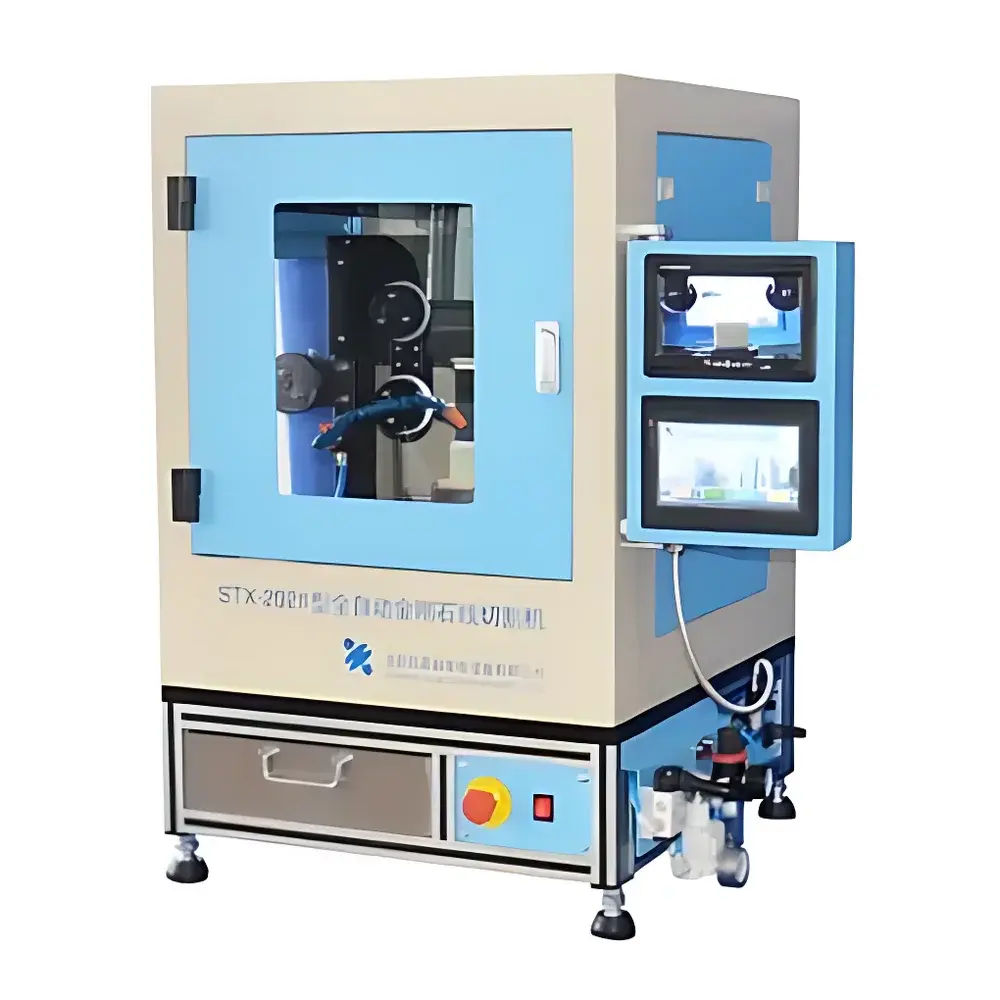
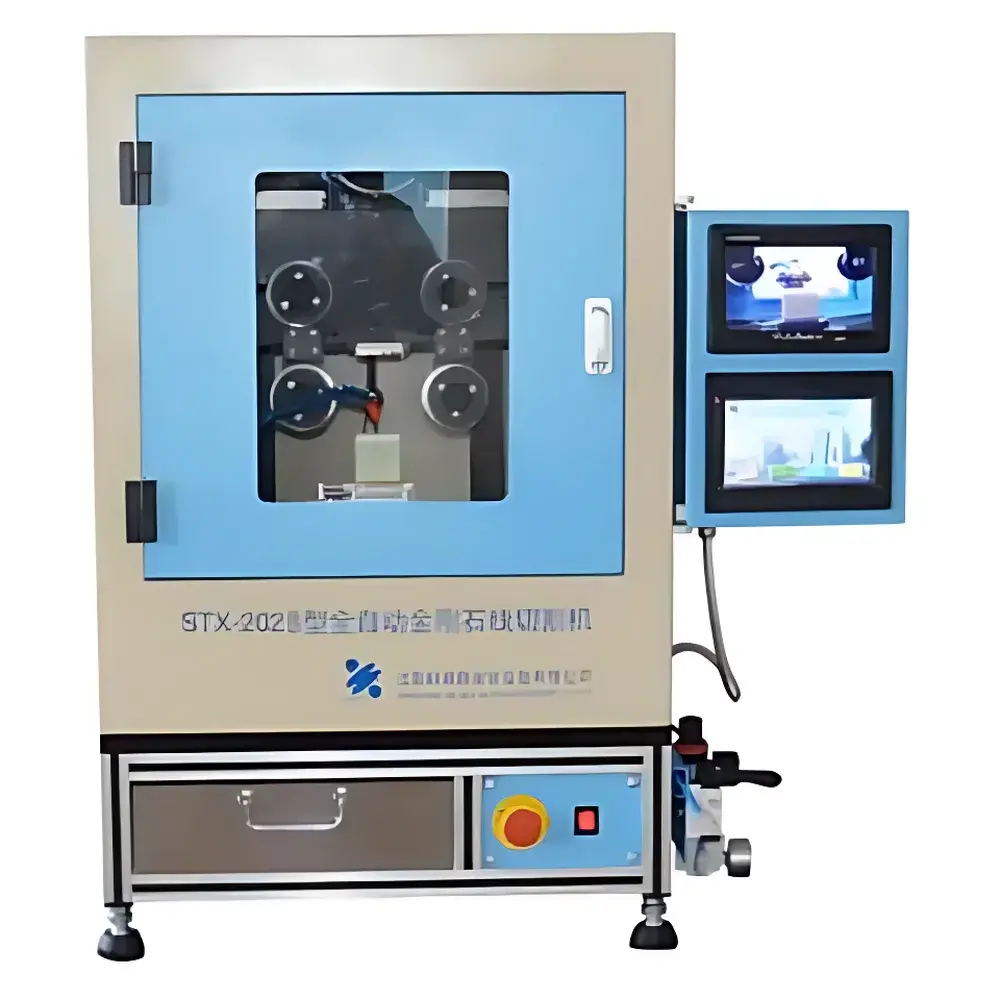
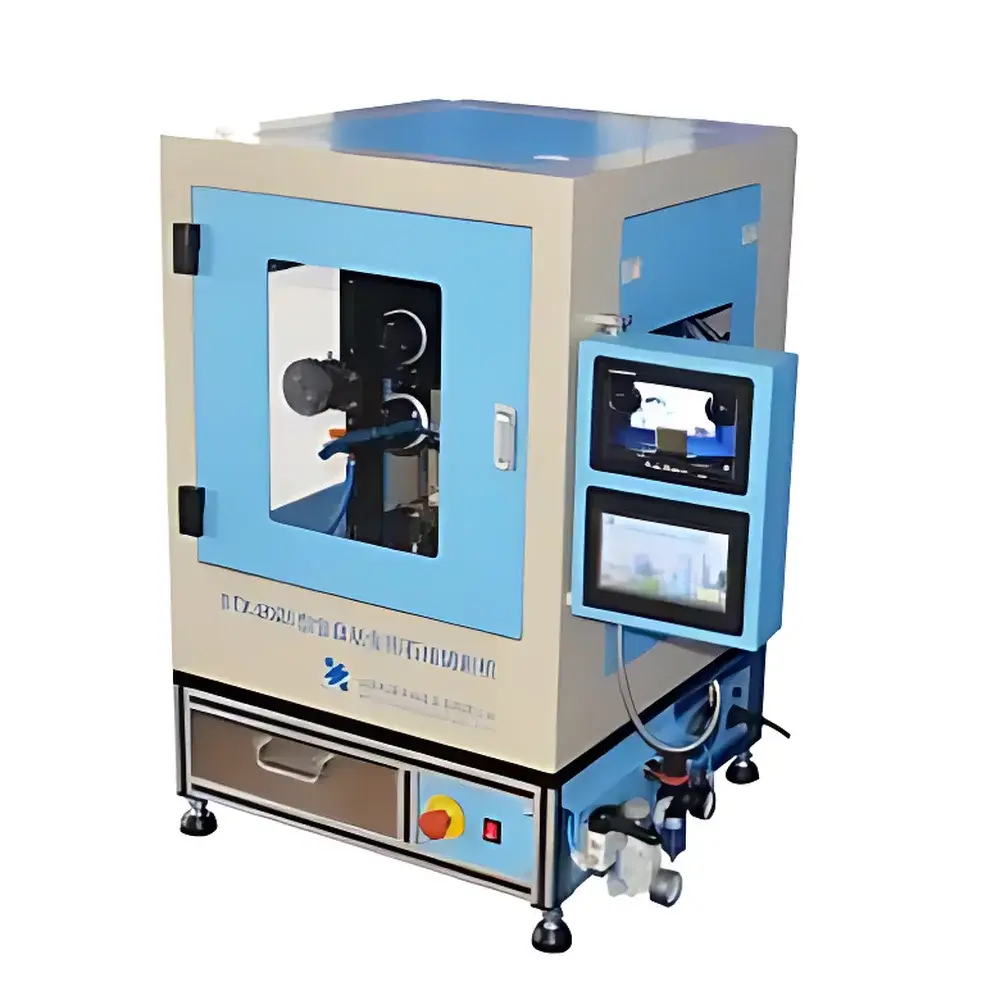
KJ GROUP STX-202B Fully Automated Diamond Wire Saw
| Brand | KJ GROUP |
|---|---|
| Origin | Liaoning, China |
| Manufacturer Type | Direct Manufacturer |
| Region of Origin | Domestic (China) |
| Model | STX-202B |
| Pricing | Upon Request |
| Power Supply | AC 220 V, 50 Hz, 10 A |
| Total Power Consumption | 120 W (excluding air compressor) |
| Frame Material | Aluminum Alloy with Sheet Metal Enclosure |
| Diamond Wire Length | ≤45 m |
| Diamond Wire Diameter | ≤0.45 mm |
| Wire Tensioning Method | Adjustable Pneumatic Tensioning |
| Spindle Motion | Reciprocating Rotation |
| Spindle Speed | 2–300 rpm (adjustable) |
| Z-Axis Travel | ≤60 mm |
| Y-Axis Travel | ≤50 mm |
| Sample Stage | Manual 2D Fixture — Horizontal Rotation: 0–360°, Tilt Angle: ±15° |
| Maximum Distance Between Guide Wheels (inner) | 96 mm |
| Max. Workpiece Dimensions | Φ50 × 50 mm |
| Specimen Holder Size (L×W×H) | 80 × 51 × 12 mm |
| Max. Cutting Depth | ≤50 mm |
| Control System | Integrated PLC + 7-inch Touchscreen HMI |
| Real-time Video Monitoring | Built-in 7-inch Display |
| Machine Dimensions (L×W×H) | 730 × 680 × 970 mm |
| Net Weight | 130 kg |
| Operating Environment | 0–45 °C, 10–85% RH (non-condensing) |
| Cooling Requirement | Cutting Oil (recommended) |
| Compressed Air Supply | ≥0.6 MPa |
| Minimum Bench Load Capacity | 150 kg |
| Recommended Bench | Solid Cement Table (800 × 700 × 500 mm) |
Overview
The KJ GROUP STX-202B Fully Automated Diamond Wire Saw is an engineered precision sample preparation instrument designed for controlled, low-damage sectioning of brittle and hard materials in academic research laboratories, materials science centers, and industrial R&D facilities. It operates on the principle of abrasive wire cutting, utilizing a continuously reciprocating diamond-impregnated wire under precisely regulated tension and feed velocity to achieve high-fidelity cross-sectional and longitudinal cuts. Unlike rotary saws or grinding methods, this system minimizes thermal stress, micro-cracking, and subsurface deformation—critical for preserving crystallographic integrity, interfacial morphology, and phase distribution in delicate specimens. The STX-202B supports both straight-section and angular slicing (±15° tilt, 360° rotation), enabling oblique sectioning for crystallographic orientation analysis, TEM lamella pre-thinning, and geological thin-section preparation.
Key Features
- Fully automated linear feed control via programmable PLC logic, eliminating manual intervention during continuous cutting sequences.
- Pneumatically actuated, stepless diamond wire tensioning system ensures consistent mechanical loading across extended cutting durations—reducing wire breakage and improving dimensional repeatability.
- Reciprocating spindle drive (2–300 rpm) provides optimized wire speed modulation for variable material hardness and required surface finish.
- Integrated 7-inch touchscreen HMI enables intuitive parameter setup—including feed rate, stroke count, dwell time, and multi-step cutting protocols—with real-time visual feedback via built-in camera monitoring.
- Modular aluminum alloy frame with full sheet-metal enclosure delivers structural rigidity while maintaining electromagnetic and acoustic isolation in shared lab environments.
- Expandable auxiliary interface for optional peripherals: MTI heating stage (for thermally stabilized wax mounting), DX-100 single-crystal orienter (for Laue-based crystal alignment), and silent oil-free air compressor (for clean, lab-grade pneumatic supply).
Sample Compatibility & Compliance
The STX-202B accommodates a broad spectrum of inorganic and organic solids with Mohs hardness below that of diamond (≤10). Validated use cases include ceramic oxides (Al2O3, ZrO2, SiC), semiconductor wafers (Si, Ge, GaAs), optical crystals (sapphire, CsI, ZnS), geological specimens (granite, basalt, meteorites), metallic alloys (Ti-6Al-4V, Mg-Al composites), biomedical hard tissues (cortical bone, dental enamel, calcified implants), and polymer-matrix composites (CFRP, GFRP). All cutting operations comply with ASTM E3-22 (Standard Guide for Preparation of Metallographic Specimens) and ISO 14577-1:2022 (Metallic materials — Instrumented indentation test) foundational requirements for specimen geometry control. When operated with traceable calibration logs and audit-trail-enabled software (via optional firmware upgrade), the system supports GLP/GMP-aligned documentation workflows per FDA 21 CFR Part 11 guidelines.
Software & Data Management
The embedded control firmware stores up to 99 user-defined cutting programs, each containing sequential motion profiles, tension presets, and video capture triggers. Parameter changes are logged with timestamp, operator ID (via optional RFID login), and system status flags (e.g., coolant flow confirmation, air pressure validation). Raw video streams from the cutting zone are buffered locally and exportable via USB 2.0 to external storage for post-acquisition review. While the base unit does not include network connectivity, RS-232 and Ethernet ports are available as factory-installed options for integration into centralized lab management systems (LIMS) or MES platforms. Firmware updates are delivered via secure HTTPS download and require cryptographic signature verification prior to installation.
Applications
- Preparation of <0.1 mm thick slices from infrared optical crystals (ZnSe, Ge) for transmission spectroscopy and FTIR substrate fabrication.
- Sectioning of geological thin sections (30 µm target thickness) for petrographic microscopy and electron probe microanalysis (EPMA).
- Isolation of oriented lamellae from battery cathode composites (NMC, LFP) for FIB-SEM correlative workflow initiation.
- Cutting of bio-integrated scaffolds (HA-coated Ti meshes, collagen-hydroxyapatite composites) under chilled oil immersion to preserve hydration state and interfacial adhesion.
- High-precision dicing of thermoelectric ingots (Bi2Te3, PbTe) for Seebeck coefficient measurement arrays.
- Serial sectioning of calcified vascular tissue (stented arteries, renal calculi) for 3D histomorphometric reconstruction using synchrotron micro-CT.
FAQ
What types of diamond wire diameters are supported?
The STX-202B accepts diamond wires ranging from Ø0.125 mm to Ø0.45 mm; standard configurations include Ø0.25 mm and Ø0.35 mm for general-purpose cutting.
Is cooling fluid mandatory during operation?
Yes—cutting oil or water-soluble coolant is required to dissipate frictional heat, suppress dust generation, and extend wire life. Dry cutting is not supported.
Can the machine perform angled cuts for crystallographic studies?
Yes—the manual 2D fixture allows precise horizontal rotation (0–360°) and ±15° tilt adjustment, enabling off-axis sectioning for Laue diffraction alignment or slip-system analysis.
What is the maximum recommended cutting depth per pass?
For optimal surface quality and wire longevity, a single-pass depth of ≤0.3 mm is advised for ceramics and crystals; deeper cuts should be executed in multiple incremental passes.
Does the system support automated batch processing of identical samples?
Yes—programmable multi-step routines allow unattended sequential cutting of up to 99 specimens with identical parameters, provided mounting fixtures remain unchanged between runs.



