
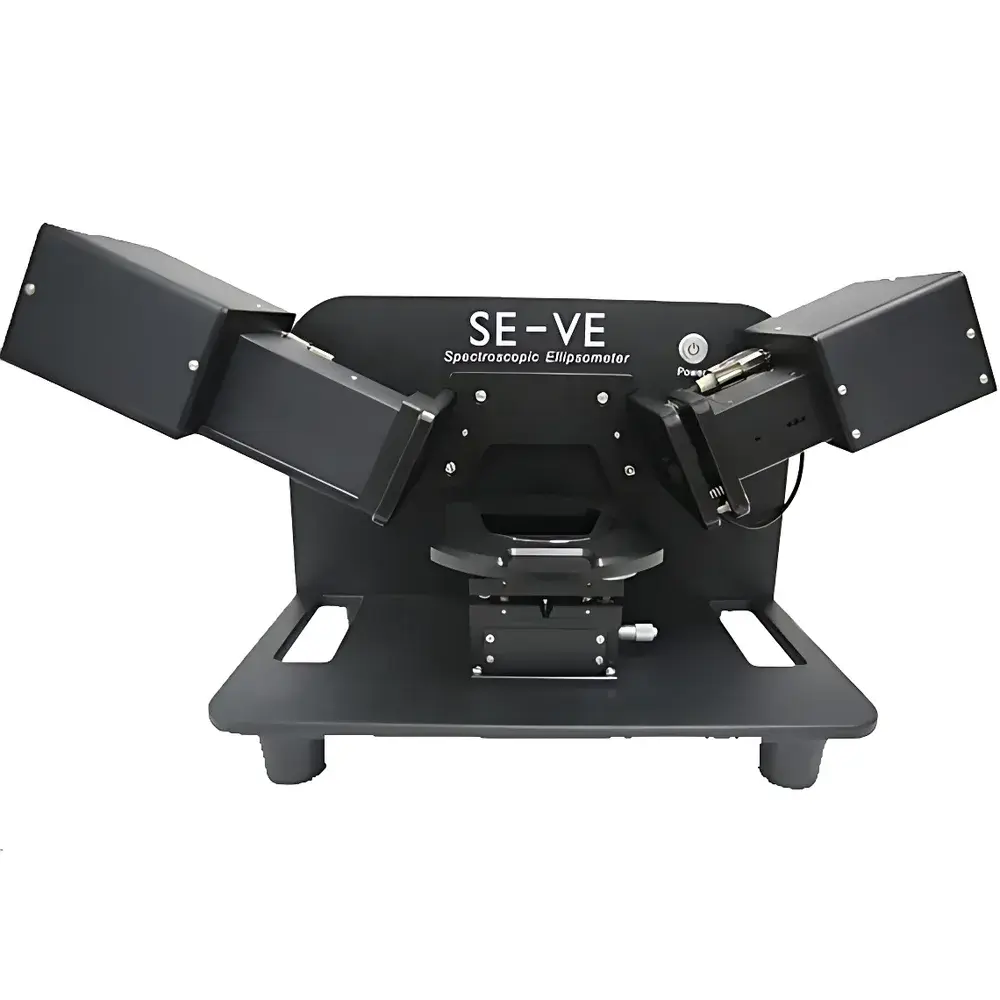
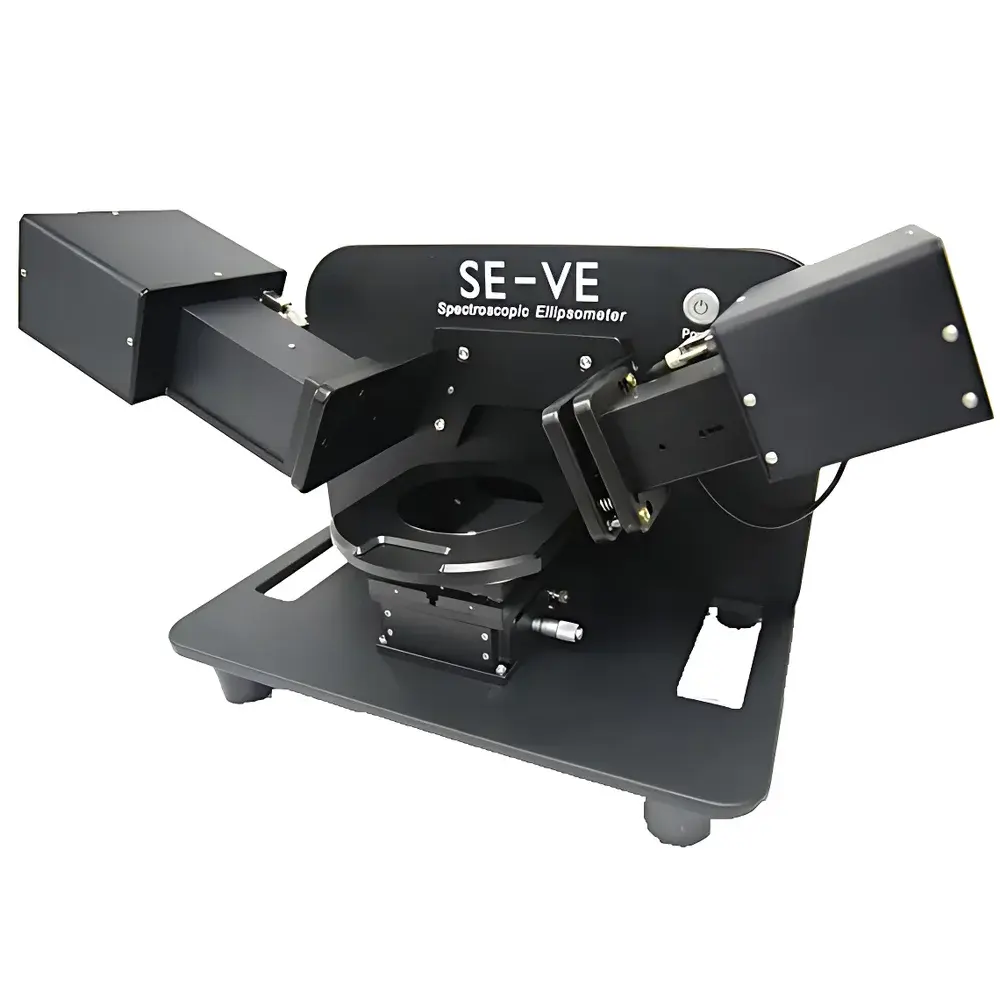
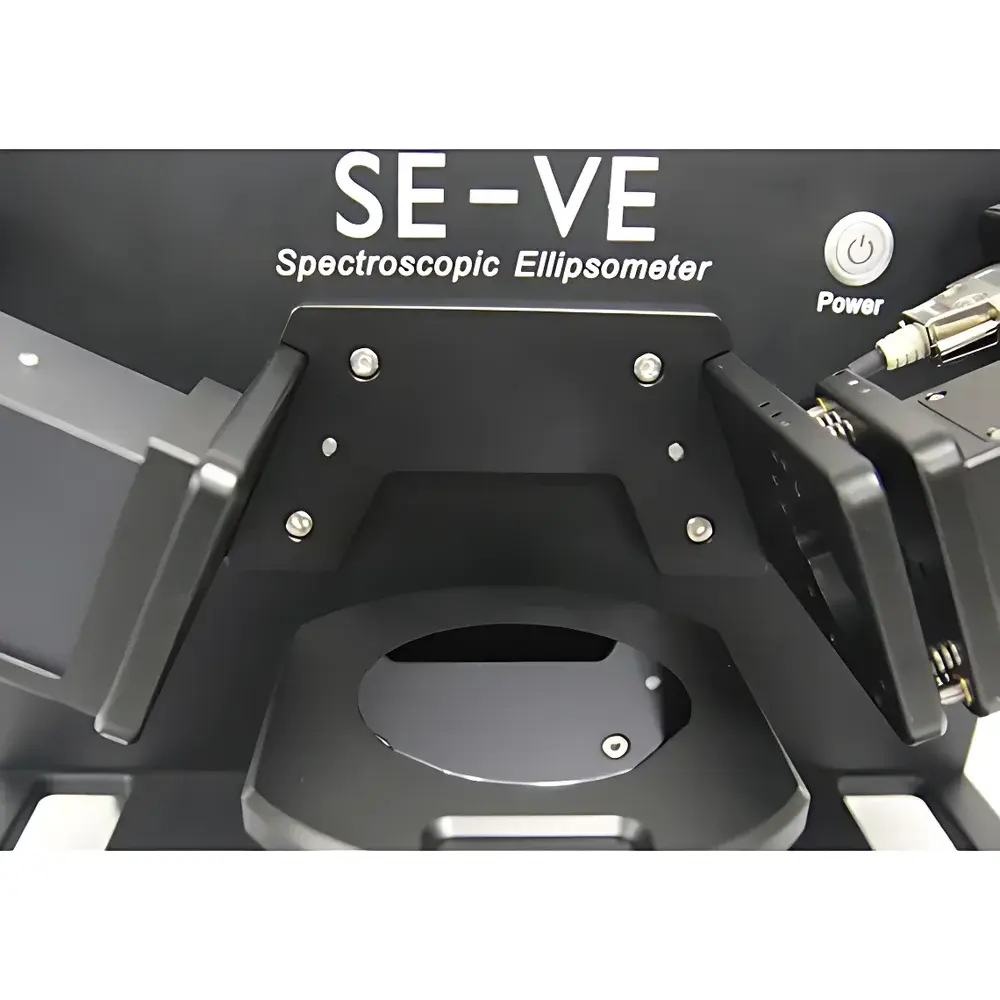
KJ GROUP SE-VE Spectroscopic Ellipsometer
| Brand | KJ GROUP |
|---|---|
| Origin | Liaoning, China |
| Manufacturer Type | Authorized Distributor |
| Origin Category | Domestic (China) |
| Model | SE-VE |
| Pricing | Available Upon Request |
| Light Source Range | 400–800 nm (Visible to Near-Infrared) |
| Measurement Mode | Fixed-Angle (65° incidence) |
| Data Acquisition | PCRSA configuration with rotating compensator |
| Output Spectra | Ψ/Δ, n/k/s, R |
| Single-Measurement Duration | 0.5–5 s |
| Thickness Repeatability | ±0.05 nm |
| Spot Size | 1–3 mm (adjustable) |
| Focus Adjustment | Manual |
| Sample Max Diameter | 160 mm |
| Mapping Capability | Not Supported |
| Optional Accessories | Temperature-Controlled Stage, Vacuum Pump, Transmission Adsorption Module |
Overview
The KJ GROUP SE-VE Spectroscopic Ellipsometer is an entry-level, fixed-angle ellipsometric system engineered for rapid, non-destructive characterization of thin-film optical properties. Based on the fundamental principles of polarization-state modulation and interference analysis, the instrument measures the change in polarization state (Ψ and Δ) of reflected light across a spectral range of 400–800 nm. This enables quantitative determination of film thickness, complex refractive index (n + ik), extinction coefficient (k), and surface roughness—without physical contact or sample damage. Designed for laboratories requiring reliable, repeatable metrology at moderate throughput, the SE-VE implements a robust PCRSA (Phase-Compensated Rotating Sample Analyzer) optical architecture with a high-stability rotating compensator. Its fixed 65° angle of incidence balances sensitivity across common dielectric and semiconductor film systems while minimizing alignment complexity and operational overhead. The system is calibrated using NIST-traceable reference standards and supports traceable measurement protocols aligned with ISO 15527 (optical thin films — ellipsometric measurement procedures) and ASTM F1597 (standard guide for ellipsometry of thin films).
Key Features
- High-stability broadband composite light source covering 400–800 nm, optimized for signal-to-noise ratio in visible-to-NIR spectral regions
- PCRSA optical configuration with precision rotating compensator for accurate, high-speed Ψ/Δ acquisition (sub-second per spectrum)
- Fixed 65° incidence geometry—eliminates goniometer-related mechanical drift and simplifies daily operation and calibration maintenance
- Integrated motorized stage with manual focus adjustment, supporting samples up to 160 mm in diameter
- Preloaded material database containing >300 optical constants for metals, oxides, nitrides, polymers, and chalcogenides (e.g., SiO₂, TiO₂, ITO, SiNₓ, PMMA, Ge, GaAs)
- Modular modeling engine supporting multi-layer stack fitting, effective medium approximations (EMA), and dispersion models (Cauchy, Sellmeier, Tauc-Lorentz)
- Compact benchtop footprint (< 0.5 m²) with integrated control electronics and fiber-coupled detection path for vibration resilience
Sample Compatibility & Compliance
The SE-VE accommodates rigid planar substrates including silicon wafers, glass slides, fused silica, sapphire, and metal-coated coupons. It is compatible with single-layer, bilayer, and periodic multilayer stacks—common in anti-reflection coatings, transparent conductive oxides, MEMS passivation layers, and photovoltaic absorber stacks. While not designed for in-situ vacuum or environmental chamber integration by default, optional accessories—including a temperature-controlled stage (−20 °C to +150 °C) and vacuum pump interface—enable controlled ambient measurements. All firmware and software comply with GLP documentation requirements, including audit-trail-enabled data logging, user-access controls, and timestamped raw-data archiving. Instrument validation documentation supports IQ/OQ protocols per ISO/IEC 17025 and aligns with FDA 21 CFR Part 11 readiness for regulated environments.
Software & Data Management
The proprietary EllipSoft™ v4.2 platform provides a unified interface for instrument control, real-time spectral visualization, model building, and regression analysis. Data export formats include CSV, TXT, and HDF5 for interoperability with MATLAB, Python (NumPy/Pandas), and JMP. Each measurement session auto-generates a metadata-rich report containing instrument configuration, environmental conditions (ambient temperature/humidity), fit residuals, confidence intervals, and covariance matrices. Software licensing includes annual updates and remote technical support. Raw spectra and fitted parameters are stored in a hierarchical folder structure compliant with FAIR (Findable, Accessible, Interoperable, Reusable) data principles. Version-controlled analysis scripts can be saved and re-executed across datasets to ensure method reproducibility across users and time.
Applications
The SE-VE serves as a primary metrology tool in academic research labs studying optical thin-film growth mechanisms (e.g., ALD, PVD, spin-coating), industrial QC for display coating uniformity, and R&D for next-generation photonic devices. Typical use cases include: thickness mapping of SiO₂ gate dielectrics on patterned wafers; dispersion analysis of perovskite absorber layers in solar cells; real-time monitoring of sol-gel film condensation kinetics; verification of AR coating stoichiometry on camera lens elements; and quantification of interfacial oxidation in Cu/Ta/NiFe multilayers. Its sub-5-second acquisition time enables batch screening of >50 samples per hour under standard lab conditions—making it suitable for both exploratory research and routine process verification.
FAQ
What is the minimum measurable thickness for amorphous SiO₂ on silicon?
For standard 65° incidence and 400–800 nm illumination, the lower detection limit is ~0.3 nm with ≤0.05 nm repeatability under stabilized lab conditions.
Does the system support variable-angle measurements?
No—the SE-VE is a fixed-angle configuration optimized for speed and stability; variable-angle capability requires the SE-VA series.
Can I import custom optical constants or dispersion models?
Yes—EllipSoft™ accepts user-defined n/k tables in CSV format and supports custom scripting via Python API for advanced model development.
Is the software validated for GMP environments?
The software includes 21 CFR Part 11-compliant features (electronic signatures, audit trails, role-based access); full GMP validation kits are available upon request.
What maintenance is required for long-term accuracy?
Annual recalibration using certified reference standards is recommended; optical alignment checks should be performed quarterly using the built-in alignment laser and reference mirror kit.



