
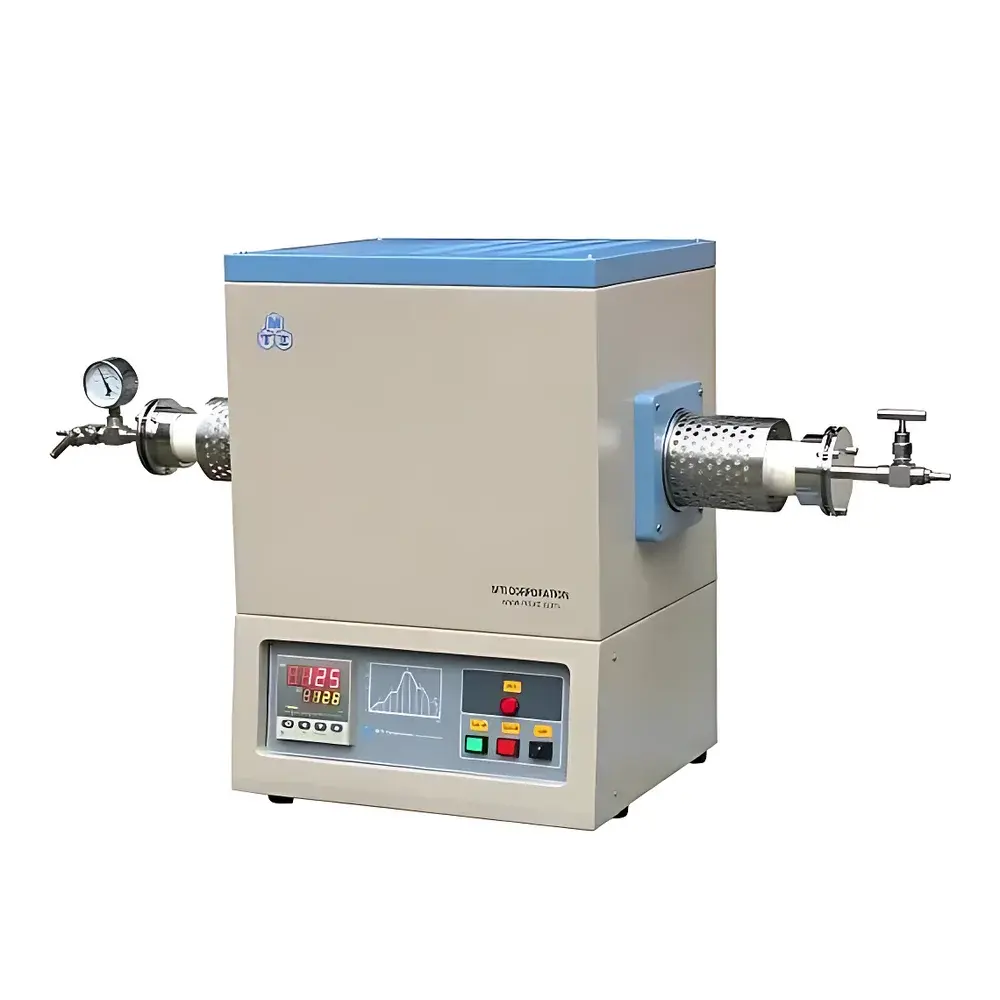
KJ GROUP GSL-1600X-S 1600°C Vacuum High-Temperature Tube Furnace
| Brand | KJ GROUP |
|---|---|
| Origin | Liaoning, China |
| Manufacturer Type | Authorized Distributor |
| Country of Origin | China |
| Model | GSL-1600X-S |
| Power Supply | AC 220 V, 50/60 Hz, 3 kW (30 A circuit breaker required) |
| Heating Element | MoSi₂ rods rated to 1750°C |
| Tube Dimensions | Ø60 mm OD × Ø54 mm ID × 790 mm L |
| Heating Zone Length | 300 mm |
| Uniform Temperature Zone | 75 mm |
| Continuous Operating Temperature Range | 800–1600°C |
| Max. Ramp/Cool Rate | 10°C/min |
| Temperature Control Accuracy | ±1°C |
| Ultimate Vacuum | ≤50 mTorr |
| External Dimensions | 445 × 380 × 615 mm |
| Net Weight | 100 kg |
| Safety Certification | CE-compliant |
Overview
The KJ GROUP GSL-1600X-S is a precision-engineered vacuum high-temperature tube furnace designed for controlled thermal processing of advanced materials under inert or reduced-pressure atmospheres. Based on resistive heating via high-purity molybdenum disilicide (MoSi₂) elements—rated to 1750°C—the system delivers stable, repeatable temperature profiles up to 1600°C for extended durations. Its dual-layer stainless steel housing incorporates high-purity alumina fiber insulation and two independent air-cooling systems, ensuring surface temperatures remain below 60°C during operation—a critical safety and energy-efficiency feature for laboratory environments. The furnace is optimized for applications requiring strict thermal uniformity, including solid-state synthesis, ceramic sintering, thin-film annealing, and precursor decomposition in CVD precursor studies. It operates within defined environmental limits: ambient temperature 10–40°C (25°C ±15°C recommended), relative humidity 45–65% RH (55% ±10% RH nominal), and altitude <1000 m above sea level.
Key Features
- Dual-shell construction with high-density alumina fiber insulation and integrated forced-air cooling circuits for thermal containment and operator safety.
- Internally coated hot-zone chamber with US-sourced alumina-based refractory coating—enhances infrared emissivity, improves thermal efficiency, and extends furnace tube service life.
- Programmable PID temperature controller supporting up to 30 segmented ramp-hold-cool profiles, enabling precise replication of complex thermal cycles (e.g., nucleation-controlled crystallization or stress-relief annealing).
- CE-certified design compliant with EN 61000-6-3 (EMC emission) and EN 61000-6-2 (immunity), verifying electromagnetic compatibility and operational robustness in shared lab infrastructure.
- Standard quartz or high-purity alumina tube (Ø60 mm OD / Ø54 mm ID / 790 mm L) with ±0.5 mm dimensional tolerance; includes four high-alumina end plugs and one pair of stainless steel flanges with Viton O-rings for vacuum-tight sealing.
Sample Compatibility & Compliance
The GSL-1600X-S accommodates cylindrical samples up to Ø52 mm in diameter and 300 mm in length within its uniform temperature zone. Compatible sample forms include powders, pellets, fibers, thin films on substrates, and pre-sintered green bodies. The furnace supports both static vacuum (≤50 mTorr with optional digital vacuum gauge) and dynamic gas flow configurations (N₂, Ar, H₂, or forming gas), with standard Swagelok-compatible inlet/outlet ports (Barker-type fittings; optional double-ferrule conversion available). All wetted materials—including flanges, gaskets, and internal coatings—are inert to common process gases and non-reactive with oxides, nitrides, and carbides. The system meets baseline requirements for GLP-aligned thermal processing workflows and is routinely deployed in laboratories adhering to ISO/IEC 17025-accredited quality management systems.
Software & Data Management
While the standard configuration uses a front-panel PID controller with RS485 Modbus RTU interface, optional PC connectivity enables real-time data logging (temperature, setpoint, time stamp) via third-party SCADA or LabVIEW-compatible drivers. All thermal programs are stored in non-volatile memory with timestamped execution history. For regulated environments, optional firmware upgrades support audit-trail functionality compliant with FDA 21 CFR Part 11 requirements—including user authentication, electronic signatures, and immutable event logs—when paired with validated data acquisition software.
Applications
- Sintering of oxide ceramics (Al₂O₃, ZrO₂, YSZ), silicon carbide (SiC), and MAX-phase compounds.
- Controlled-atmosphere annealing of transition metal dichalcogenides (TMDs) and perovskite thin films.
- Thermal decomposition of metal-organic frameworks (MOFs) and polymer-derived ceramics (PDCs).
- Graphitization and defect engineering of carbon nanomaterials under inert purge.
- Calibration and validation of thermocouples (Type S, B, or C) at elevated temperatures per ASTM E230/E230M.
FAQ
What vacuum level can the GSL-1600X-S achieve without additional pumping hardware?
The base configuration achieves ≤50 mTorr using a standard two-stage rotary vane pump; ultimate pressure may improve to ≤10 mTorr with extended pump-down time and proper leak-checking.
Is the furnace compatible with hydrogen gas atmospheres?
Yes—when equipped with H₂-rated stainless steel flanges, metal-sealed KF25 vacuum fittings, and appropriate gas monitoring (e.g., residual gas analyzer), it supports low-concentration H₂/N₂ mixtures up to 5% v/v per NFPA 55 guidelines.
Can the temperature controller be integrated into a central lab automation system?
Yes—via RS485 Modbus RTU, the controller supports read/write access to setpoints, ramp rates, and status registers, enabling synchronization with PLC-based process orchestration platforms.
What maintenance is required for the MoSi₂ heating elements?
No routine replacement is needed under normal operation; however, periodic visual inspection for surface cracking or sagging is recommended after every 200 h of use above 1400°C.
Does the system include over-temperature protection?
Yes—an independent redundant thermocouple (Type S) feeds a hardwired safety cut-off relay that interrupts power if the measured temperature exceeds the setpoint by >20°C.
Related Products



