
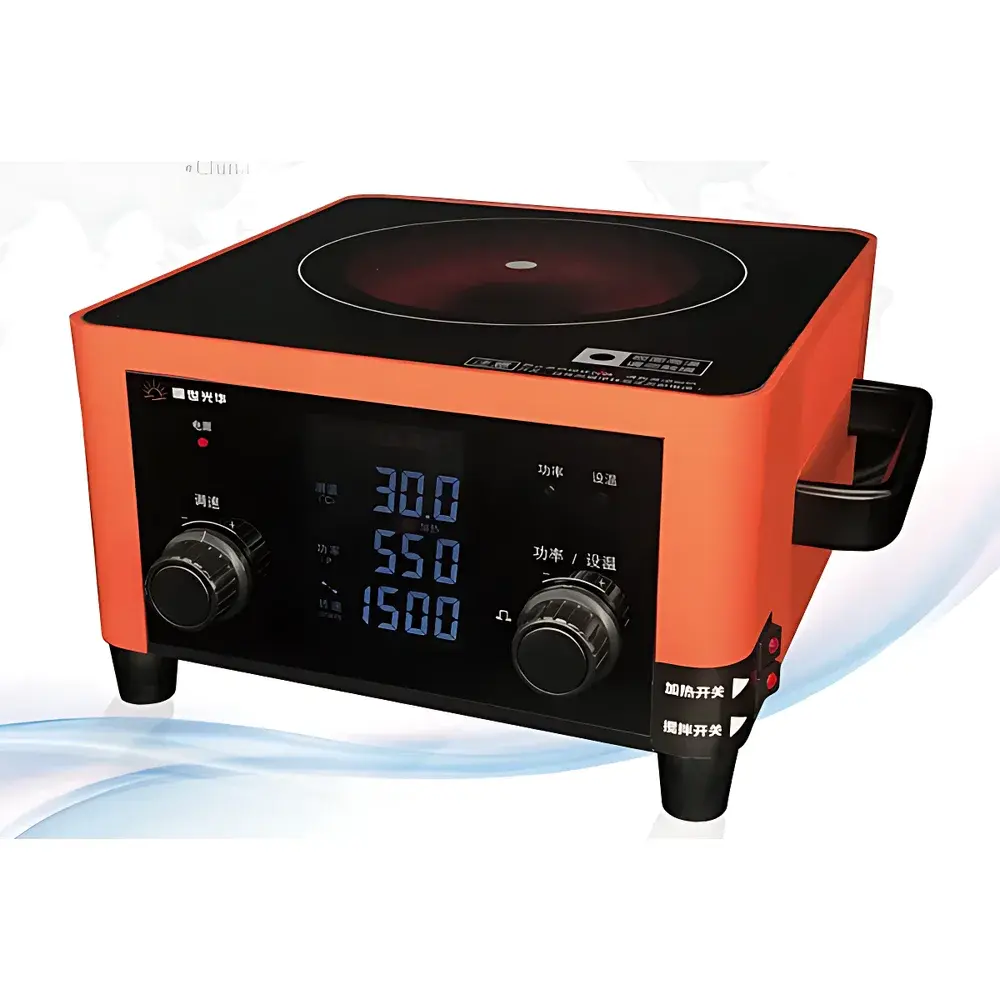
Truelab 2Y1D Far-Infrared Digital Magnetic Stirrer with Integrated Heating & IoT Safety Monitoring
| Brand | Truelab |
|---|---|
| Model | 2Y1D |
| Type | Magnetic Stirrer |
| Max. Stirring Volume | 3 L |
| Speed Range | 300–1500 rpm |
| Heating Temperature Range | Ambient to 250 °C |
| Power Adjustment | 0–550 W |
| Temperature Sensing | External PT1000 Sensor |
| Temperature Display Range | 30–270 °C |
| Control Accuracy | ±1 °C |
| Dimensions | 196 × 196 × 118 mm |
| Input | 220 V, 50 Hz |
| Housing Material | Glass-Fiber-Reinforced Engineering Nylon |
| Heating Element | Carbon-Fiber Far-Infrared Tube |
| Display | 3.5-inch VA-LCD |
Overview
The Truelab 2Y1D Far-Infrared Digital Magnetic Stirrer is an integrated laboratory platform engineered for precision thermal control and homogeneous mixing in demanding analytical, quality control, and R&D workflows. Unlike conventional magnetic stirrers or standalone hot plates, this instrument combines far-infrared radiant heating, closed-loop temperature regulation, high-torque magnetic stirring, real-time digital monitoring, and optional NB-IoT–enabled safety diagnostics into a single compact unit. Its heating mechanism relies on carbon-fiber far-infrared emitters that transfer thermal energy directly to vessel walls and contents via electromagnetic radiation (wavelength range ~3–10 µm), eliminating open coils, flame hazards, and convective inefficiencies. This enables rapid, uniform heating of both flat-bottom and round-bottom glassware — including Erlenmeyer flasks, beakers, and reaction vessels — without requiring specialized geometry or thermal contact pads. Designed for continuous operation under GLP-compliant environments, the system meets fundamental electrical safety requirements per IEC 61010-1 and incorporates multiple hardware-level protections to support unattended use.
Key Features
- Far-infrared heating technology: No exposed heating elements; inherently spark-free and flameless operation compliant with Class I, Division 2 hazardous location guidelines for non-explosive lab spaces.
- Integrated dual-function control: Simultaneous independent regulation of stirring speed (300–1500 rpm) and surface temperature (ambient to 250 °C) with ±1 °C accuracy verified using external PT1000 sensor input.
- Robust thermal architecture: Glass-fiber-reinforced nylon housing rated UL94 V-0 for flame resistance; carbon-fiber emitter with thermal inertia optimized for stable power delivery across 0–550 W range.
- Enhanced operator safety: Dual-mode high-temperature alert (visual LED + on-screen warning); forced-air cooling system with thermal cutoff at ≥280 °C; IPX4-rated splash-resistant enclosure; electronic ground-fault interruption (<0.1 s trip time).
- Digital human-machine interface: 3.5-inch VA-LCD display showing real-time temperature, RPM, and instantaneous power draw; intuitive rotary encoder navigation with tactile feedback.
- IoT-ready safety monitoring (optional): NB-IoT module supports remote fault logging, predictive maintenance alerts, automatic service ticket generation, and encrypted firmware updates — fully traceable for FDA 21 CFR Part 11 audit readiness when paired with validated cloud infrastructure.
Sample Compatibility & Compliance
The 2Y1D accommodates standard borosilicate glassware up to 3 L volume, including flat-bottom beakers (≥80 mm diameter), round-bottom flasks (with optional support stands), and jacketed reactors. Its uniform far-infrared emission profile ensures consistent thermal coupling regardless of vessel curvature, eliminating cold spots common with resistive hot plates. The system complies with ISO/IEC 17025 clause 5.4.2 regarding equipment suitability for intended measurements and satisfies essential requirements of EN 61326-1 (EMC) and EN 61010-1 (safety). When deployed in regulated pharmaceutical or clinical labs, its temperature stability and data integrity features align with USP <1058> Analytical Instrument Qualification protocols and support IQ/OQ documentation packages.
Software & Data Management
While the base unit operates autonomously via embedded firmware, the optional IoT module enables secure TLS 1.2–encrypted telemetry transmission to enterprise LIMS or ELN platforms. Logged parameters include timestamped temperature setpoint deviations, motor current draw anomalies, overtemperature events, and GFCI activation records — all stored with immutable audit trails. Data export supports CSV and JSON formats compatible with JMP, MATLAB, and LabArchives. For regulated users, optional 21 CFR Part 11–compliant electronic signatures and role-based access control are available through certified middleware integration.
Applications
This stirrer serves critical functions across multiple domains: dissolution testing (USP Apparatus II), polymerization kinetics studies requiring precise thermal ramping, enzymatic assay incubation with concurrent mixing, solvent reflux setups, catalyst slurry homogenization, and buffer preparation under controlled thermal conditions. Its ability to maintain ±1 °C stability while sustaining 1500 rpm makes it suitable for viscous media handling where conventional stirrers exhibit torque drop-off. In teaching labs, the intuitive interface and fail-safe design reduce training overhead while reinforcing core safety principles outlined in ACS Guidelines for Chemical Laboratory Safety.
FAQ
Does the 2Y1D require calibration before first use?
Yes — initial verification of temperature accuracy using a NIST-traceable thermometer is recommended per ISO/IEC 17025 Section 6.5. Routine calibration intervals depend on usage frequency and regulatory context (typically every 3–6 months in GMP settings).
Can it be used with metal containers?
No — ferromagnetic or conductive vessels interfere with magnetic coupling and may reflect infrared radiation unpredictably; only non-magnetic, IR-transparent materials (e.g., borosilicate glass, quartz, certain ceramics) are supported.
Is the IoT module mandatory for CE marking?
No — the base device meets CE requirements independently; the NB-IoT option is an add-on feature governed by separate radio equipment directive (RED) conformity assessment.
What maintenance is required for long-term reliability?
Annual inspection of thermal paste integrity on the PT1000 sensor mount and visual check of carbon-fiber emitter surface for microcracks; no routine lubrication or motor servicing needed due to brushless DC architecture.
How does the system handle power interruptions?
It retains last-set parameters in non-volatile memory and resumes operation upon power restoration — unless safety-critical fault conditions (e.g., overheating) were active prior to outage, in which case manual reset is required.



