
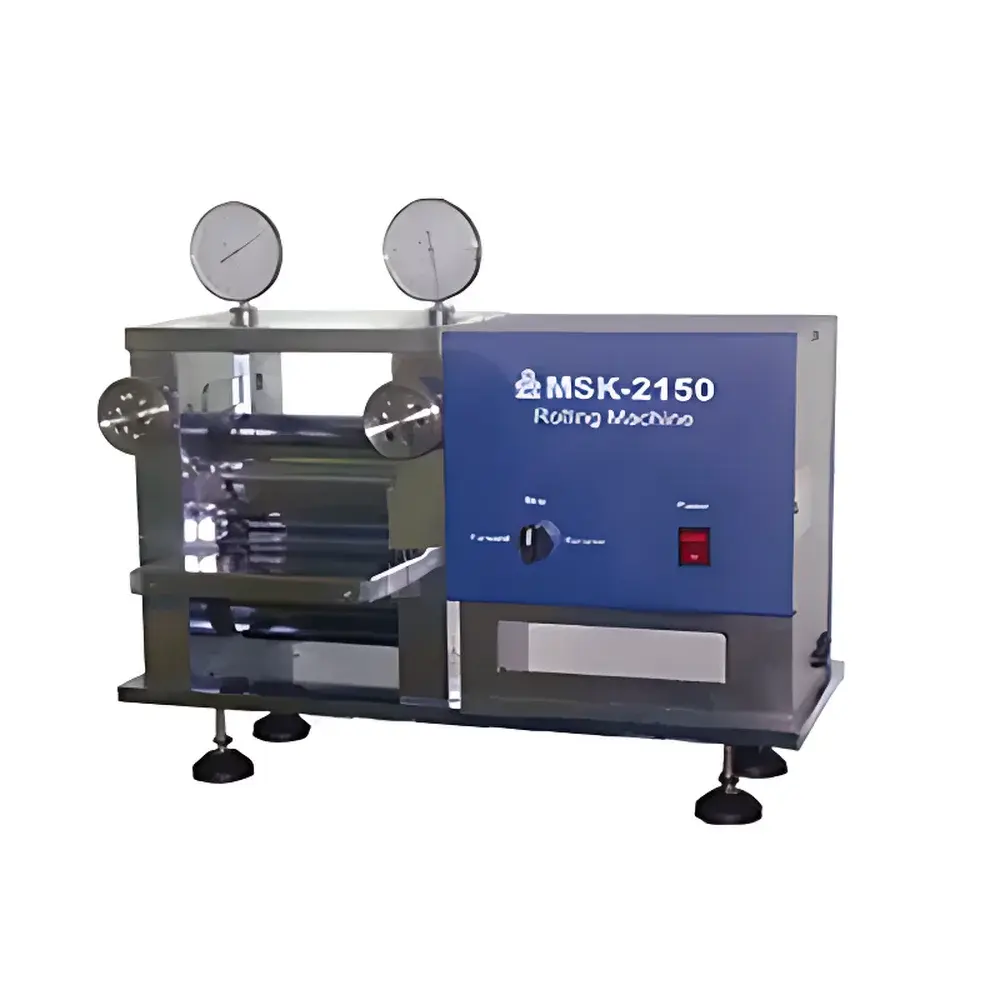
KJ GROUP MSK-2150 Electric Calendering Roll Press
| Brand | KJ GROUP |
|---|---|
| Origin | Liaoning, China |
| Manufacturer Type | Authorized Distributor |
| Country of Origin | China |
| Model | MSK-2150 |
| Quotation | Upon Request |
| Power Supply | AC 220 V, 50 Hz, 120 W |
| Roll Diameter | 94 mm |
| Roll Surface Hardness | ≥ HRC 60 |
| Maximum Thickness Reduction | 0–1.5 mm |
| Maximum Web Width | 150 mm |
| Linear Roll Speed | 50 mm/s |
| Dimensions (L×W×H) | 520 × 220 × 320 mm |
| Net Weight | 65 kg |
Overview
The KJ GROUP MSK-2150 Electric Calendering Roll Press is a precision-engineered laboratory-scale calender designed for controlled thickness reduction and density enhancement of electrode coatings used in lithium-ion, solid-state, and next-generation battery R&D. Operating on the principle of two counter-rotating hardened steel rolls under adjustable mechanical load, the MSK-2150 applies uniform compressive force across the web to achieve reproducible densification without delamination or edge cracking. Unlike manual or pneumatic systems, its servo-assisted electric drive ensures consistent linear velocity (50 mm/s) and eliminates torque fluctuation during continuous feeding—critical for maintaining coating integrity and interfacial homogeneity in thin-film electrodes. The system is purpose-built for low-to-medium throughput environments including university electrochemistry labs, national research institutes, and pilot-scale battery material developers requiring traceable, repeatable calendering data under non-GMP but GLP-aligned workflows.
Key Features
- Hardened alloy steel rolls (Ø94 mm, surface hardness ≥ HRC 60) engineered for dimensional stability and wear resistance over extended operational cycles
- Precision-machined roll gap adjustment mechanism with micrometer-scale resolution (±5 µm repeatability) enabling sub-micron control of final coating thickness
- Integrated overload protection and emergency stop circuit compliant with EN 60204-1 safety standards
- CE-marked electrical architecture meeting EMC Directive 2014/30/EU and Low Voltage Directive 2014/35/EU requirements
- Compact footprint (520 × 220 × 320 mm) optimized for fume hood integration or benchtop deployment in constrained lab spaces
- Low-power consumption design (120 W nominal) suitable for continuous operation without thermal drift or forced cooling
Sample Compatibility & Compliance
The MSK-2150 accommodates free-standing and current-collector-supported electrode sheets up to 150 mm wide and 1.5 mm total thickness—including slurry-cast NMC, LFP, silicon anodes, solid polymer electrolytes, and conductive carbon films on Cu/Al foil. Its roll geometry and surface finish minimize adhesion-induced tearing and ensure uniform stress distribution across heterogeneous composites. While not certified for ISO 13485 or FDA 21 CFR Part 11 out-of-the-box, the system supports audit-ready documentation when paired with external calibrated thickness gauges (e.g., Mitutoyo ID-C112X) and logbooks adhering to ASTM D6988-17 (Standard Practice for Recording Calendering Parameters in Battery Electrode Manufacturing). All structural components comply with RoHS 2011/65/EU restrictions on hazardous substances.
Software & Data Management
The MSK-2150 operates as a standalone electromechanical unit without embedded firmware or proprietary software. Process parameters—including roll speed, initial/final thickness measurements, number of passes, and ambient temperature—are manually recorded per batch using standardized lab notebooks or LIMS-integrated Excel templates. For traceability, users are advised to pair the press with digital micrometers featuring RS232/USB output and timestamped data export, enabling alignment with internal QA protocols requiring raw measurement provenance. Optional third-party data acquisition modules (e.g., National Instruments USB-6009 + LabVIEW-based interface) can be integrated to log real-time motor current draw as a proxy for rolling force consistency—supporting root-cause analysis during process deviation investigations.
Applications
- Electrode optimization studies: correlating calendering pressure, pass count, and dwell time with porosity (via mercury intrusion porosimetry), ionic conductivity (EIS), and cycle life performance
- Teaching laboratories: demonstrating solid-state deformation mechanics, yield point behavior of viscoelastic slurries, and the relationship between volumetric density and electronic percolation threshold
- Pilot-line feasibility testing: validating coating formulations prior to transfer to industrial four-high rolling mills (e.g., for dry electrode or aqueous binder systems)
- Reference material preparation: producing thickness-calibrated standards for XRD texture analysis, SEM cross-section imaging, and BET surface area validation
- Quality assurance screening: rapid verification of coating uniformity across batch runs using handheld eddy-current or beta-backscatter gauges
FAQ
What is the maximum recommended operating temperature for the rolls during continuous use?
The rolls are passively cooled; sustained operation above ambient +15°C requires intermittent duty cycling (e.g., 5 min active / 3 min rest) to prevent thermal expansion-induced gap drift.
Can the MSK-2150 process materials with abrasive fillers such as SiO₂ or Al₂O₃ coatings?
Yes—provided the coating binder exhibits sufficient green strength. However, periodic inspection of roll surface finish (every 200 h) is recommended when processing >15 wt% hard-phase composites.
Is roll parallelism adjustable independently of gap setting?
No—parallelism is factory-set and maintained via precision-ground end plates; user adjustment is not supported to preserve metrological integrity.
Does the system include calibration certificates for thickness or force measurement?
No—calibration must be performed externally using NIST-traceable instruments; KJ GROUP provides mechanical alignment verification reports upon request.
What safety interlocks are implemented beyond the emergency stop button?
A dual-channel light curtain (IEC 61496-1 compliant) is available as an optional add-on; standard configuration includes roll rotation inhibition when front guard is open.
Related Products



