
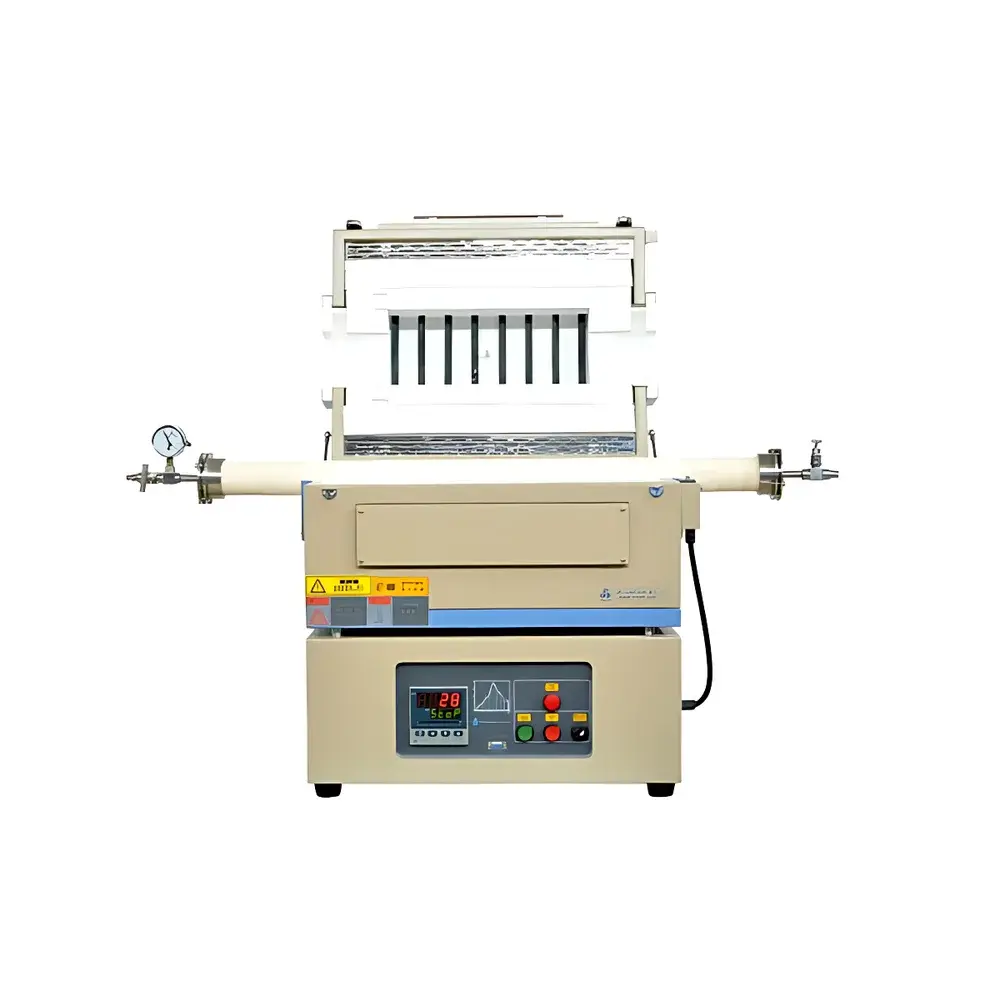
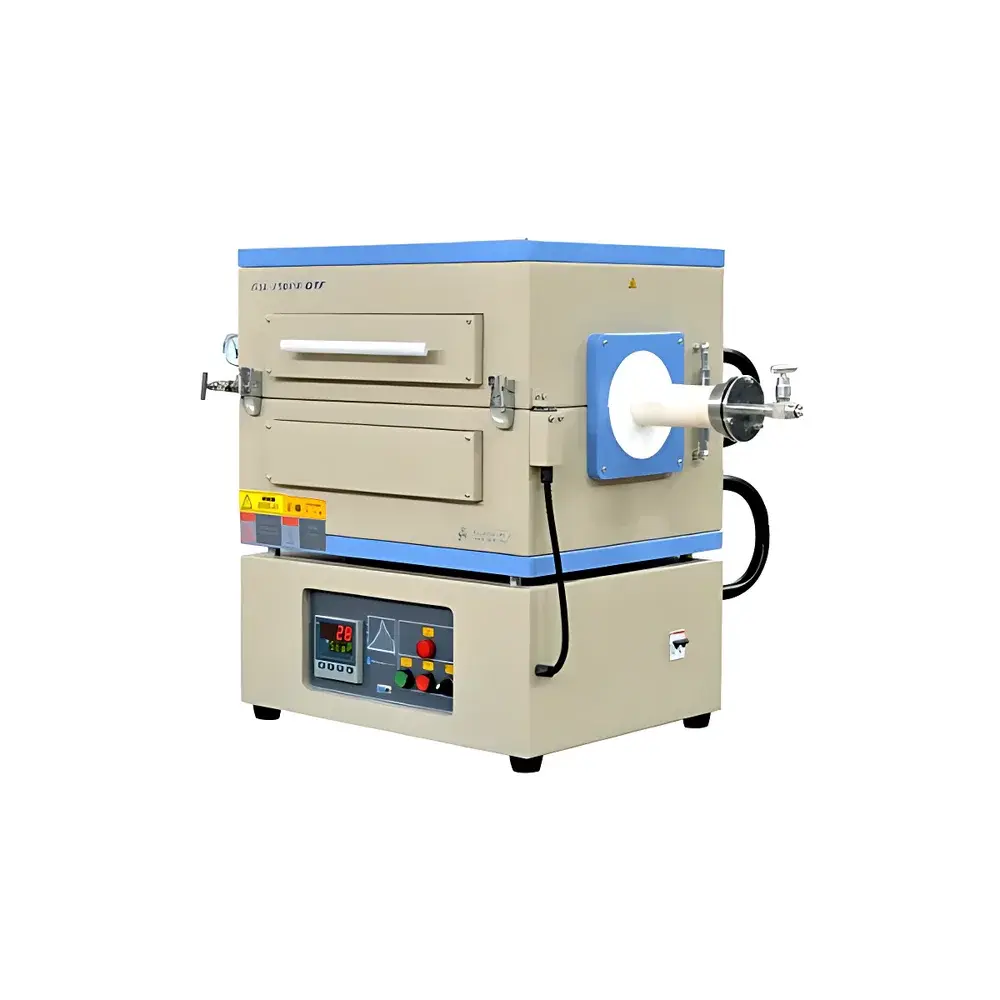
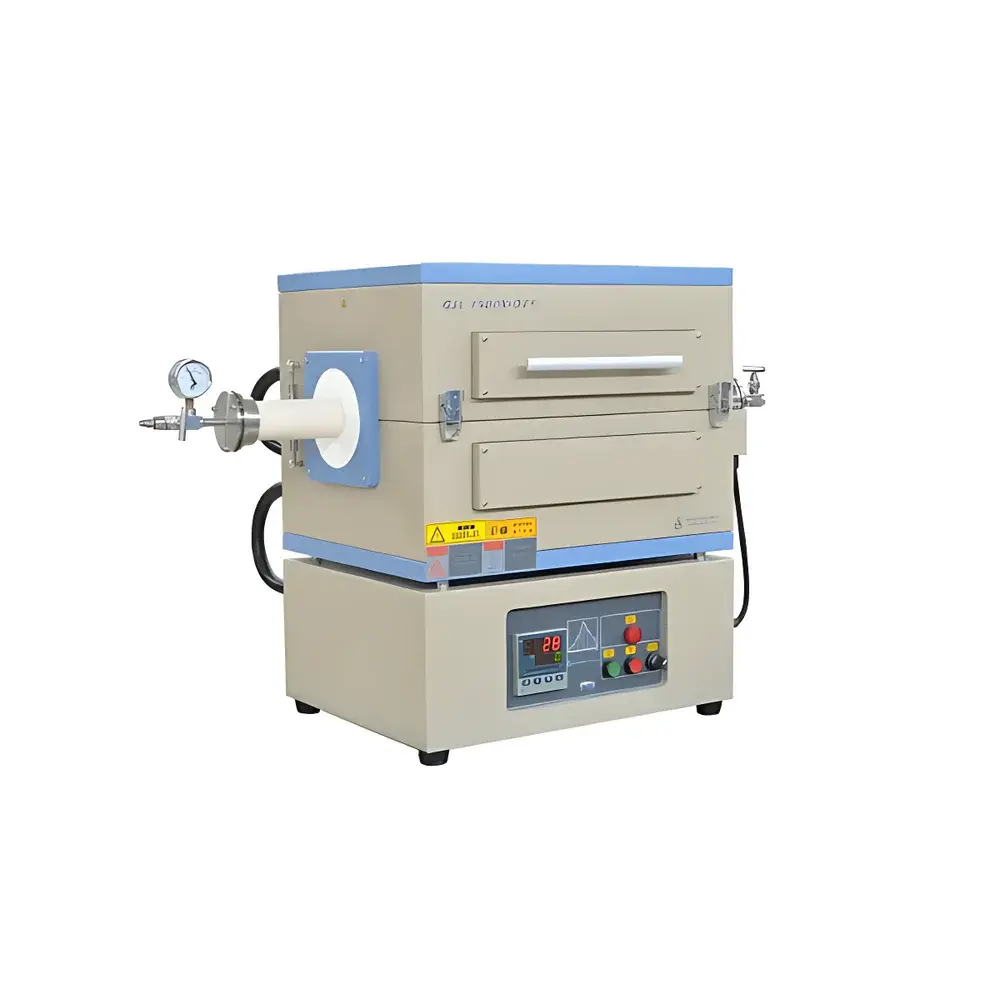
KJ GROUP OTF-1500X Single-Zone Open-End Tube Furnace (1500 °C)
| Brand | KJ GROUP |
|---|---|
| Origin | Liaoning, China |
| Manufacturer Type | Authorized Distributor |
| Country of Origin | China |
| Model | OTF-1500X |
| Voltage | AC 220 V, 50/60 Hz |
| Power Input | 6 kW |
| Tube Material | High-Purity Alumina (Al₂O₃) |
| Standard Tube Dimensions | Ø60 mm OD × Ø53 mm ID × 1000 mm L |
| Optional Tube | Ø80 mm OD × Ø73 mm ID × 1000 mm L |
| Heating Elements | 16 × SiC rods (1500 °C rated), Φ14 mm × 350 mm |
| Thermocouple Type | S-type (Platinum/Rhodium) |
| Heating Zone Length | 390 mm |
| Effective Uniform Temperature Zone | 150 mm (±1 °C) |
| Max Operating Temperature | 1500 °C |
| Continuous Service Temperature | 1400 °C |
| Recommended Ramp Rate | 10 °C/min |
| Temperature Control | PID with 30-segment programmable ramp-soak profile |
| Control Accuracy | ±1 °C |
| Safety Features | Door-interlocked power cutoff, overheat protection, thermocouple break detection |
| Vacuum Performance | 10⁻² torr (with rotary vane pump), 10⁻⁵ torr (with turbomolecular pumping system) |
| Communication Interface | RS485 (PC software optional) |
| Certifications | CE, UL/MET/CSA (for all >24 V components), TÜV/CAS certification available upon customer-requested third-party testing |
Overview
The KJ GROUP OTF-1500X is a precision-engineered single-zone open-end tube furnace designed for high-temperature thermal processing under controlled atmospheres or vacuum conditions. Utilizing silicon carbide (SiC) heating elements and S-type platinum/rhodium thermocouples, it delivers stable, repeatable operation up to 1500 °C—making it suitable for annealing, sintering, crystal growth, precursor decomposition, and solid-state reaction studies in materials science, ceramics, battery electrode development, and catalysis research. Its open-ended configuration enables rapid sample insertion and retrieval, while the integrated flange sealing system—compatible with standard alumina tube end plugs—ensures reliable gas-tight or vacuum-tight operation when paired with appropriate feedthroughs and pressure-rated fittings. The furnace is constructed with dual-layer insulation (high-purity ceramic fiber + reflective aluminum foil) to minimize radial heat loss and improve energy efficiency during extended dwell cycles.
Key Features
- Robust thermal architecture: 16 individually mounted 1500 °C-rated SiC heating rods provide uniform axial heat distribution across a 390 mm heating zone, with a certified ±1 °C uniformity span over 150 mm (measured at centerline under steady-state conditions).
- Advanced process control: 30-segment programmable PID temperature controller supports complex ramp-hold-cool profiles; real-time monitoring and remote parameter adjustment via RS485 interface.
- Integrated safety systems: Automatic power cutoff upon door opening, dual-stage overtemperature cutoff (hardware + software), and thermocouple failure detection prevent uncontrolled thermal excursions.
- Compliance-ready design: All electrical components exceeding 24 V are certified to UL 61010-1, MET, and CSA C22.2 No. 61010-1 standards; full CE marking per EU Machinery Directive 2006/42/EC and EMC Directive 2014/30/EU.
- Modular vacuum compatibility: Factory-configured for integration with mechanical roughing pumps (achieving ≤10⁻² torr) or high-vacuum turbomolecular systems (≤10⁻⁵ torr), supporting inert, reducing, oxidizing, or ultra-high-purity process environments.
Sample Compatibility & Compliance
The OTF-1500X accommodates cylindrical samples up to Ø53 mm (standard tube ID) or Ø73 mm (optional tube), with unrestricted axial access facilitating loading of powder beds, pressed pellets, wire substrates, or crucible-based assemblies. It supports ASTM C1171 (sintering shrinkage), ISO 11507 (UV/weathering preconditioning), and USP (thermal sterilization validation protocols) when operated within validated parameters. For GLP/GMP-regulated laboratories, optional PC-based control software provides audit-trail-capable logging (timestamped temperature, setpoint, ramp rate, alarm events) compliant with FDA 21 CFR Part 11 requirements when deployed with electronic signature modules.
Software & Data Management
An optional Windows-compatible control suite enables full graphical visualization of temperature profiles, real-time data streaming at 1 Hz resolution, and export of .csv/.txt files for post-processing in MATLAB, Python, or statistical analysis platforms. The software supports batch recipe storage, version-controlled program libraries, and automated report generation—including deviation alerts against predefined tolerance bands. All communication adheres to Modbus RTU protocol over RS485, ensuring interoperability with SCADA and MES infrastructure in industrial pilot-scale settings.
Applications
- Solid-state synthesis of Li-ion cathode materials (e.g., NMC, LFP) under Ar/H₂ or O₂ flow
- Graphitization and thermal reduction of graphene oxide films on quartz or silicon wafers
- Thermal calibration of thermocouples and reference materials per ISO/IEC 17025 accredited procedures
- Controlled atmosphere annealing of metal-organic frameworks (MOFs) to tune porosity and stability
- Vacuum-assisted densification of advanced ceramics (SiC, ZrO₂, AlN) without contamination from furnace insulation
- Pre-oxidation treatments for high-temperature alloy coatings prior to plasma spray deposition
FAQ
What maximum pressure differential can the furnace tube withstand?
The standard alumina tube is rated for internal overpressure up to 0.02 MPa (2 bar gauge) when properly sealed with KJ GROUP-supplied end plugs and flange gaskets.
Is the uniform temperature zone verified per ASTM E220?
While not supplied with formal ASTM E220 calibration certificates, the furnace’s ±1 °C uniformity specification is derived from internal mapping using traceable S-type thermocouples; users requiring NIST-traceable validation may request a third-party calibration add-on.
Can the furnace be integrated into an automated glovebox system?
Yes—the open-end configuration and standardized flange dimensions (CF-63 or KF-50 compatible with optional adapters) allow direct coupling to inert-atmosphere gloveboxes with integrated vacuum transfer lines.
Does the controller support analog output for external data acquisition systems?
No analog voltage/current outputs are built-in; however, digital temperature and status data are accessible via RS485 Modbus registers for seamless integration with PLCs or DAQ hardware.
What maintenance intervals are recommended for the SiC heating elements?
Under continuous operation at ≤1400 °C with proper atmosphere control, SiC rods typically maintain nominal resistance for ≥2000 hours; visual inspection and resistance measurement every 500 operating hours are advised to detect early-stage oxidation or cracking.



