
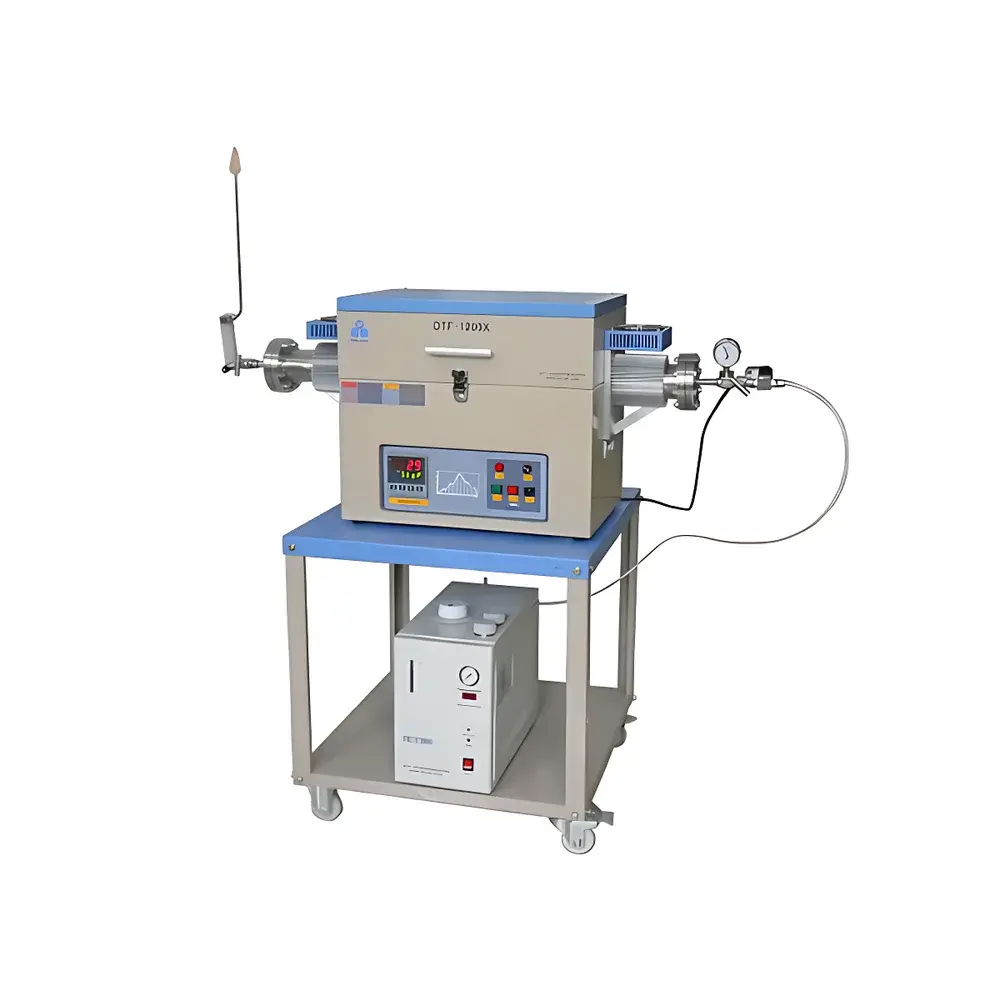
KJ GROUP OTF-1200X-60HG High-Pressure Hydrogen Tube Furnace (1100 °C)
| Brand | KJ GROUP |
|---|---|
| Origin | Liaoning, China |
| Manufacturer Type | Authorized Distributor |
| Country of Origin | China |
| Model | OTF-1200X-60HG |
| Power Supply | AC 220 V, 50/60 Hz, 3 kW |
| Max Temperature | 1100 °C (<1 h) |
| Heating Zone Length | 440 mm |
| Uniform Zone Length | 150 mm |
| Max Ramp Rate | 20 °C/min |
| Temperature Control Accuracy | ±1 °C |
| Tube Dimensions | OD 60 mm × ID 52 mm × L 1000 mm |
| Pressure Rating | 30 PSI (gauge) |
| Vacuum Level | ≤10⁻⁵ torr |
| Cooling | Dual-layer shell with forced-air circulation |
| Safety | Integrated H₂ leak detection (3M sensor), automatic H₂ generator shutoff, over-temperature protection, flame-based H₂ exhaust treatment |
| Certification | CE |
Overview
The KJ GROUP OTF-1200X-60HG is a high-precision, high-pressure horizontal tube furnace engineered for controlled thermal processing under hydrogen-rich atmospheres—specifically designed for applications requiring both elevated temperature stability and stringent gas safety management. Operating up to 1100 °C for short-duration holds (≤1 h), the furnace employs a programmable 30-segment PID temperature controller to deliver reproducible thermal profiles across research-scale synthesis, reduction annealing, catalyst activation, and hydrogenation studies. Its core architecture integrates a seamless nickel-based alloy tube rated for inert, oxidizing, and reducing environments—including sustained operation at 30 PSI gauge pressure in pure H₂—making it suitable for solid-state chemistry, metal hydride formation, and advanced ceramic sintering where redox control is critical. The furnace complies with CE safety directives and incorporates fail-safe engineering: real-time hydrogen concentration monitoring via a certified 3M electrochemical sensor triggers immediate shutdown of the integrated high-purity hydrogen generator upon detection above threshold.
Key Features
- Dual-layer stainless steel housing with active air-cooling system maintains external surface temperature below 60 °C under full-load operation, ensuring operator safety and lab environmental stability.
- High-density alumina microfiber insulation vacuum-formed into rigid chamber walls, combined with U.S.-sourced alumina reflective coating on inner furnace lining, enhances thermal efficiency and minimizes contamination during high-temperature runs.
- CF-flanged end caps enable rapid assembly/disassembly and support ultra-high vacuum compatibility (≤10⁻⁵ torr) or positive-pressure operation up to 30 PSI—validated for use with H₂, Ar, N₂, O₂, and forming gas mixtures.
- Heating zone constructed from Mo-doped Fe–Cr–Al resistance wire with stabilized zirconia coating ensures long-term structural integrity and oxidation resistance at temperatures approaching 1100 °C.
- Integrated safety subsystem includes independent over-temperature cut-off, real-time pressure transduction, and flame-based hydrogen exhaust treatment via 1/4″ SS tubing routed to an external fume hood—eliminating accumulation of unburned H₂ in enclosed spaces.
- Equipped with a calibrated 0–1000 mL/min rotameter for precise gas flow regulation and standardized 6 mm double-ferrule fittings for argon purging and hydrogen supply lines.
Sample Compatibility & Compliance
The OTF-1200X-60HG accommodates standard cylindrical samples up to 50 mm in diameter and 150 mm in length within its 52 mm ID quartz or metallic alloy tube. It supports crucibles made from alumina, graphite, molybdenum, tungsten, and silicon carbide—provided material compatibility with H₂ at elevated temperature is verified per ASTM E2913 or ISO 11146 guidelines. The system meets CE marking requirements for electromagnetic compatibility (EMC Directive 2014/30/EU) and low-voltage safety (LVD Directive 2014/35/EU). While not inherently GLP/GMP-qualified, its programmable controller logs setpoint history and supports optional RS485/Modbus RTU output for integration into validated laboratory information management systems (LIMS) compliant with FDA 21 CFR Part 11 audit trail requirements.
Software & Data Management
Temperature programming is performed locally via the built-in 30-segment digital controller with password-protected parameter editing and real-time deviation display. Optional PC connectivity (via RS485 interface) enables remote monitoring and data logging using third-party SCADA platforms or custom Python-based acquisition scripts. All ramp/soak cycles are timestamped and stored in non-volatile memory; event logs—including alarm triggers (H₂ leak, over-temp, pressure fault)—are retained for post-run analysis. No proprietary software suite is bundled; however, the controller’s Modbus register map is publicly documented to facilitate interoperability with LabVIEW, MATLAB, or industrial PLC environments.
Applications
- Reductive annealing of transition metal oxides (e.g., NiO → Ni, Co₃O₄ → Co) for battery electrode precursor synthesis.
- Hydrogen-assisted sintering of refractory metals and hardmetals under controlled p(H₂) gradients.
- Catalyst pretreatment including sulfidation, carburization, and nitridation under dynamic gas flow regimes.
- Growth of 2D materials (e.g., graphene, TMDs) via chemical vapor deposition (CVD) with H₂ as carrier and etchant.
- Thermal stability testing of hydrogen storage alloys (e.g., MgH₂, NaAlH₄) under isobaric/isothermal conditions.
- Calibration reference furnaces for thermocouple validation per ASTM E230/E230M when operated with traceable Pt/Pt–Rh thermocouples.
FAQ
What cooling water specifications are required?
No external water cooling is needed—the unit uses self-contained air circulation. However, if optional water-cooled flanges are added later, deionized water with conductivity <5 µS/cm and flow rate ≥2 L/min is recommended.
Can the furnace operate continuously at 1100 °C?
No. Continuous operation is rated to 1000 °C. At 1100 °C, dwell time must be limited to ≤60 minutes per cycle to preserve heating element lifetime and thermal insulation integrity.
Is the hydrogen generator included in the base configuration?
Yes—a dedicated high-purity (≥99.999%) electrolytic H₂ generator is factory-integrated and interlocked with the leak detection circuit.
What vacuum pump is recommended for achieving 10⁻⁵ torr?
A two-stage oil-sealed rotary vane pump (e.g., Edwards RV8) paired with a turbomolecular pump (e.g., Pfeiffer HiPace 80) is required; roughing and high-vacuum line components are not supplied.
Does the system support inert gas purging prior to H₂ introduction?
Yes—standard configuration includes dual-gas inlet manifold with manual valves for sequential Ar/N₂ purge followed by H₂ admission, minimizing explosion risk during atmosphere transition.



