
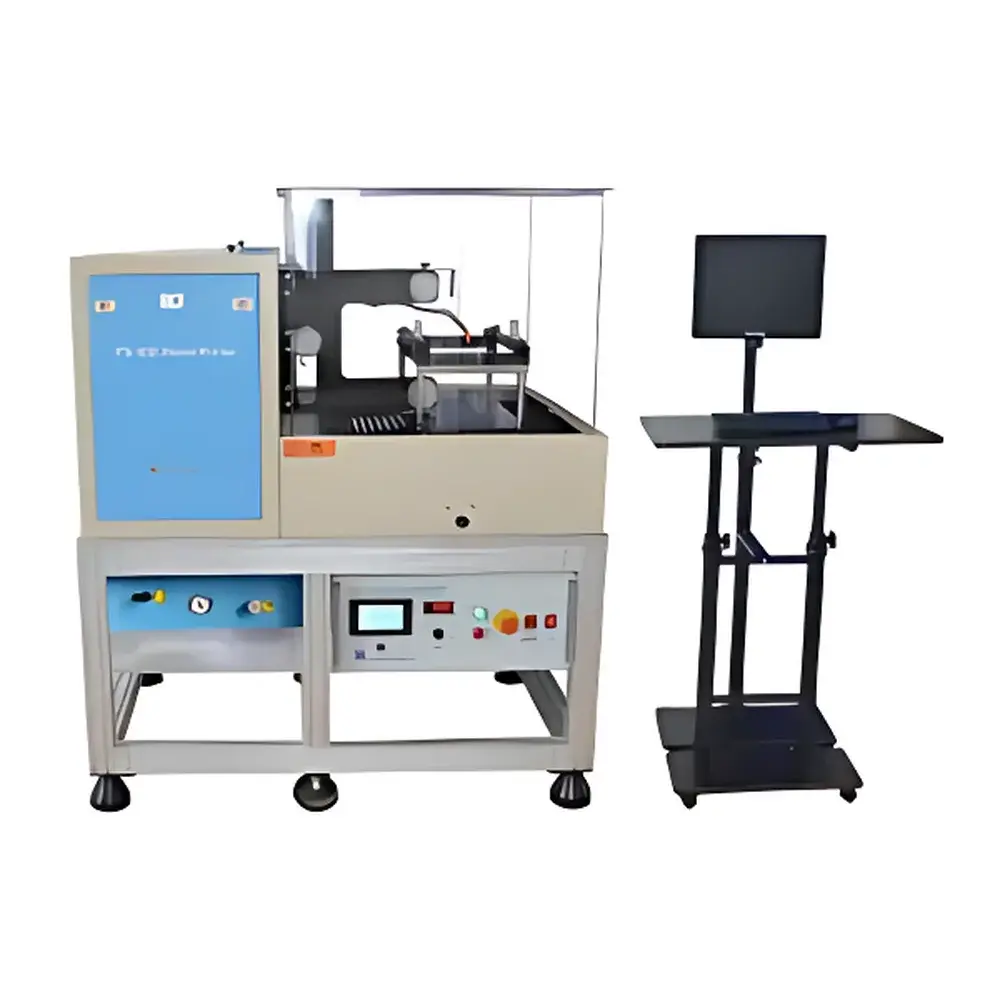
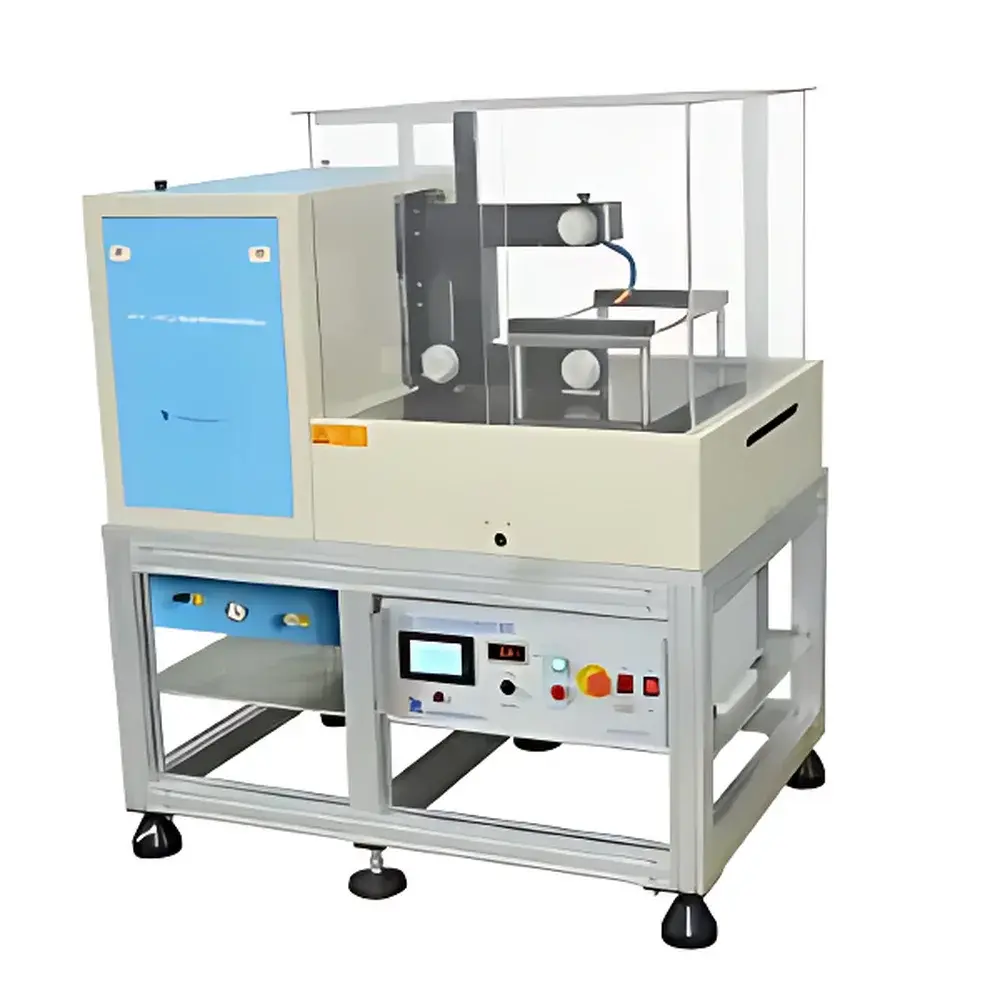
KJ GROUP STX-100QX Diamond Wire Curvilinear Cutting Machine
| Brand | KJ GROUP |
|---|---|
| Origin | Liaoning, China |
| Manufacturer Type | Authorized Distributor |
| Instrument Category | Domestic |
| Model | STX-100QX |
| Instrument Type | Precision Diamond Wire Cutting System |
| X-Axis Travel | 200 mm |
| Y-Axis Travel | 280 mm |
| Max. Cutting Thickness | 120 mm |
| Positioning Accuracy | 0.01 mm |
| Wire Speed | 0–15 m/s |
| X/Y Feed Rate | 0.06–6 mm/min |
| Worktable Dimensions | 220 × 450 mm |
| Max. Sample Dimensions | 200 × 280 × 120 mm |
| Wire Tensioning Method | Pneumatic Tensioning |
Overview
The KJ GROUP STX-100QX Diamond Wire Curvilinear Cutting Machine is a CNC-controlled precision cutting system engineered for non-linear, two-dimensional contour slicing of brittle and high-hardness materials. Unlike conventional straight-line diamond wire saws, the STX-100QX employs a synchronized XY translational stage combined with programmable wire trajectory control—enabling true curvilinear motion along user-defined vector paths. Its operational principle relies on abrasive cutting via tensioned diamond-impregnated stainless steel wire (typically 0.1–0.35 mm diameter), where material removal occurs through mechanical abrasion under controlled feed rate, wire speed, and coolant flow. This architecture delivers sub-10 µm kerf widths and surface roughness (Ra) typically < 1.6 µm on ceramics and single crystals—critical for preparing specimens for tensile testing, microstructural analysis, TEM lamella pre-thinning, and optical characterization. Designed for laboratory-scale R&D and quality assurance workflows, the system supports reproducible sectioning of high-value, low-tolerance samples without thermal damage or subsurface cracking.
Key Features
- CNC-driven XY stage with 0.01 mm resolution positioning and repeatability ±0.02 mm over full travel (200 mm × 280 mm)
- Pneumatically regulated wire tension system ensuring consistent cutting force across variable load conditions and extended operation cycles
- Adjustable wire speed range (0–15 m/s) optimized for material-specific removal rates—e.g., slower speeds (1–3 m/s) for brittle infrared crystals; higher speeds (8–12 m/s) for polycrystalline metals and composites
- Programmable feed rate (0.06–6 mm/min) enabling fine control over material removal depth per pass—essential for minimizing chipping in laminated or anisotropic substrates
- Integrated coolant delivery system with adjustable flow and directional nozzles to suppress heat generation and evacuate debris from the kerf zone
- Modular worktable (220 × 450 mm) accommodating fixtures for vacuum chucks, custom jigs, and 3D precision clamping accessories (e.g., STX-100QX 3D Precision Fixture, optional)
Sample Compatibility & Compliance
The STX-100QX accommodates a broad spectrum of inorganic and composite materials with Vickers hardness up to ~25 GPa—well below diamond’s ~70–100 GPa—ensuring effective abrasive cutting without premature wire wear. Verified compatibility includes technical ceramics (Al2O3, ZrO2, SiC), semiconductor wafers (Si, Ge, GaAs), optical crystals (sapphire, CsI, ZnS, ZnSe), geological specimens (granite, basalt, meteorites), biomedical hard tissues (cortical bone, dental enamel, calcified implants), and fiber-reinforced composites (CFRP, GFRP). All cutting protocols adhere to ASTM C1327-22 (Standard Test Method for Vickers Indentation Hardness of Advanced Ceramics) and ISO 4527:2021 (Metallic coatings — Electrodeposited coatings of nickel, cobalt and their alloys) for specimen geometry fidelity. The machine’s mechanical design conforms to IEC 61000-6-2 (EMC immunity) and IEC 61000-6-4 (EMC emission) standards; electrical safety complies with GB/T 5226.1–2019 (equivalent to EN 60204-1).
Software & Data Management
Control is executed via proprietary Windows-based CNC software supporting DXF/SVG import for direct vector path translation. Users define closed-loop 2D contours—including ellipses, airfoils, asymmetric polygons, and Bézier curves—with real-time preview of toolpath, estimated cycle time, and kerf compensation offset. The software logs timestamped operational parameters (wire speed, feed rate, tension pressure, coolant status) with CSV export capability. Audit trails include operator ID, job name, start/stop timestamps, and error codes—supporting GLP-compliant documentation per FDA 21 CFR Part 11 when deployed with networked authentication and electronic signature modules (optional configuration). No cloud connectivity is embedded; all data remains local unless interfaced externally via Ethernet or USB.
Applications
- Preparation of ASTM E8/E21-compliant tensile test coupons from monolithic ceramics and intermetallics
- Sectioning of geological thin sections (30–50 µm) for petrographic microscopy and SEM-EDS phase mapping
- Fabrication of IR-transmissive windows and lens blanks from ZnS, ZnSe, and Ge crystals with minimal subsurface damage
- Extraction of histologically intact bone–implant interface specimens for push-out testing and backscattered electron imaging
- Isolation of thermoelectric leg segments (Bi2Te3, PbTe) with preserved grain boundary integrity for Seebeck coefficient measurement
- Cutting of additively manufactured Ni-based superalloy components for residual stress analysis via synchrotron XRD
FAQ
What materials are incompatible with the STX-100QX?
Materials exceeding ~28 GPa Vickers hardness—such as cubic boron nitride (c-BN), polycrystalline diamond compacts (PDC), or tungsten carbide with >94% WC content—are not recommended due to accelerated wire wear and inconsistent kerf geometry.
Can the machine perform multi-pass profiling or tapered cuts?
No. The STX-100QX executes planar 2D contour cuts only; Z-axis vertical movement is fixed. Tapered or 3D-profiled cuts require post-processing on a CNC milling or EDM system.
Is coolant type specified or user-selectable?
Deionized water or water-soluble synthetic coolants (e.g., Blaser Swisslube Vasco 700 series) are recommended. Oil-based coolants are prohibited due to pump and seal compatibility constraints.
What is the typical wire lifetime under standard operating conditions?
With proper tensioning, coolant flow, and feed optimization, a 0.25 mm diamond wire achieves 8–12 hours of cumulative cutting time on medium-hardness ceramics (e.g., Al2O3) before requiring replacement.
Does the system support automated batch processing?
Yes—via script-based job queuing within the CNC software. Up to 99 sequential contours can be queued with independent parameter sets per job, enabling unattended overnight operation under supervised lab conditions.



