
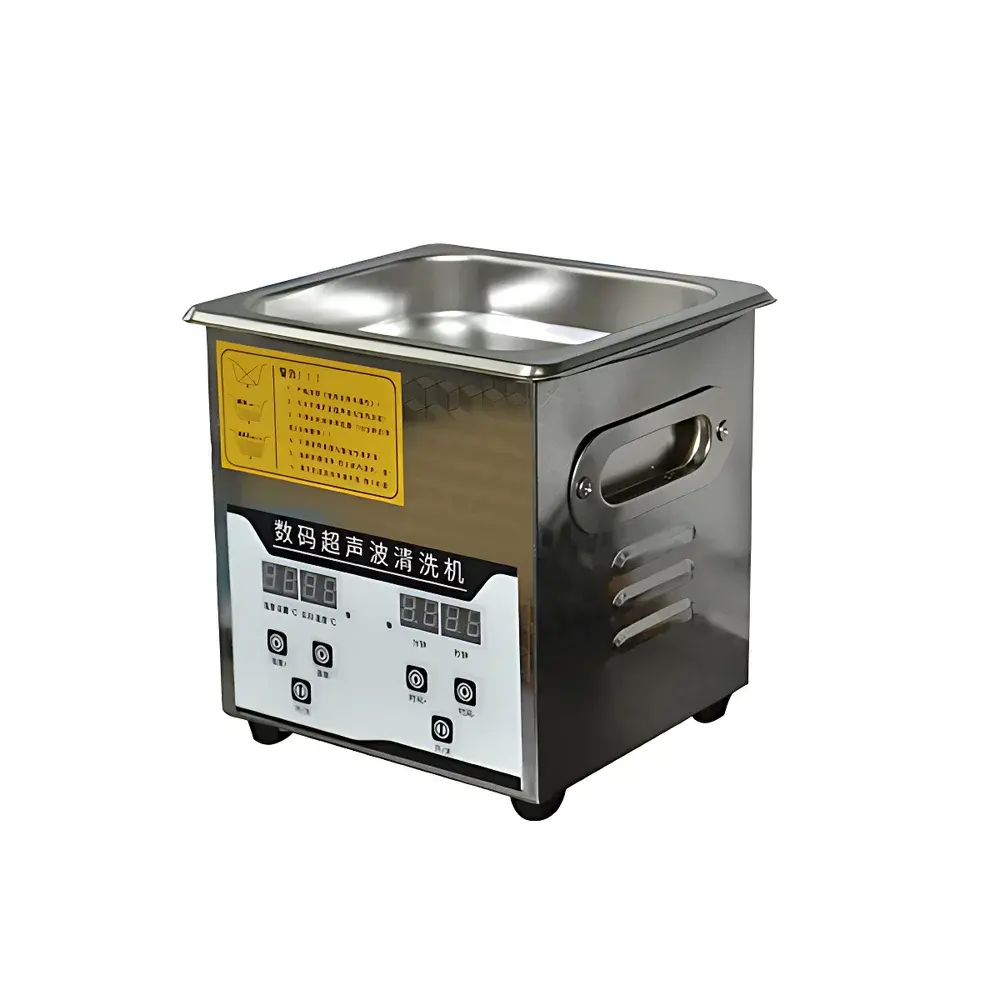
KJ GROUP VGT-1620QTD Benchtop Ultrasonic Cleaner
| Brand | KJ GROUP |
|---|---|
| Origin | Liaoning, China |
| Model | VGT-1620QTD |
| Capacity | 2000 mL |
| Ultrasonic Frequency | 25 kHz or 40 kHz |
| Ultrasonic Power | 60 W |
| Adjustable Power | No |
| Adjustable Temperature | Yes (RT to 80 °C) |
| Adjustable Timer | Yes |
| Sound-Dampening Lid | Included |
| Drain/Inlet | Manual Control |
| Dimensions (W×D×H) | 190 × 170 × 220 mm |
| Weight | < 1 kg |
| Tank Material | One-Piece Drawn Stainless Steel (304) |
| Tank Internal Dimensions | 150 × 140 × 100 mm |
| Power Supply | 220 V, 50 Hz |
Overview
The KJ GROUP VGT-1620QTD is a compact, benchtop ultrasonic cleaner engineered for precision cleaning of delicate and complex-surface components in research laboratories, quality control environments, and small-scale industrial settings. It operates on the principle of acoustic cavitation: high-frequency ultrasonic energy (selectable at 25 kHz or 40 kHz) generates microscopic vacuum bubbles in the cleaning solution; their rapid implosion produces localized shockwaves and microstreaming that dislodge particulate contaminants, organic residues, oils, and biofilms from surfaces—without mechanical abrasion or surface damage. Designed for reproducible, non-destructive cleaning of intricate geometries—including blind holes, crevices, and microstructures—the VGT-1620QTD delivers consistent cleaning performance across diverse sample types while maintaining strict thermal and temporal control.
Key Features
- Benchtop form factor (190 × 170 × 220 mm) optimized for space-constrained labs and cleanroom-compatible workstations.
- One-piece drawn stainless steel (grade 304) tank with seamless construction eliminates weld seams—enhancing corrosion resistance, structural integrity, and leak prevention.
- Integrated stainless steel mesh basket with argon arc welding ensures uniform part suspension and maximizes cavitation exposure during immersion.
- Dual-frequency operation (25 kHz for heavy particulate removal; 40 kHz for fine-detail cleaning of optics, microelectronics, and precision instruments).
- Digitally controlled heating system with adjustable setpoint from ambient temperature (RT) up to 80 °C—enabling thermally assisted cleaning of waxy, greasy, or viscous residues.
- Programmable digital timer (0–30 min range) with automatic shutdown upon cycle completion—supporting unattended operation and protocol standardization.
- Acoustically insulated lid reduces operational noise and minimizes solvent evaporation during heated cycles.
- Manual inlet and drain ports allow flexible integration with deionized water systems or solvent recovery setups.
Sample Compatibility & Compliance
The VGT-1620QTD is validated for use with aqueous solutions, mild alkaline detergents, and low-volatility solvents compatible with stainless steel and common lab plastics (e.g., PTFE, PP, PC). It supports cleaning of optical lenses, semiconductor wafers, surgical instruments, watch movements, jewelry, printed circuit boards (PCBs), ceramic substrates, and biological sample holders. While not certified to IEC 61000-6-3 (EMC) or ISO 13485 out-of-the-box, its design aligns with general laboratory safety practices per ISO/IEC 17025:2017 clause 6.4 (equipment suitability) and supports GLP-compliant documentation when paired with external logging tools. Heating and timing functions are traceable via front-panel display, enabling basic audit readiness for internal SOPs.
Software & Data Management
The VGT-1620QTD features an embedded microcontroller-based interface with LED display and tactile membrane buttons—no external software or PC connectivity required. All operational parameters (temperature setpoint, timer duration, frequency selection) are retained in non-volatile memory across power cycles. Though it lacks USB/Ethernet interfaces or FDA 21 CFR Part 11-compliant electronic records, its manual operation mode permits full integration into paper-based or LIMS-linked workflows where user-defined protocols are logged externally. For regulated environments, time/temperature logs can be manually recorded or captured via external data loggers interfaced with the unit’s analog temperature output (optional accessory).
Applications
- Pre-analytical sample preparation: removal of fingerprints, dust, and processing residues from microscope slides, cuvettes, and NMR tubes.
- Electronics manufacturing: post-solder flux cleaning of SMT assemblies and MEMS devices prior to inspection or packaging.
- Pharmaceutical R&D: cleaning of glass vials, syringe barrels, and stainless-steel contact parts in formulation development labs.
- Materials science: degassing of nanoparticle suspensions and dispersion media prior to rheological or DLS characterization.
- Jewelry and optics servicing: non-abrasive restoration of anti-reflective coatings and gemstone settings without surface pitting.
- Academic teaching labs: hands-on demonstration of cavitation physics, cleaning kinetics, and parameter optimization (frequency vs. particle size, temperature vs. surfactant efficacy).
FAQ
What cleaning solutions are compatible with the VGT-1620QTD?
Aqueous alkaline detergents (pH 9–11), ethanol/water mixtures, and isopropanol are commonly used. Avoid strong acids, halogenated solvents, or solutions exceeding 80 °C.
Can the unit operate continuously for extended periods?
Yes—designed for intermittent duty cycles (up to 30 min per session); allow ≥10 min cooldown between consecutive runs to maintain transducer longevity.
Is the stainless steel tank suitable for ultrasonic cleaning with sodium hydroxide solutions?
Grade 304 stainless steel provides adequate resistance to dilute NaOH (<5% w/v) below 60 °C; prolonged exposure above this threshold may accelerate etching.
Does the unit include a degassing function?
No dedicated degas mode is provided, but initiating the ultrasonic cycle for 1–2 minutes before loading samples effectively removes dissolved air from the bath.
How is temperature accuracy verified and maintained?
The built-in PT100 sensor is factory-calibrated; users may verify accuracy using a traceable NIST-certified thermometer immersed at the tank center.
Related Products



