
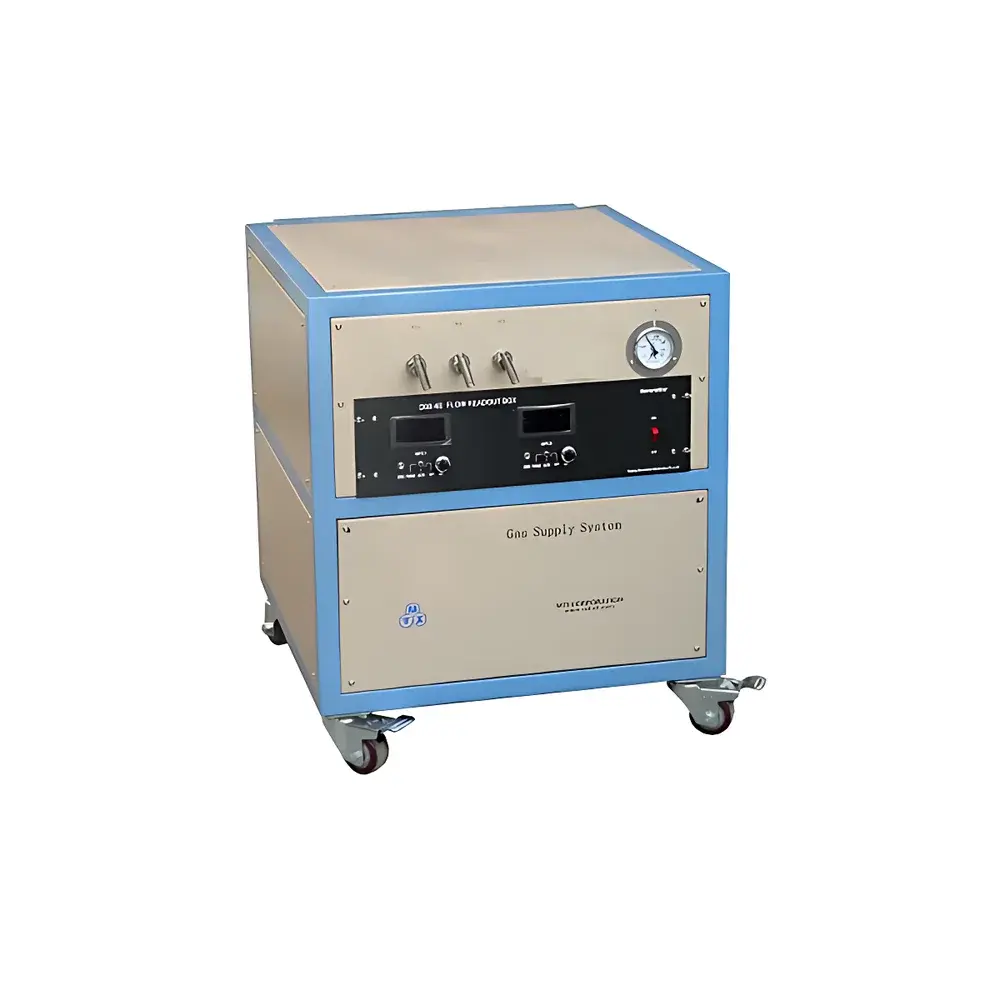
KJ GROUP GSL-2Z Dual-Channel Mass Flow Controlled Gas Mixing System
| Brand | KJ GROUP |
|---|---|
| Origin | Liaoning, China |
| Manufacturer Type | Authorized Distributor |
| Country of Origin | China |
| Model | GSL-2Z |
| Pricing | Available Upon Request |
| Power Supply | 185–245 VAC, 50 Hz |
| Max. Output Power | 18 W |
| Flow Control Range | Channel 1: 1–199 SCCM |
| Channel 2 | 1–499 SCCM |
| Max. Operating Pressure | 3 MPa (3 × 10⁶ Pa) |
| Accuracy | ±1% FS |
| Linearity | ±0.5–1.5% FS |
| Repeatability | ±0.2% FS |
| Response Time | Gas Dynamic: 1–4 s |
| Electrical | ≤10 s |
| Needle Valve Material | 316 Stainless Steel |
| Operating Pressure Differential | 0.1–0.5 MPa |
| Vacuum/Pressure Gauge Range | –0.1 to +0.15 MPa (0.01 MPa per division) |
| Mixing Chamber Dimensions | Ø80 mm × 120 mm |
| Shut-off Valve | 1/4″ BSP, 316 Stainless Steel |
| Ambient Operating Temperature | 5–45 °C |
| Overall Dimensions (W × D × H) | 600 × 600 × 650 mm |
Overview
The KJ GROUP GSL-2Z Dual-Channel Mass Flow Controlled Gas Mixing System is an engineered solution for precise, independent regulation and blending of two process gases in vacuum-compatible thermal environments—particularly tube furnaces used in chemical vapor deposition (CVD), annealing, oxidation, and thin-film synthesis. Built upon dual thermal mass flow controllers (MFCs), the system delivers stable, repeatable gas delivery under variable pressure conditions—from high vacuum (<10⁻³ mbar) up to 3 MPa absolute—enabling controlled reactive atmospheres essential for materials science research and semiconductor process development. Its modular architecture integrates seamlessly with standard horizontal tube furnaces via a dedicated mobile cart platform, allowing synchronized positioning of gas delivery hardware and furnace assembly. The system operates on fundamental principles of thermal dispersion sensing, where gas-specific heat capacity and flow-induced temperature differentials are converted into calibrated volumetric flow rates (SCCM) referenced to NTP (0 °C, 1 atm, dry gas). This ensures traceable, gas-type-compensated measurement across common process gases including N₂, Ar, O₂, H₂, NH₃, SiH₄, and forming gas mixtures.
Key Features
- Dual independent thermal mass flow controllers with full-scale ranges of 1–199 SCCM (Channel 1) and 1–499 SCCM (Channel 2), each factory-calibrated for specified gases and traceable to NIST standards.
- Robust 316 stainless steel fluidic path—including needle valves, shut-off valves, and mixing chamber—rated for continuous operation at up to 3 MPa and compatible with aggressive chemistries and ultra-high-purity applications.
- Integrated vacuum/pressure gauge with dual-range capability (–0.1 to +0.15 MPa) featuring 0.01 MPa resolution, enabling real-time monitoring of chamber backpressure during dynamic gas switching or pump-down sequences.
- Compact, benchtop-ready mobile cart (600 × 600 × 650 mm) with casters and leveling feet; designed to support standard tube furnaces while maintaining ergonomic access to front-panel controls and visual indicators.
- Front-panel analog dials and digital LED displays for instantaneous flow rate verification, eliminating reliance on external software during routine operation—critical for GLP-compliant lab workflows.
- Electrical response time ≤10 s and gas-dynamic response of 1–4 s ensure rapid stabilization after setpoint changes, supporting pulsed gas delivery protocols required in ALD and plasma-enhanced CVD processes.
Sample Compatibility & Compliance
The GSL-2Z is compatible with inert, oxidizing, reducing, and mildly corrosive gases commonly employed in solid-state synthesis and microelectronics fabrication. It supports gas mixtures used in ASTM F1950 (silicon wafer cleaning), ISO 14644-1 (cleanroom process gas purity), and SEMI F57 (gas delivery system qualification). All wetted components meet USP Class VI biocompatibility requirements and are passivated per ASTM A967. While not intrinsically rated for hazardous area use, the system complies with IEC 61000-6-3 (EMC emissions) and IEC 61000-6-2 (immunity), and its electrical design conforms to IEC 61010-1 for laboratory equipment safety. Documentation includes material certifications (EN 10204 3.1), calibration certificates (with uncertainty budgets), and CE marking per Machinery Directive 2006/42/EC.
Software & Data Management
The GSL-2Z operates in standalone mode without mandatory software dependency. However, optional RS-485 (Modbus RTU) or analog 0–5 VDC outputs enable integration into centralized process control systems (e.g., LabVIEW, DeltaV, or Siemens PCS7). When connected, logged data—including timestamped flow values, pressure readings, and valve status—can be archived in CSV or SQL formats compliant with FDA 21 CFR Part 11 requirements when paired with validated electronic lab notebooks (ELNs) or LIMS platforms. Audit trails, user access levels, and electronic signatures are enforced at the host system layer; the GSL-2Z itself provides deterministic analog output linearity and stable zero-point drift (<0.05% FS/month), ensuring long-term data integrity.
Applications
- CVD and PECVD reactor feed systems for graphene, MoS₂, and perovskite thin-film growth.
- Controlled-atmosphere annealing of metal oxides, nitrides, and battery electrode materials (e.g., LiCoO₂, NMC).
- Gas-phase doping and surface functionalization in nanomaterial synthesis (carbon nanotubes, quantum dots).
- Calibration reference gas generation for FTIR, Raman, and residual gas analyzers (RGAs).
- Process validation studies requiring reproducible gas ratios under vacuum or elevated pressure (e.g., catalyst testing per ISO 10012).
- Education and training platforms in university cleanroom labs and semiconductor process courses.
FAQ
Does the GSL-2Z support custom gas calibrations beyond factory-default gases?
Yes—KJ GROUP provides optional recalibration services for non-standard gases (e.g., Cl₂, BF₃, WF₆) using certified reference standards and traceable flow benches. Custom calibration certificates include gas-specific K-factors and expanded uncertainty statements.
Can the system operate continuously at maximum pressure (3 MPa) and full flow simultaneously?
Yes—the fluidic design and 316SS valve train are pressure-rated for continuous service at 3 MPa across the full flow range. Thermal derating is not required below 45 °C ambient.
Is the mixing chamber heated or insulated?
No—the Ø80 × 120 mm stainless steel mixing chamber is unheated and ambient-temperature stabilized. For condensable or low-dew-point gases, optional trace-heating jackets (0–150 °C) are available as add-on modules.
What maintenance intervals are recommended for long-term accuracy?
Annual verification against primary flow standards is recommended. Needle valves require biannual cleaning with IPA and ultrasonic bath; MFC sensors should be zero-checked monthly using closed-loop purge procedures per ISO 4064-2.
Are replacement MFC modules field-swappable?
Yes—each MFC is housed in a standardized DIN-rail mount with plug-and-play electrical and pneumatic interfaces. Swapping requires no firmware reconfiguration or recalibration if using identical part-number modules.



