
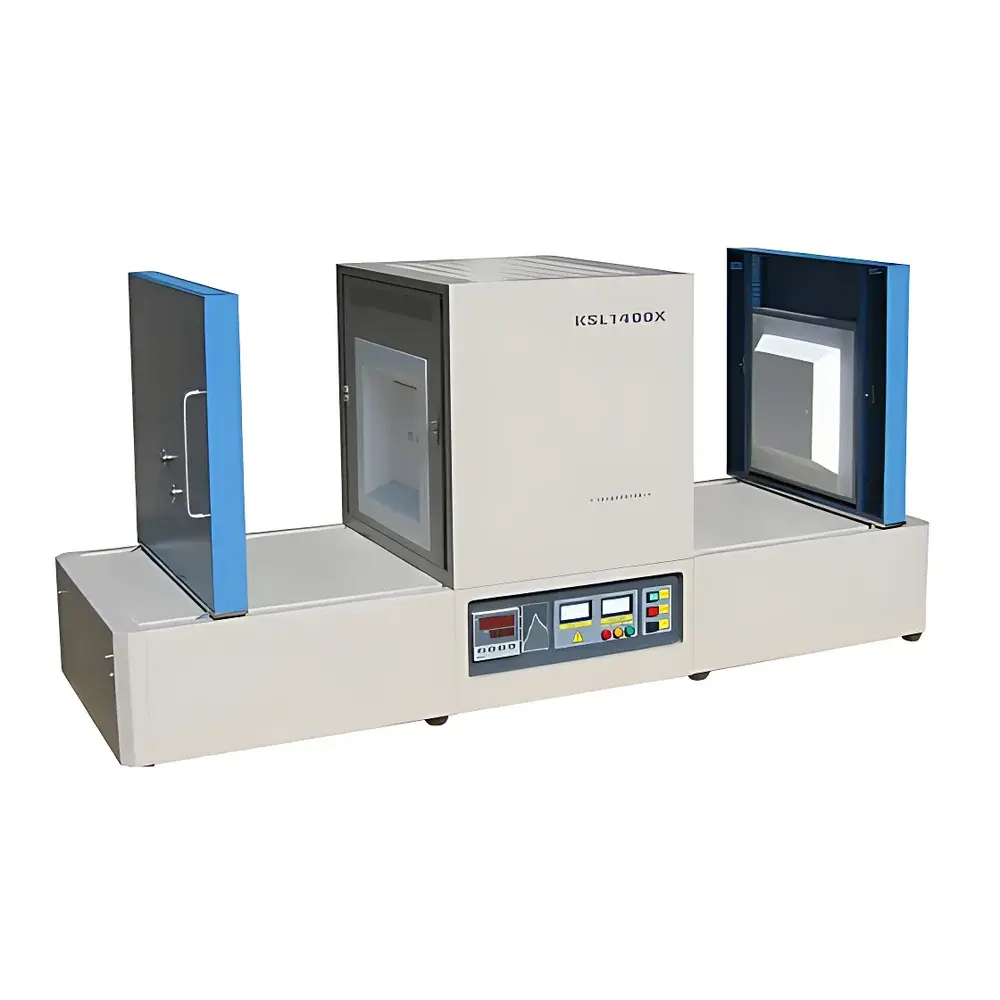
KJ GROUP KSL-1400X Track-Mounted Box Furnace
| Brand | KJ GROUP |
|---|---|
| Origin | Anhui, China |
| Model | KSL-1400X |
| Maximum Temperature | 1400 °C |
| Temperature Control Accuracy | ±1 °C |
| Rated Power | 5 kW |
| Heating Rate (to Max Temp) | 10 °C/min |
| Heating Element | Silicon Carbide Rods |
| Internal Chamber Dimensions | 250 mm × 250 mm × 300 mm |
| Chamber Configuration | Dual-Side Sliding Track Doors |
| Control System | 30-Stage Programmable PID Controller with S-Type Platinum-Rhodium Thermocouple |
| Power Supply | AC 220 V / 50 Hz |
| Net Weight | 120 kg |
| Overall Dimensions | 1800 mm × 600 mm × 840 mm |
Overview
The KJ GROUP KSL-1400X Track-Mounted Box Furnace is a high-temperature laboratory furnace engineered for precise thermal processing in materials science, ceramics, metallurgy, and advanced powder synthesis applications. Designed around a robust refractory chamber and silicon carbide (SiC) heating elements, it delivers stable, uniform temperature distribution across its 250 mm × 250 mm × 300 mm usable workspace. The furnace operates up to a maximum temperature of 1400 °C, with a continuous working temperature limit of 1300 °C—optimized for long-term thermal stability and repeatable heat treatment cycles. Temperature regulation is achieved via an S-type (Platinum-10% Rhodium / Platinum) thermocouple integrated with a 30-stage programmable PID controller (708P series), enabling complex multi-step thermal profiles with ramp/soak sequences. Its dual-side sliding track door configuration minimizes heat loss during sample loading/unloading and improves ergonomic access—particularly valuable in glovebox-integrated workflows or sequential sintering protocols.
Key Features
- Dual-track sliding door mechanism: Enables simultaneous access from both left and right sides without compromising structural integrity or thermal insulation.
- Silicon carbide rod heating system: Offers rapid thermal response, extended service life under cyclic operation, and resistance to oxidation at elevated temperatures.
- 30-segment programmable temperature control: Supports custom heating/cooling ramps, dwell times, and cooling rate modulation—essential for controlled crystallization, annealing, and calcination processes.
- High-accuracy S-type thermocouple (IEC 60584-1 Class 1): Ensures traceable, NIST-compatible temperature measurement within ±1 °C over the full operating range.
- Refractory ceramic fiber insulation: Provides low thermal mass, fast heat-up, and energy-efficient operation while maintaining external surface temperatures below 60 °C at maximum setpoint.
- Integrated safety architecture: Includes over-temperature protection (independent limit controller), automatic power cutoff on door opening, and ground-fault circuit interruption (GFCI) compliance.
Sample Compatibility & Compliance
The KSL-1400X accommodates standard crucibles (alumina, quartz, graphite, and molybdenum), ceramic setters, and substrate carriers up to 230 mm × 230 mm × 280 mm. It is routinely deployed in ASTM C1171 (ceramic sintering), ISO 11843 (thermal stability testing), and GB/T 16534 (Chinese national standard for high-temperature furnaces). While not certified for GMP or FDA 21 CFR Part 11 environments out-of-the-box, its programmable logic, audit-ready temperature logs (via optional RS485/Modbus interface), and deterministic thermal profiles support GLP-aligned documentation when paired with validated data acquisition systems.
Software & Data Management
The furnace’s embedded 708P controller supports local parameter configuration and real-time monitoring via front-panel LCD. For centralized lab integration, optional communication modules enable RS485 Modbus RTU connectivity to SCADA platforms or LIMS systems. Temperature profiles and event logs—including ramp deviations, soak duration, and fault codes—are timestamped and exportable as CSV files. When interfaced with third-party software (e.g., LabVIEW or custom Python-based DAQ), the system supports automated calibration verification, statistical process control (SPC) charting, and electronic batch record generation compliant with ALCOA+ principles.
Applications
- Sintering of oxide and non-oxide ceramics (e.g., Al₂O₃, SiC, ZrO₂)
- Heat treatment of metallic alloys and intermetallic compounds
- Thermal decomposition and precursor calcination in battery cathode material synthesis
- Pre-oxidation of carbon-based composites
- Residue ashing and gravimetric analysis per AOAC 923.03 and EPA Method 3010A
- Calibration reference furnace for secondary thermocouple validation (up to 1300 °C)
FAQ
What is the recommended maintenance interval for silicon carbide heating rods?
Silicon carbide rods typically require inspection every 200–300 operating hours above 1200 °C; replacement is advised when resistance increases by >20% or visible cracking occurs.
Can the furnace be operated under inert or reducing atmospheres?
Yes—when equipped with optional quartz or alumina tube inserts and gas inlet/outlet ports, it supports N₂, Ar, H₂/N₂ mixtures, and vacuum down to 10⁻² mbar (with external pump). Sealed configurations require modified door gaskets and pressure-rated viewports.
Is the 30-stage program memory retained after power loss?
Yes—the controller retains all programmed profiles and setpoints in non-volatile memory; no reconfiguration is needed following unexpected shutdown.
What certifications does the KSL-1400X carry?
It complies with IEC 61000-6-3 (EMC emission standards) and IEC 61000-6-2 (immunity), and meets CE marking requirements for laboratory equipment under Directive 2014/35/EU (LVD) and 2014/30/EU (EMC).
How is temperature uniformity validated within the chamber?
Uniformity is characterized per ASTM E2203 using a 5-point thermocouple mapping protocol at 1000 °C and 1300 °C; typical deviation across the hot zone is ≤±5 °C at steady state.



