
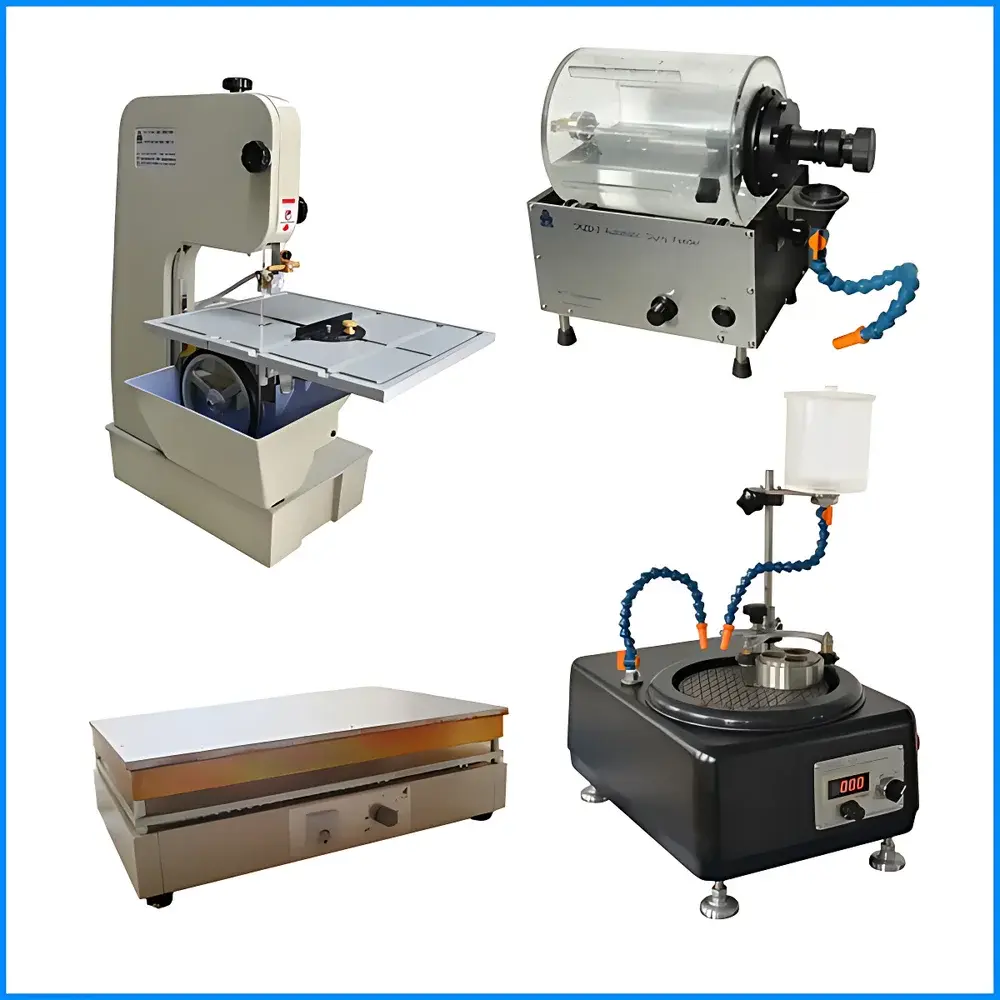
KJ GROUP KJ-BrittleMate Series Integrated Processing System for Glass, Crystals & Ceramics
| Brand | KJ GROUP |
|---|---|
| Origin | Liaoning, China |
| Manufacturer Type | Authorized Distributor |
| Country of Origin | China |
| Model | KJ-BrittleMate Series |
| Price | Upon Request |
Overview
The KJ GROUP KJ-BrittleMate Series Integrated Processing System is an entry-tier, laboratory-scale platform engineered for the precise sectioning, mounting, and surface preparation of brittle inorganic materials—including optical glasses, single crystals (e.g., quartz, sapphire, LiNbO₃), technical ceramics (Al₂O₃, SiC, ZrO₂), geological specimens, and advanced electronic substrates. Designed around core principles of mechanical material removal under controlled kinematic constraints, the system integrates four functionally coordinated modules: diamond band saw cutting (SYJ-D2000), thermoplastic mounting via wax bonding (KJML heating stage), automated abrasive delivery (SKZD-2 dropper), and precision lapping & polishing (UNIPOL-810). Each unit operates within defined force, speed, and thermal regimes to minimize subsurface damage—critical for preserving crystallographic integrity, minimizing microcrack propagation, and achieving surface finishes suitable for subsequent SEM imaging, XRD analysis, or optical characterization. The system adheres to fundamental metrological practices for sample preparation workflows, supporting reproducible cross-sectional geometry and planarization across heterogeneous brittle matrices.
Key Features
- Semi-automated diamond band saw (SYJ-D2000) with adjustable tilt (±15°) and curved-cut capability, enabling non-perpendicular sectioning for cleavage plane exposure or oblique interface analysis;
- KJML heated mounting station featuring a 400 mm × 280 mm uniform-temperature aluminum plate (operating range: ambient to 120 °C), optimized for low-viscosity paraffin wax bonding without thermal shock to temperature-sensitive crystals;
- SKZD-2 programmable abrasive dropper delivering consistent slurry flow (adjustable 0.1–5 mL/min) during lapping, reducing operator variability and improving particle distribution uniformity on the polishing pad;
- UNIPOL-810 dual-axis precision lapping/polishing system with independent control of platen rotation (0–300 rpm), carrier rotation (0–200 rpm), and downforce (0–50 N), supporting both fixed-abrasive and loose-abrasive protocols;
- Modular architecture permitting individual unit calibration and maintenance—fully compliant with ISO/IEC 17025 traceability requirements when paired with certified reference standards;
- Compact footprint (<1.2 m² total), CE-marked electrical safety compliance, and integrated coolant management for dust suppression and thermal stability.
Sample Compatibility & Compliance
The KJ-BrittleMate Series accommodates specimens up to 200 mm in diameter or length and thicknesses ranging from 0.5 mm to 60 mm. It supports mounting of anisotropic crystals (e.g., calcite, KDP), low-fracture-toughness glasses (e.g., borosilicate, fused silica), porous ceramics, and multi-layer composites. All processing steps align with ASTM E3–22 (Standard Guide for Preparation of Metallographic Specimens) and ISO 14577–1:2022 (Metallic materials — Instrumented indentation test), adapted for non-metallics through empirical validation. Wax mounting meets ASTM C1327–21 criteria for temporary bonding media in ceramic microstructure analysis. No hazardous solvents or high-pressure gas systems are required—ensuring compatibility with standard university and industrial lab infrastructure.
Software & Data Management
While the base configuration operates via analog controls and manual parameter setting, optional digital upgrades include UNIPOL-810’s embedded controller with USB data logging (rpm, load, time stamp) and SYJ-D2000’s incremental angle encoder output. Raw operational logs may be exported in CSV format for integration into LIMS environments. The system supports GLP-aligned documentation: each sample batch can be assigned a unique ID; process parameters (cutting speed, heating duration, lapping time, slurry type) are manually recorded in standardized lab notebooks per 21 CFR Part 11 Annex 11 guidelines. Audit trails remain operator-maintained but structurally compatible with electronic signature-ready platforms.
Applications
- Cross-sectional preparation of optical waveguide devices prior to near-field scanning optical microscopy (NSOM);
- Thin-section fabrication of mineralogical samples for transmitted-light petrographic analysis;
- Surface planarization of piezoelectric wafers before electrode deposition or dicing;
- Controlled fracture surface generation for SEM-based crack-tip morphology studies in structural ceramics;
- Routine QC sample prep for hardness testing (Vickers/Knoop) on tempered glass or sintered alumina;
- Preparation of TEM lamellae precursors via sequential low-force lapping—enabling site-specific FIB lift-out.
FAQ
What types of abrasives are compatible with the UNIPOL-810 module?
Silicon carbide, aluminum oxide, diamond suspensions (0.25–30 µm), and colloidal silica are routinely used. Slurry viscosity must remain below 150 cP for reliable SKZD-2 delivery.
Can the SYJ-D2000 cut curved profiles in fused quartz without chipping?
Yes—when operated at ≤150 rpm with constant coolant flow and feed rate <0.1 mm/s, sub-50 µm edge chipping is consistently achieved on 10-mm-thick specimens.
Is the KJML heating platform calibrated to NIST-traceable standards?
Factory calibration is performed using PT100 sensors with ±0.5 °C accuracy; end users may perform field verification with Class A thermocouples per ISO/IEC 17025 Section 6.6.
Does the system support automated recipe recall?
Not natively—but external PLC interfacing is supported via RS-485 ports on UNIPOL-810 and SYJ-D2000 for integration into centralized lab automation networks.
What is the typical surface roughness (Ra) achievable after full UNIPOL-810 polishing?
Using 1 µm diamond followed by 0.05 µm colloidal silica on pitch pads, Ra values of 0.8–1.2 nm are reproducibly attained on single-crystal silicon and BK7 glass substrates.



