
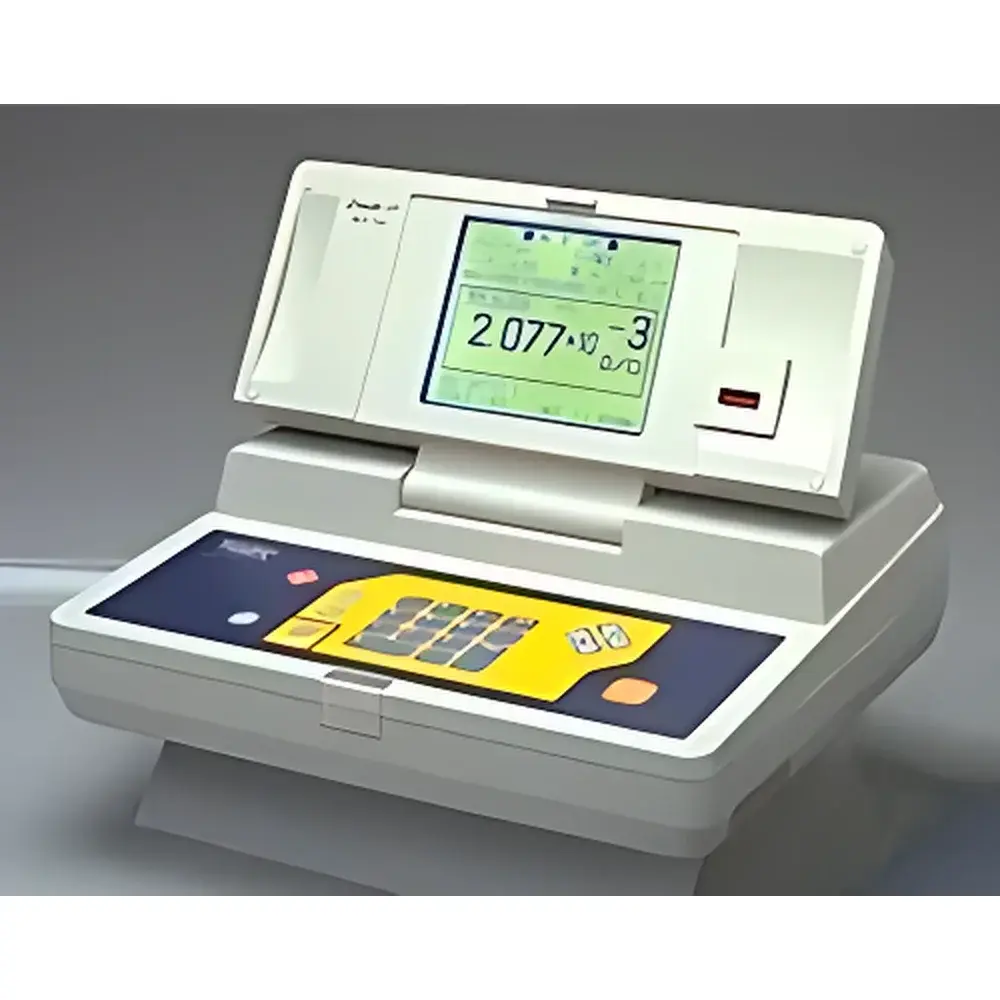
MCP-T610 Low-Resistance Analyzer
| Origin | Japan |
|---|---|
| Manufacturer Type | Authorized Distributor |
| Origin Category | Imported |
| Model | MCP-T610 |
| Pricing | Upon Request |
| Measurement Method | Four-Point Probe, Constant Current Method |
| Resistance Range | 10⁻³ Ω to 10⁷ Ω |
| Supported Test Currents | 100 mA, 10 mA, 1 mA, 100 µA, 10 µA, 1 µA, 0.1 µA |
| Accuracy | ±2.0% ±20 digits (10⁻³–10⁻¹ Ω), ±1.0% ±5 digits (10⁰–10² Ω), ±1.0% ±3 digits (10³–10⁴ Ω), ±0.5% ±3 digits (10⁵ Ω), ±1.0% ±3 digits (10⁶ Ω), ±2.0% ±5 digits (10⁷ Ω) |
| Power Supply | AC 85–264 V, 47–63 Hz |
| Battery Backup | ~3 years (rechargeable lithium battery) |
| Probe Types | ASP, ESP, PSP, BSP, QPP, TFP (all four-point collinear probes) |
| Standard Probe | MCP-TP03P (4-pin, needle length 5 mm, tip radius 0.37 mm) |
| Calibration Checker | MCP-TRF1 (1 Ω standard resistor for ASP/ESP probes) |
| Optional Probes | MCP-TP08P (4 mm needle, Ø2 mm tip, 240 g/needle spring force), MCP-TP06P (1.5 mm needle, 0.26 mm tip radius, 70 g/needle), MCP-TPQPP (2.2 mm needle, 0.37 mm tip radius, 210 g/needle), MCP-TP05P (1 mm needle, 0.15 mm tip radius, 50 g/needle), MCP-TFP (dedicated thin-film probe) |
| Data Interface | RS232C |
| Dimensions & Weight | 330 × 270 × 88 mm, 3.4 kg |
| Display | 5.7-inch LCD |
| Data Storage Capacity | 1000 measurements |
| Preloaded Measurement Files | 18 user-configurable test setups |
Overview
The MCP-T610 Low-Resistance Analyzer is a precision four-point probe instrument engineered for accurate, repeatable surface and bulk resistivity characterization of conductive and semi-conductive materials. Based on the van der Pauw and linear four-point probe principles, it eliminates contact resistance errors by separating current injection and voltage sensing functions across four collinear electrodes. This architecture ensures high reproducibility in low-resistance measurements—critical for quality assurance in thin-film deposition, printed electronics, EMI shielding validation, and advanced composite development. Designed and manufactured under stringent Japanese engineering standards, the MCP-T610 delivers traceable measurement performance across seven decades of resistance (10⁻³ Ω to 10⁷ Ω), with programmable constant-current excitation optimized for material-specific conductivity regimes.
Key Features
- Seven-decade resistance range (10⁻³ Ω to 10⁷ Ω) with auto-ranging and manual current selection (100 mA to 0.1 µA)
- High-resolution 5.7-inch backlit LCD interface supporting real-time display of resistance (Ω), sheet resistance (Ω/sq), and volume resistivity (Ω·cm)
- Eight interchangeable four-point probe configurations—including ASP (standard), ESP (edge-sensitive), PSP (planar), BSP (bipolar), QPP (long-sample), and TFP (thin-film probe)—each mechanically calibrated and documented per IEC 62631-3-1
- Onboard storage for up to 1000 measurement records with timestamp, probe ID, current setting, and unit mode
- Eighteen preconfigured measurement files allow rapid setup for standardized test protocols across R&D, QC, and production environments
- Integrated lithium battery backup sustains calibration memory and settings for approximately three years without external power
- RS232C serial interface enables remote control, automated data logging, and integration into LabVIEW or Python-based test automation frameworks
Sample Compatibility & Compliance
The MCP-T610 supports planar, flexible, and irregularly shaped samples ranging from rigid metal foils (<10 µm thick) to elastomeric composites, conductive inks, and sintered ceramics. Its modular probe system accommodates geometric constraints: MCP-TP05P (1 mm needle, 0.15 mm tip radius) enables reliable contact on brittle or ultra-thin substrates; MCP-TP08P (240 g/needle spring force) ensures stable penetration into heterogeneous pastes or filled polymers. All probes conform to ASTM F1711 (Standard Test Method for Sheet Resistance of Semiconductor Wafers Using Four-Point Probes) and ISO 3915 (Electrical Resistivity of Conductive Foams and Plastics). The instrument’s measurement uncertainty budget aligns with GLP-compliant documentation requirements, and its digital audit trail—when paired with validated PC software—supports FDA 21 CFR Part 11 compliance for regulated industries.
Software & Data Management
While the MCP-T610 operates autonomously via front-panel controls, its RS232C port enables bidirectional communication with host systems. A vendor-provided Windows utility supports batch export of ASCII-formatted datasets (CSV/TXT), including metadata such as probe type, applied current, temperature (if external sensor connected), and operator ID. For enterprise integration, the device responds to SCPI-like command sets, permitting script-driven sequencing in MATLAB, Python (pySerial), or custom QA platforms. All stored measurements retain full traceability: each record includes probe serial number, calibration date (via embedded EEPROM), and measurement mode identifier—essential for internal audit readiness and ISO/IEC 17025 accreditation.
Applications
- Quality control of conductive coatings: EMI-shielding paints, anti-static floor finishes, transparent ITO/PEDOT:PSS films
- R&D of functional composites: carbon-black-loaded rubber, graphene-doped thermoplastics, metal-polymer hybrids
- Process validation in roll-to-roll manufacturing: printed electrodes, flexible PCB traces, RFID antenna inks
- Characterization of sintered ceramics and powder metallurgy parts where bulk resistivity correlates with density and grain boundary integrity
- Failure analysis of delaminated or oxidized conductive layers in photovoltaic interconnects and battery current collectors
FAQ
What standards does the MCP-T610 comply with for surface resistivity testing?
The instrument implements measurement methodologies aligned with ASTM F1711, ISO 3915, and JIS C 2141, with probe geometries certified per IEC 62631-3-1 Annex B.
Can the MCP-T610 measure anisotropic materials?
Yes—by rotating the sample relative to the probe axis and performing orthogonal measurements, users can quantify directional resistivity differences in fiber-reinforced composites or textured thin films.
Is calibration traceable to national metrology institutes?
Each probe is supplied with a calibration certificate referencing NIST-traceable standards; annual recalibration services are available through authorized service centers in North America and EU.
How does the instrument handle contact resistance during low-Ω measurements?
The four-point probe topology inherently excludes lead and contact resistance from the measured voltage drop, enabling sub-milliohm resolution without compensation algorithms.
Does the MCP-T610 support statistical process control (SPC) outputs?
Yes—data exported via RS232C includes raw readings, timestamps, and configuration flags, enabling direct ingestion into Minitab, JMP, or custom SPC dashboards.



