
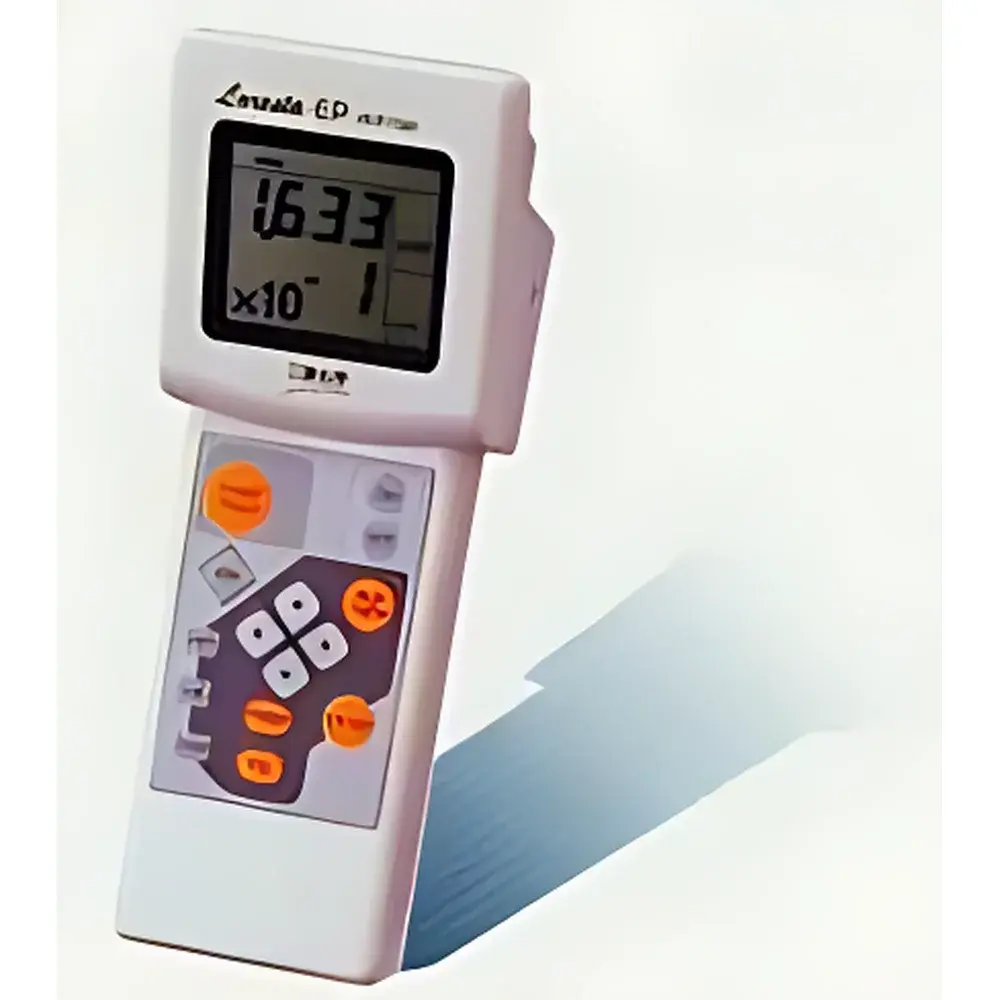
MCP-T360 Low-Resistance Surface Resistivity Analyzer
| Origin | Japan |
|---|---|
| Manufacturer Type | Authorized Distributor |
| Origin Category | Imported |
| Model | MCP-T360 |
| Pricing | Upon Request |
| Measurement Method | Four-Point Probe (Constant Current) |
| Resistance Range | 10⁻² – 10⁶ Ω |
| Supported Test Currents | 100 mA, 10 mA, 1 mA |
| Accuracy | ±1.0% ±20 digits / ±1.0% ±5 digits / ±0.5% ±5 digits / ±0.5% ±3 digits / ±2.0% ±5 digits (range-dependent) |
| Display | LCD |
| Power Supply | DC 6.5 V, 350 mA |
| Probe Interface | Dedicated MCP Four-Point Probes (ASP, ESP, PSP, BSP, QPP, TFP) |
| Data Output | RS-232C |
| Dimensions & Weight | 100 × 230 × 45 mm, 500 g |
| Standard Probe | MCP-TP03P (4-point, integrated needle length 5 mm, tip radius 0.37 mm) |
| Optional Probes | MCP-TP08P (4 mm needle, Ø2 mm tip, 240 g/needle spring force), MCP-TP06P (1.5 mm needle, 0.26 mm tip radius, 70 g/needle), MCP-TPQPP (2.2 mm needle, 0.37 mm tip radius, 210 g/needle), MCP-TP05P (1 mm needle, 0.15 mm tip radius, 50 g/needle), MCP-TFP (1 W detector for ASP/ESP probes) |
Overview
The MCP-T360 Low-Resistance Surface Resistivity Analyzer is a precision handheld instrument engineered for reliable, contact-based four-point probe (4PP) resistivity measurement of conductive and semi-conductive surface layers. Based on the constant-current four-terminal sensing principle—where two outer electrodes inject current while two inner electrodes measure voltage drop—the MCP-T360 eliminates lead resistance and contact potential errors inherent in two-point methods. This architecture ensures high reproducibility across low-resistance regimes (10⁻² to 10⁶ Ω), making it suitable for quality assurance of thin conductive films, coatings, laminates, and printed circuit substrates where surface uniformity, continuity, and micro-defect detection are critical. Designed and calibrated in accordance with JIS K 7194 and ASTM D257 standards for surface resistivity, the MCP-T360 delivers traceable, repeatable data without requiring external shunt calibration or manual correction.
Key Features
- True four-point probe architecture with integrated constant-current source and high-impedance voltage sensing—eliminates contact resistance and thermal EMF interference.
- Multi-range current sourcing (100 mA, 10 mA, 1 mA) automatically selected based on measured resistance to optimize signal-to-noise ratio and prevent sample heating or polarization.
- Modular MCP probe system supporting six standardized probe configurations—including ASP (standard flat), ESP (edge-sensitive), PSP (penetrating), BSP (bipolar spacing), QPP (quadrupole), and TFP (thin-film probe)—each engineered for specific sample geometry, thickness, and mechanical compliance.
- Onboard LCD display with real-time resistance readout, range indication, and status feedback; no external PC required for basic operation.
- RS-232C serial interface compliant with EIA/TIA-232-F specifications enables direct integration into automated QA workstations or legacy lab data acquisition systems.
- Compact, ergonomic housing (100 × 230 × 45 mm, 500 g) with internal battery support via included MCP-TA05 AC adapter (DC 6.5 V, 350 mA) for field-deployable use in production lines or cleanroom environments.
Sample Compatibility & Compliance
The MCP-T360 accommodates a broad spectrum of planar and quasi-planar samples including conductive paints, EMI-shielding coatings, antistatic laminates, metallized polymer films, sputtered metal layers, conductive elastomers, carbon-loaded plastics, and flexible printed circuits. Its probe family allows adaptation to substrate rigidity, thickness (down to <50 µm), surface roughness (Ra < 5 µm), and edge proximity constraints. All MCP probes feature precision-machined tungsten-carbide tips with controlled spring loading (50–240 g per needle) to ensure consistent contact pressure without damaging delicate surfaces. The analyzer complies with ISO/IEC 17025 requirements for measurement uncertainty estimation and supports GLP-compliant documentation when paired with validated RS-232 logging software. While not FDA 21 CFR Part 11 certified out-of-the-box, its deterministic measurement protocol and audit-ready output format facilitate validation under GMP-regulated environments for medical device coating QC.
Software & Data Management
Raw resistance values and active measurement parameters (current range, applied voltage, temperature-compensated status if external sensor connected) are transmitted via ASCII-encoded RS-232C frames at 9600 baud, 8N1. No proprietary drivers are required—data integrates natively with LabVIEW, MATLAB, Python (pySerial), or Excel via standard terminal emulators. Optional firmware updates (distributed via secure vendor portal) enhance timestamping accuracy and add batch ID tagging for traceability. Internal memory is not present; however, the instrument’s deterministic response time (<150 ms per reading) enables high-throughput logging in synchronized industrial control systems. Calibration certificates—traceable to NMIJ (National Metrology Institute of Japan) reference standards—are supplied with each unit and include full uncertainty budgets per IEC/ISO Guide 98-3.
Applications
- Process validation of conductive ink curing on flexible electronics substrates.
- In-line verification of electroplated copper layer continuity on PCB panels prior to solder mask application.
- Batch release testing of antistatic packaging films per ANSI/ESD S11.11.
- R&D characterization of transparent conductive oxides (TCOs) and graphene transfer films on glass or PET.
- Failure analysis of delamination-induced resistance spikes in multilayer EMI gaskets.
- Quality screening of carbon-black-doped rubber compounds used in grounding straps and static-dissipative flooring.
FAQ
What standards does the MCP-T360 comply with for surface resistivity measurement?
The instrument implements measurement methodology aligned with ASTM D257, IEC 60093, and JIS K 7194. Its four-point probe design inherently satisfies the geometric correction requirements specified in these standards for planar isotropic materials.
Can the MCP-T360 measure through insulating top layers?
No—it requires direct metallic or ohmic contact with the conductive layer. For buried-layer evaluation, cross-sectional SEM-EDS or eddy-current mapping is recommended.
Is temperature compensation supported?
The base unit does not include an integrated temperature sensor, but external PT100 or thermistor inputs can be interfaced via custom RS-232 command extensions for post-processing correction using material-specific TCR coefficients.
How is calibration maintained over time?
Annual recalibration against certified resistance standards (e.g., IET Labs SR104 or Keysight A6020) is recommended. Drift verification can be performed using the included MCP-TP03P probe and a stable 1 kΩ reference resistor traceable to national standards.
Does the MCP-T360 support statistical process control (SPC) outputs?
Yes—when integrated with third-party SPC software via RS-232, it delivers individual readings with timestamps, enabling X-bar/R chart generation, Cp/Cpk calculation, and out-of-spec alerts per ISO 22514-2.



