
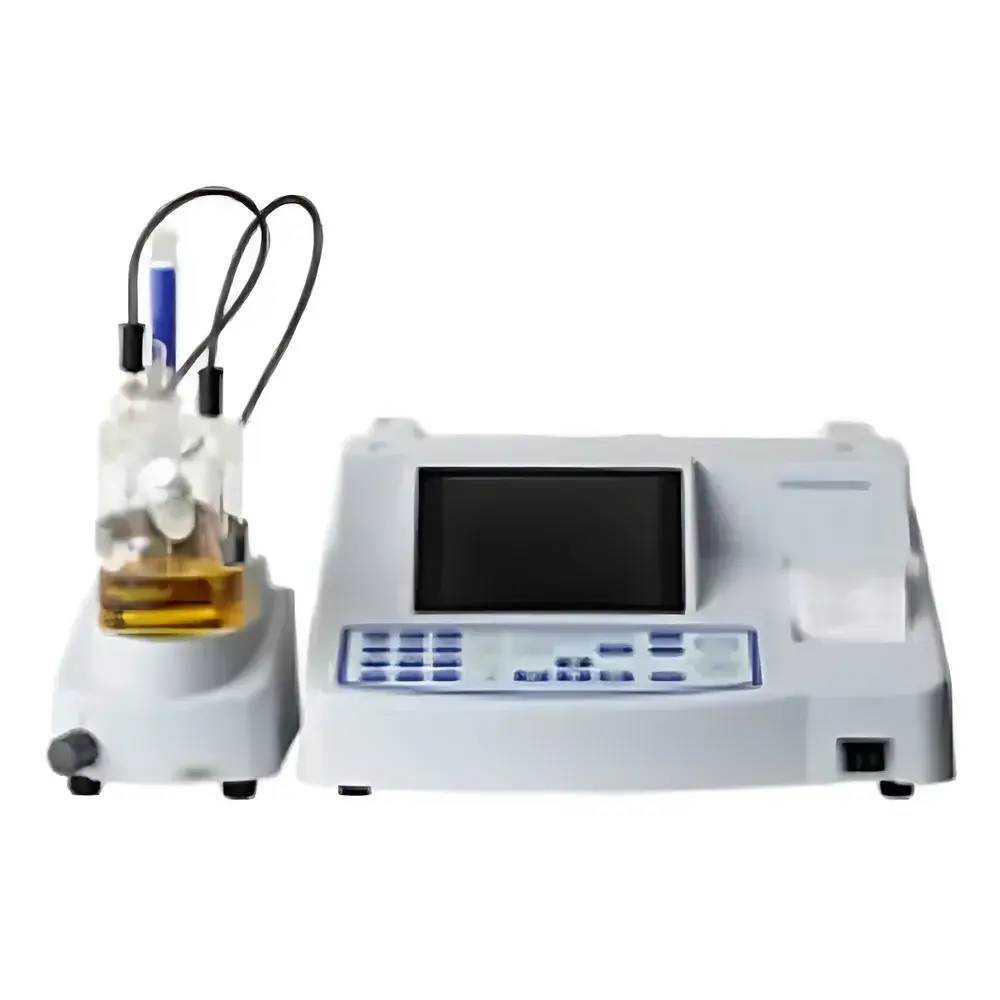
Mitsubishi Chemical CA-200 Coulometric Karl Fischer Moisture Analyzer
| Brand | Mitsubishi Chemical |
|---|---|
| Origin | Japan |
| Model | CA-200 |
| Detection Principle | Coulometric Karl Fischer Titration |
| Electrolysis Current | 430 mA |
| Titration Rate | 2.2 mg H₂O/min (36 µg H₂O/sec) |
| Measurement Range | 10 µg – 100 mg H₂O |
| Sensitivity | 0.1 µg H₂O |
| Precision | ±3 µg (for 10 µg–1 mg H₂O) |
| Cell Volume | 150 mL |
| Display | 5.7-inch color LCD |
| Data Storage | ~100 measurements |
| Stirring | Magnetic stirring |
| Connectivity | RS-232 (optional), USB (data export & peripheral interface), optional electronic balance interface |
| Compliance | GLP/GMP-supporting audit trail, auto-electrode cleaning, calendar/time stamping, self-diagnostic mode |
| Power | AC 220–240 V, 50/60 Hz, 310 VA |
| Dimensions (main unit) | 330 × 320 × 148 mm |
| Weight (main unit) | ~5 kg |
Overview
The Mitsubishi Chemical CA-200 is a single-channel coulometric Karl Fischer moisture analyzer engineered for high-precision quantification of trace water content in samples where ultra-low detection limits and metrological reliability are critical. Unlike volumetric KF titrators, the CA-200 employs constant-current coulometric generation of iodine at the anode—based on Faraday’s law—ensuring direct, stoichiometric correlation between charge passed and water consumed (1 mole I₂ ≡ 1 mole H₂O). This principle delivers inherent accuracy without reliance on standardized titrant concentration or calibration drift correction. Designed as the successor to the CA-100, the CA-200 integrates enhanced signal stability, real-time background compensation (displayed continuously in µg H₂O/sec), and automated electrode maintenance—eliminating manual cleaning cycles that introduce variability and downtime. Its architecture meets foundational requirements for regulated environments, including time-stamped measurement records, electronic signature readiness, and full system self-diagnostics.
Key Features
- Coulometric detection with 430 mA constant-current electrolysis, enabling rapid titration at up to 36 µg H₂O/sec (2.2 mg H₂O/min) and sub-microgram sensitivity (0.1 µg H₂O detection limit)
- 5.7-inch full-color LCD interface with intuitive navigation, multilingual support, and real-time visualization of background drift, titration progress, and cell status
- Automatic electrode conditioning system that applies periodic cleaning pulses to remove passivating deposits—maintaining consistent electrode response across extended operation
- Dual USB ports: one dedicated to internal data archiving (CSV export), the other configurable for external thermal printer (58 mm paper width, 21-dot matrix) or firmware updates
- Flexible configuration support: compatible with dual-cell setups (e.g., parallel analysis or solvent blank referencing), optional vaporizer modules, and integrated electronic balance input for automatic sample mass registration
- Comprehensive GLP/GMP-enabling functions—including date/time stamping (Y/M/D/h/m/s), audit-trail-capable memory backup (>2 months on full charge), and validation-ready self-test routines (display, printer, memory, and moisture assay verification)
Sample Compatibility & Compliance
The CA-200 accommodates a broad spectrum of solid, liquid, and gaseous matrices—including pharmaceutical excipients, lithium battery electrolytes, polymer resins, petrochemical solvents, and fine chemical intermediates—provided they are soluble in KF reagents and do not react with iodine or sulfur dioxide. Sample introduction is typically via syringe injection into the sealed 150 mL titration cell; optional oven or vaporizer attachments extend applicability to thermally labile or low-solubility materials. The instrument conforms to core regulatory expectations for analytical instrumentation: measurement data includes immutable timestamps, user ID fields (when paired with external authentication), and full traceability of all parameter changes. While not pre-certified to ISO/IEC 17025, its design supports laboratory implementation of ASTM E203, USP , and EP 2.5.12 protocols, and its software architecture permits integration into 21 CFR Part 11-compliant workflows when deployed with validated IT infrastructure.
Software & Data Management
Data handling is structured around three operational modes: Simple (single formula, fixed unit), Composite (up to 12 customizable formulas with 6 selectable units), and Bromine Index/Value (dedicated calculation logic per ASTM D1159 and D2710). All modes support statistical post-processing—including mean, SD, RSD, and confidence intervals—as well as re-calculation using internal or external standard concentrations. Stored results (up to 100 assays) retain raw current-time integrals, background-corrected water mass, sample mass (if balance-linked), and operator-defined metadata. USB export generates timestamped CSV files with column headers compliant with LIMS ingestion standards. Internal memory retains file integrity during power loss, and the self-diagnostic suite validates hardware functionality prior to assay initiation—reducing risk of undetected instrumental error.
Applications
The CA-200 serves as a reference-grade tool in quality control laboratories where water content directly impacts product stability, safety, or performance. Key use cases include: residual moisture verification in lyophilized biologics (targeting ≤0.5% w/w); water ingress testing in sealed lithium-ion battery cells (detection down to 10 µg ensures SEI layer integrity); specification release testing of hygroscopic APIs per ICH Q5C; and purity assessment of high-purity solvents used in semiconductor manufacturing (where 10–50 ppm H₂O can induce etching defects). Its coulometric precision also supports method development for novel KF-compatible reagents and validation of alternative drying protocols under accelerated stability studies.
FAQ
What is the difference between coulometric and volumetric Karl Fischer titration?
Coulometric KF generates iodine electrochemically within the titration cell at a known current, making water quantification directly proportional to total charge passed (Faraday’s law). Volumetric KF delivers pre-standardized iodine solution from a burette, requiring frequent titer verification. Coulometry offers superior precision below 100 µg H₂O and eliminates reagent stability concerns.
Can the CA-200 be used for bromine index/bromine number analysis?
Yes—the instrument includes dedicated Bromine Index and Bromine Number calculation modes compliant with ASTM D1159 and D2710, utilizing the same coulometric cell but with bromide-containing electrolyte solutions.
Does the CA-200 support 21 CFR Part 11 compliance?
The hardware and firmware provide foundational capabilities—electronic signatures, audit trails, and secure data storage—but formal Part 11 compliance requires site-specific validation, including access controls, electronic record retention policies, and system-level IT governance.
Is external computer connection required for routine operation?
No—full operation, data storage, printing, and reporting are self-contained. RS-232 or USB-to-PC connectivity is optional and used only for advanced data aggregation, remote monitoring, or LIMS integration.
How often does the titration cell require maintenance?
With active background compensation and automated electrode cleaning, routine maintenance intervals extend to 2–4 weeks under continuous use. Cell rinsing with dry methanol and periodic cathode wire inspection remain recommended best practices per manufacturer guidelines.





