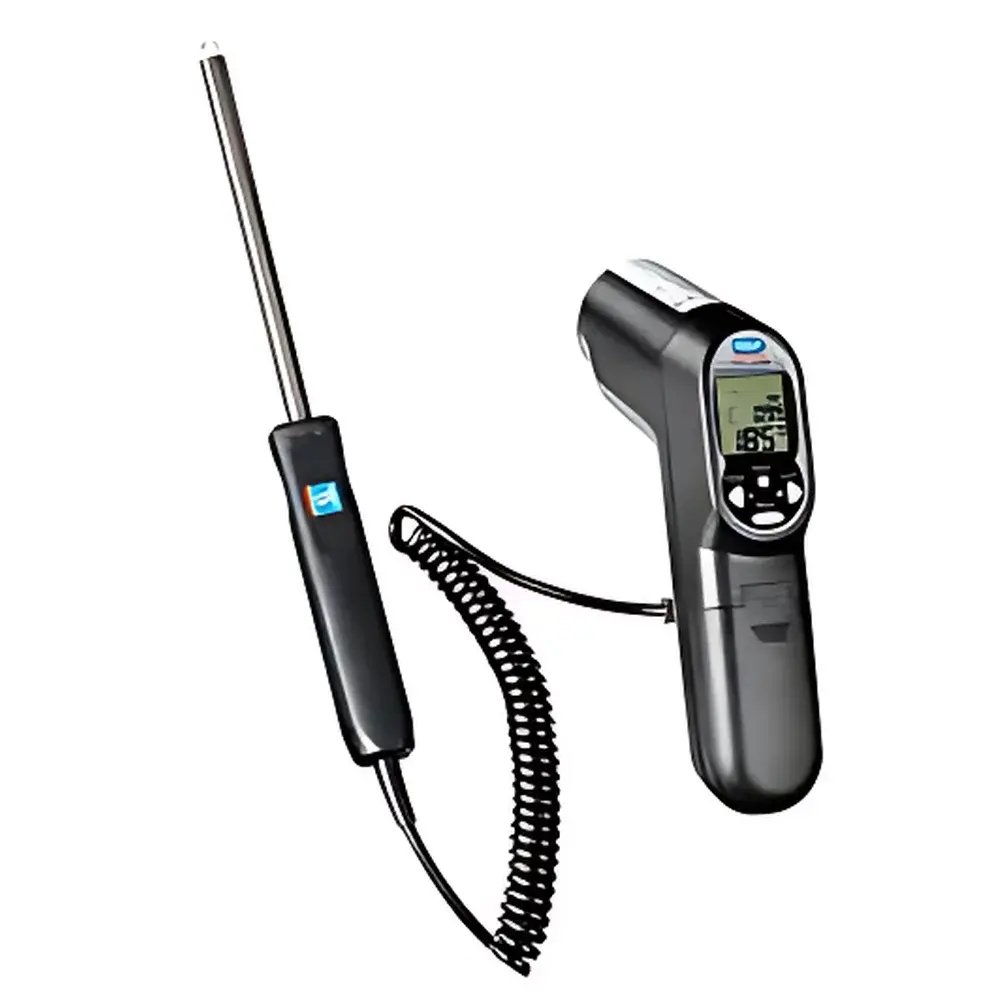
TMTL 1400K Dual-Mode Contact & Infrared Thermometer
| Measurement Range (IR) | –60 °C to +500 °C |
|---|---|
| Measurement Range (Contact) | –60 °C to +1400 °C |
| Sensor Type | K-type thermocouple (TMDT 2–30, up to 900 °C) |
| Accuracy | ±2% of reading or ±2 °C (whichever is greater) |
| Response Time | 500–1000 ms |
| D | S Ratio: 11:1 |
| Spectral Range | 8–14 µm |
| Emissivity Adjustment | 0.1–1.0 (adjustable) |
| Display Resolution | 0.1 °C |
| Laser Class | II (635–650 nm, ≤1 mW) |
| Operating Temp. | 0 °C to 50 °C |
| Storage Temp. | –20 °C to +65 °C |
| Power | 2 × AAA (IEC LR03), 140 h (laser/backlight off) |
| Dimensions | 175 × 72 × 39 mm |
| Weight | 940 g |
| EMC Compliance | EN 61326-1:1997 + A1 + A2 |
| Laser Safety | CFR 1040.10 / IEC 60825-1 |
Overview
The TMTL 1400K Dual-Mode Contact & Infrared Thermometer is an engineered solution for industrial, maintenance, and laboratory environments requiring both non-contact surface temperature assessment and high-temperature contact measurement in a single handheld platform. It operates on two complementary physical principles: infrared radiometry (for emissive surface temperature estimation) and thermocouple-based conduction (for direct thermal equilibrium measurement). The infrared channel utilizes a thermopile detector calibrated across the 8–14 µm atmospheric transmission window—optimal for measuring common industrial materials with variable emissivity. Simultaneously, the integrated K-type thermocouple input supports direct contact measurements up to 1400 °C using compatible probes such as the TMDT 2–30 series (rated to 900 °C), enabling traceable, high-fidelity readings where emissivity uncertainty or surface obstruction precludes reliable IR use. Designed for reproducibility under field conditions, the instrument features a fixed 11:1 distance-to-spot ratio, adjustable emissivity (0.1–1.0), and dual-channel capability—including synchronized wireless sensor inputs—making it suitable for comparative thermal profiling and transient process monitoring.
Key Features
- Dual measurement architecture: Independent infrared radiometry and K-type thermocouple input with automatic mode recognition
- Extended contact range up to 1400 °C, validated for use with certified K-type probes meeting IEC 60584-1 tolerance class 1
- High-stability infrared optics with spectral filtering optimized for oxidized metals, ceramics, polymers, and painted surfaces
- Adjustable emissivity compensation with 0.01-step resolution and user-defined material presets
- Integrated Class II visible laser targeting (635–650 nm, <1 mW) compliant with FDA 21 CFR 1040.10 and IEC 60825-1
- Multi-function display modes: Max/Min/Avg/Delta, dual-channel comparison (IR + contact or IR + wireless sensor)
- Configurable audible and visual alarms for upper/lower limit deviation, supporting ISO 50001 energy audit workflows
- Auto-power-off (60 s after trigger release) and programmable backlight control to extend battery life
- Ruggedized housing rated for industrial handling, supplied in a shock-absorbing transit case (415 × 195 × 50 mm)
Sample Compatibility & Compliance
The TMTL 1400K accommodates diverse sample geometries and thermal states without requiring surface preparation. Infrared mode is effective on stationary or moving targets—including conveyor-belt components, rotating machinery, and furnace linings—provided the target fills the measurement spot defined by the 11:1 optical geometry. Contact measurements are applicable to solid conductors, refractory bricks, molten metal ladles (via immersion probes), and high-temperature alloys. The device complies with electromagnetic compatibility requirements per EN 61326-1:1997 (including amendments A1 and A2), ensuring stable operation in electrically noisy plant environments. Its laser subsystem conforms to international safety standards (IEC 60825-1, CFR 1040.10), and its thermal accuracy specification aligns with ASTM E2847 guidance for infrared thermometer validation. While not intrinsically safe, it is routinely deployed in non-hazardous area applications within petrochemical, metallurgical, and power generation facilities.
Software & Data Management
Data logging and configuration are supported via USB interface (device-class CDC) and optional PC software compatible with Windows 10/11. Logged sessions include timestamped IR and contact values, emissivity settings, alarm status flags, and probe identification metadata. Export formats include CSV and XML, facilitating integration into LIMS platforms and compliance reporting systems. Audit trails record parameter changes, calibration date stamps, and user-initiated resets—supporting GLP and GMP-aligned documentation practices. Firmware updates preserve measurement traceability through version-controlled calibration coefficients stored in write-protected memory. No cloud dependency or proprietary subscription is required; all data remains under full user control.
Applications
- Preventive maintenance: Bearing temperature trending, electrical connection hot-spot detection, steam trap verification
- Metallurgy & heat treatment: Furnace uniformity mapping, quench monitoring, billet temperature verification pre-rolling
- Automotive manufacturing: Brake rotor thermal cycling, exhaust manifold validation, EV battery cell surface profiling
- Food processing: Oven belt temperature validation, fryer oil thermal stability, post-pasteurization cooling line monitoring
- Research & development: Material emissivity characterization, thermal interface resistance testing, combustion chamber wall analysis
- Energy efficiency audits: Radiator output verification, insulation integrity assessment, boiler tube temperature gradient analysis
FAQ
What is the maximum recommended distance for accurate infrared measurement?
For optimal accuracy, maintain a target diameter ≥ distance / 11 (e.g., 110 mm minimum at 1.21 m). Accuracy degrades if the target occupies <80% of the spot size.
Can the TMTL 1400K measure through glass or plastic?
No—standard silica glass and most polymers are opaque in the 8–14 µm band. Use contact mode or specialized short-wave IR instruments for transparent barrier applications.
Is calibration traceable to NIST or other national standards?
Yes—factory calibration includes reference to ITS-90 fixed points (melting ice, zinc, aluminum) and is documented with a certificate of conformity; accredited third-party calibration services are available.
How does emissivity error affect measurement uncertainty?
A 0.05 emissivity misadjustment introduces ~1.2 °C error at 500 °C for oxidized steel (ε ≈ 0.8); users should verify emissivity using black tape or paint methods per ASTM E1933.
Does the instrument support data export for statistical process control (SPC)?
Yes—CSV exports include raw values, timestamps, and measurement mode identifiers, enabling direct import into Minitab, JMP, or custom SPC dashboards.