
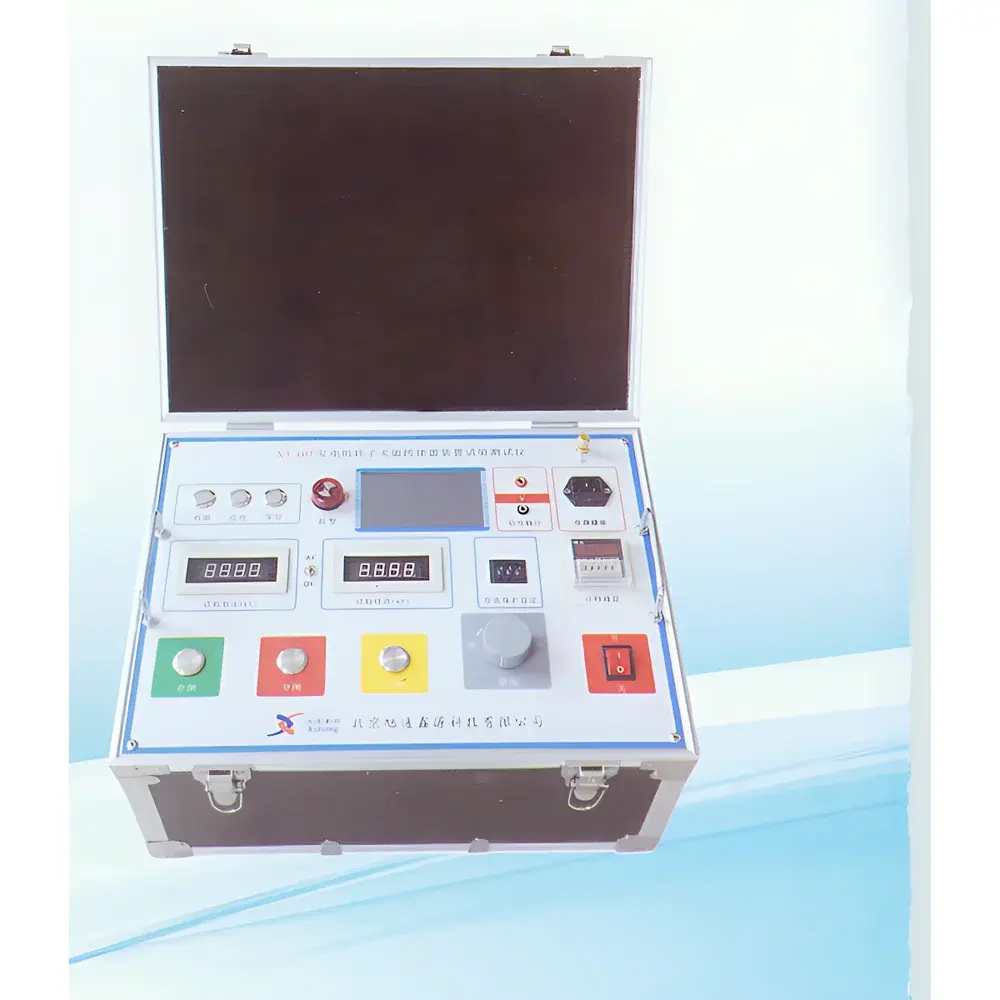
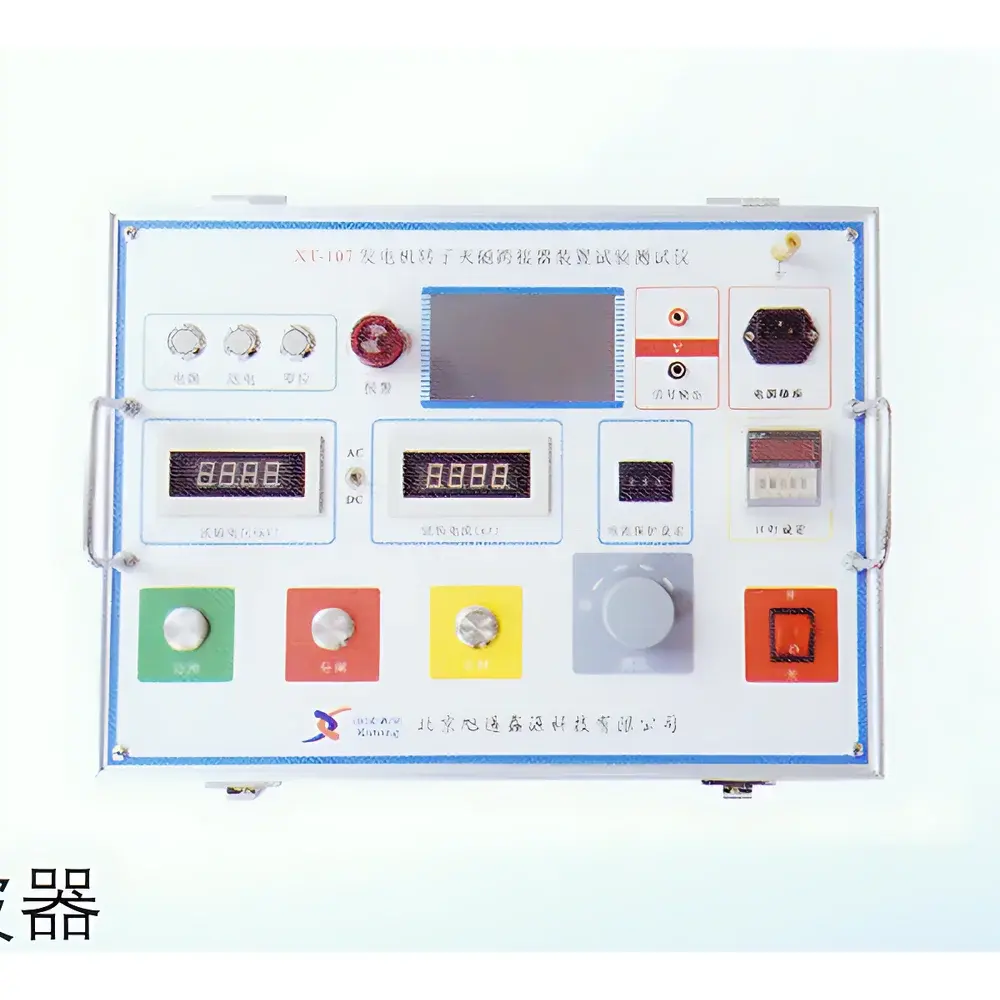
XT-107 Generator Rotor Demagnetization Crowbar Device Test Instrument
| Brand | Xutongyongfu |
|---|---|
| Origin | Beijing, China |
| Manufacturer Type | Authorized Distributor |
| Country of Origin | China |
| Model | XT-107 |
| Price Range | USD 8,500 – 11,500 (FOB) |
| Max Test Force | 50 kN |
| Loading Rate | 50 N/s |
| Platen Spacing | 300 mm |
| Platen Size | 400 mm × 400 mm |
| Rated DC Output Voltage | 4.5 kV |
| Rated AC Output Voltage | 3 kV |
| Output Capacity | 2 kVA |
| Voltage/Current Measurement Accuracy | ±1.5% |
| Operating Ambient | −5°C to +40°C, ≤90% RH at +25°C |
| Power Supply | AC 220 V ±10%, 50 Hz ±1 Hz |
| Display | 4½-digit digital meters + embedded oscilloscope module |
| Safety Features | Zero-position interlock, overcurrent protection, audible/visual timer alarm |
| Isolation | Galvanically isolated input/output circuits |
Overview
The XT-107 Generator Rotor Demagnetization Crowbar Device Test Instrument is a purpose-built high-voltage test system engineered for the functional verification and performance validation of rotor overvoltage protection devices—specifically, thyristor-based crowbar circuits used in large turbo-generators with static self-excited excitation systems. It operates on the principle of controlled transient voltage application to simulate rotor overvoltage events (e.g., field winding de-energization faults, short-circuit-induced transients, or commutation failures), enabling precise measurement of crowbar triggering thresholds, conduction angles, clamping voltage levels, and response timing. Designed in strict compliance with DL/T 843–2010 (“Technical Specifications for Static Self-Excited Excitation Systems of Large Turbo-Generators”) and aligned with IEC 60034-4 and IEEE Std 115 test philosophy for rotating machine protection systems, the XT-107 serves as a critical tool during commissioning, periodic maintenance, and post-repair verification of excitation system safety integrity.
Key Features
- Galvanic isolation architecture ensures complete separation between mains input and high-voltage output circuits—eliminating ground-loop risks and safeguarding both operator and DUT (Device Under Test) during energized testing.
- Dual-mode high-voltage output: independently configurable AC (3 kV RMS) and DC (4.5 kV) sources, each rated at 2 kVA continuous duty, supporting standardized step-response and ramped overvoltage stress protocols.
- Integrated 4½-digit digital voltmeter and ammeter with rotary selector switch—enabling rapid switching between voltage, current, and auxiliary signal monitoring without external instrumentation.
- Embedded real-time oscilloscope module (7-inch TFT-LCD, 100 MHz bandwidth, 1 GS/s sampling) captures thyristor gate trigger timing, conduction angle waveform, and dynamic clamping behavior with sub-microsecond resolution.
- Mechanical zero-position interlock prevents accidental high-voltage activation; automatic overcurrent cutoff (<10 ms response) and programmable timed alarm (audible + visual) enforce strict operational safety boundaries.
- Compact benchtop form factor (400 × 300 × 300 mm) with rear-panel HV terminals—minimizing operator proximity to live conductors during setup and measurement.
Sample Compatibility & Compliance
The XT-107 is validated for testing crowbar assemblies installed in synchronous generators rated up to 600 MVA, including those conforming to GB/T 7064, IEC 60034-3, and ANSI C50.13 standards. It supports evaluation of both imported OEM units (e.g., ABB, Siemens, GE Energy) and domestically assembled crowbars using discrete or hybrid thyristor modules. All electrical safety design elements meet IEC 61010-1:2010 (Measurement Category III, Pollution Degree 2) requirements. Test reports generated by the instrument are structured to support GLP-compliant documentation workflows and satisfy mandatory regulatory audits under China’s DL/T 573–2010 “Guidelines for Preventive Tests of Power Equipment.”
Software & Data Management
While the XT-107 operates primarily in manual mode per DL/T 843–2010 procedural mandates, its embedded oscilloscope supports USB mass-storage export of waveform data (.CSV and .BIN formats) for offline analysis in MATLAB, LabVIEW, or proprietary excitation system diagnostic platforms. Timestamped measurement logs—including applied voltage, peak current, conduction delay, and thermal status—are retained internally for ≥1,000 test cycles. Optional RS-232/Modbus RTU interface enables integration into centralized plant-wide test management systems, supporting traceability requirements under ISO/IEC 17025 and power utility internal QA/QC frameworks.
Applications
- Periodic verification of crowbar triggering voltage tolerance (±1.5% accuracy verified per IEC 61000-4-5 surge immunity reference conditions).
- Commissioning validation of new or retrofitted excitation systems prior to grid synchronization.
- Root-cause analysis of unexplained rotor insulation failures via comparative conduction-angle drift assessment.
- Calibration and functional check of field discharge resistors and nonlinear ZnO arresters integrated within crowbar subassemblies.
- Supporting technical due diligence during generator asset transfer or insurance risk assessment audits.
FAQ
Does the XT-107 comply with international standards beyond DL/T 843–2010?
Yes—it meets IEC 61010-1:2010 safety requirements and its measurement uncertainty budget aligns with ISO/IEC 17025 clause 5.4.6 for calibration traceability.
Can the instrument perform automated sequence testing per IEEE C37.90.1?
No—the XT-107 is designed for manual, operator-guided tests per DL/T 843–2010; it does not include programmable test sequencing or pass/fail logic engines.
Is the embedded oscilloscope calibrated and traceable to national standards?
Yes—factory calibration includes NIM (National Institute of Metrology, China) traceable verification of vertical sensitivity, timebase accuracy, and trigger jitter; certificate provided with each unit.
What maintenance intervals are recommended for HV components?
Annual inspection of HV bushings, contactor contacts, and isolation transformers is advised; full recalibration required every 24 months or after 500 operational cycles.
Does the unit support third-party software integration for enterprise-level test data archiving?
Yes—via optional Modbus RTU gateway, enabling bidirectional communication with SCADA-integrated test record systems compliant with IEC 62443 cybersecurity profiles.



