
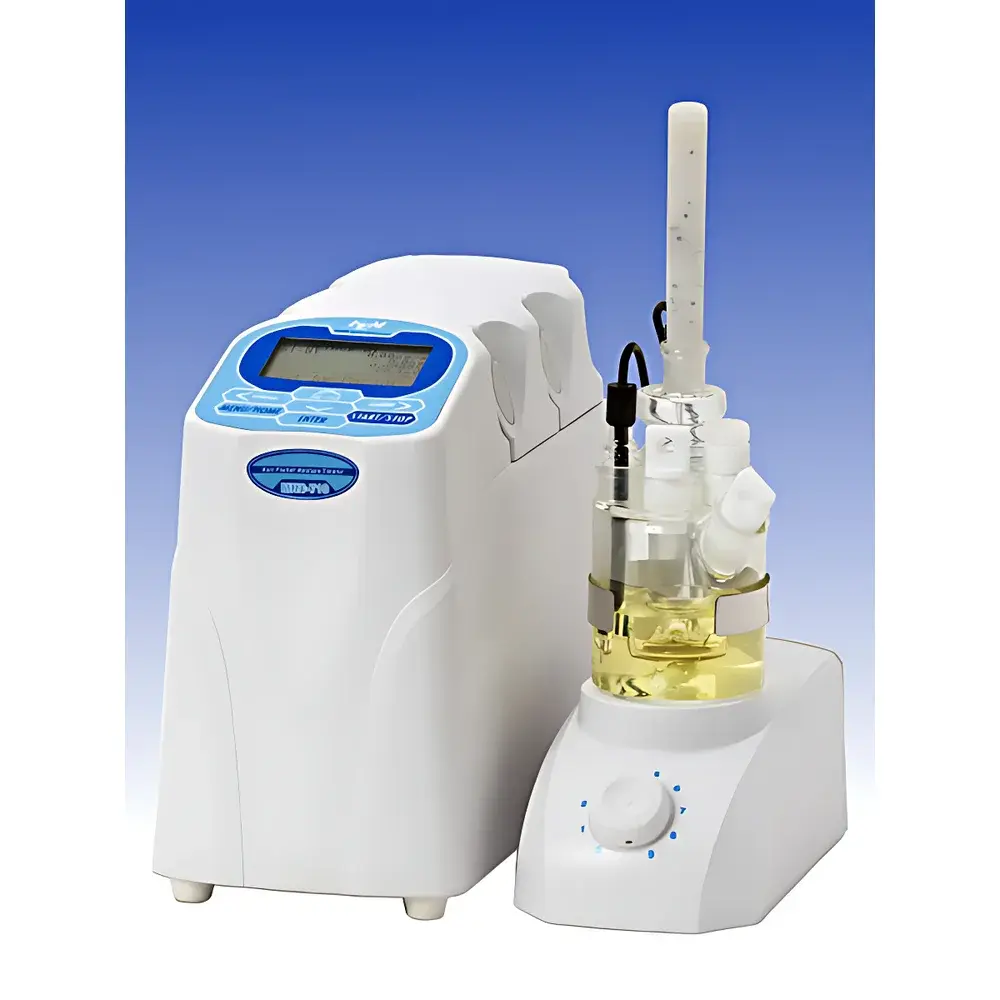
KEM JFH-21 Coulometric Karl Fischer Moisture Analyzer
| Origin | Japan |
|---|---|
| Instrument Type | Coulometric Karl Fischer Titrator |
| Titration Method | Coulometric Karl Fischer Titration |
| Endpoint Detection | Constant-Current Polarity Detection |
| Electrolysis Control | Pulse-Modulated Current Control |
| Max Electrolysis Current | 400 mA |
| Max Water Titration Rate | 2.1 mg H₂O/min |
| Background Correction | Automatic μg/sec Drift Compensation |
| Water Measurement Range | 10 μg – 100 mg H₂O |
| Repeatability | ±5 μg (for 10–1000 μg), RSD ≤0.5% (≥1 mg H₂O) |
| Sensitivity | 0.1 μg H₂O |
| Display | 2-line × 20-character LCD (showing moisture content, reagent concentration, titration rate, background drift, elapsed time, and calculation mode) |
| Connectivity Options | RS-232 interface for printer, PC, or analytical balance |
| End Signal | Visual alert + audible timer alarm |
| Delayed Titration | Programmable start delay (time-based) |
| Calculation Modes | %, ppm, mg/g (M/W) |
| Operating Temperature | 5–40 °C |
| Relative Humidity | ≤80% RH, non-condensing |
| Power Supply | AC 230–240 V, 50/60 Hz, 30 VA |
| Dimensions (H×W×D) | 200 × 280 × 180 mm |
| Net Weight | 4.5 kg (main unit), 6.3 kg (unit + power supply) |
Overview
The KEM JFH-21 Coulometric Karl Fischer Moisture Analyzer is a compact, benchtop-grade instrument engineered for high-sensitivity quantitative determination of trace water content in liquids, solids, and gases using the coulometric Karl Fischer (KF) titration principle. Unlike volumetric KF systems, the JFH-21 generates iodine electrochemically at the anode via controlled pulse-modulated current—eliminating the need for standardized KF reagents and enabling direct, stoichiometric quantification of water based on Faraday’s law. This architecture delivers sub-microgram resolution and exceptional reproducibility across low-moisture matrices such as pharmaceutical excipients, lithium battery electrolytes, polymer resins, and high-purity solvents. Designed for compliance-critical environments, the JFH-21 operates within defined environmental tolerances (5–40 °C, ≤80% RH non-condensing) and supports audit-ready workflows through timestamped measurement records and configurable end-point signaling.
Key Features
- Coulometric generation of iodine with precise pulse-modulated current control (max 400 mA), ensuring stoichiometric accuracy and minimizing reagent consumption.
- Ultra-low detection limit of 0.1 μg H₂O and validated measurement range from 10 μg to 100 mg H₂O—ideal for trace moisture analysis in hygroscopic or ultra-dry materials.
- Automatic background drift compensation (reported in μg/sec), dynamically correcting for ambient moisture ingress and electrode aging effects.
- Two-line alphanumeric LCD interface displaying real-time parameters: moisture content (% or ppm), KF reagent concentration (molarity), titration rate (μg/sec), background drift, elapsed time, and active calculation mode.
- Programmable delayed titration initiation—enabling timed sample introduction or synchronization with external handling systems.
- RS-232 serial port supporting bidirectional communication with analytical balances (for automatic sample weight import), thermal printers (for GLP-compliant hardcopy reports), and host PCs (for data archiving and remote operation).
Sample Compatibility & Compliance
The JFH-21 accommodates a broad spectrum of sample types—including volatile organic solvents (e.g., acetonitrile, chloroform), viscous oils, powdered APIs, and membrane-separated gas streams—when used with appropriate KF-compatible anolyte/catholyte solutions and sealed sample injection ports. Its coulometric design inherently avoids volumetric errors associated with syringe calibration or burette wear, aligning with ISO 8533:2017 and ASTM E203-22 requirements for coulometric moisture determination. While the instrument itself does not embed FDA 21 CFR Part 11 electronic signature controls, its timestamped measurement logs, user-definable calculation modes (%/ppm/mg/g), and deterministic endpoint detection support documentation practices required under GLP and GMP frameworks. All operational parameters—including drift correction values, titration duration, and final moisture result—are retained in non-volatile memory for retrospective review.
Software & Data Management
Data output is managed exclusively via the built-in RS-232 interface using ASCII protocol. The analyzer transmits structured measurement records containing sample ID (user-entered), date/time stamp, sample weight (if balance-integrated), calculated moisture value with unit, reagent concentration, background drift, and titration duration. No proprietary software is bundled; however, standard terminal emulators (e.g., Tera Term, PuTTY) or laboratory information management systems (LIMS) with serial input capability can capture and parse these outputs. For regulated environments, users commonly integrate the JFH-21 into validated data acquisition workflows using third-party middleware that enforces audit trails, user access controls, and electronic signatures—ensuring alignment with ALCOA+ data integrity principles.
Applications
- Pharmaceutical quality control: Quantifying residual moisture in lyophilized products, active pharmaceutical ingredients (APIs), and excipients per USP and Ph. Eur. 2.5.12.
- Electrochemical materials testing: Measuring trace water in Li-ion battery electrolytes (e.g., LiPF₆ in EC/DMC), where H₂O concentrations >20 ppm degrade cell performance and safety.
- Polymer manufacturing: Verifying dryness of PET, nylon, and polycarbonate pellets prior to extrusion or injection molding to prevent hydrolytic degradation.
- Chemical synthesis monitoring: Tracking moisture ingress during Grignard reactions, organolithium preparations, or catalyst activation protocols requiring <10 ppm ambient water.
- Food ingredient certification: Validating low-moisture specifications for dried dairy powders, starches, and functional food additives.
FAQ
What is the fundamental difference between coulometric and volumetric Karl Fischer titration?
Coulometric KF generates iodine electrochemically in the titration cell at a known current, allowing direct calculation of water mass from total charge passed (Faraday’s law). Volumetric KF dispenses pre-standardized iodine-containing reagent from a burette, requiring periodic reagent standardization and introducing volumetric uncertainty.
Can the JFH-21 be used for solid samples?
Yes—when paired with a compatible oven evaporator (e.g., KEM OV-210, sold separately) or a sealed glass vial with septum injection, the JFH-21 accurately quantifies water released thermally from solids without manual dissolution.
Does the instrument support automated sample weighing?
It does not include an integrated balance, but its RS-232 port enables seamless two-way communication with most METTLER TOLEDO, SARTORIUS, and OHAUS analytical balances for automatic weight transfer and calculation.
Is calibration required before each analysis?
No routine calibration is needed—the coulometric method is intrinsically calibrated via Faraday’s constant. However, periodic verification using certified water standards (e.g., 1.00 mg H₂O ampoules per ISO 15528) is recommended for metrological traceability.
How is measurement repeatability verified?
Repeatability is assessed per ISO 5725-2:1994 by analyzing five replicates of a stable reference material (e.g., 100 μg water standard); the JFH-21 meets specification: ±5 μg SD for 10–1000 μg range, and ≤0.5% RSD for ≥1 mg measurements.
Related Products




