
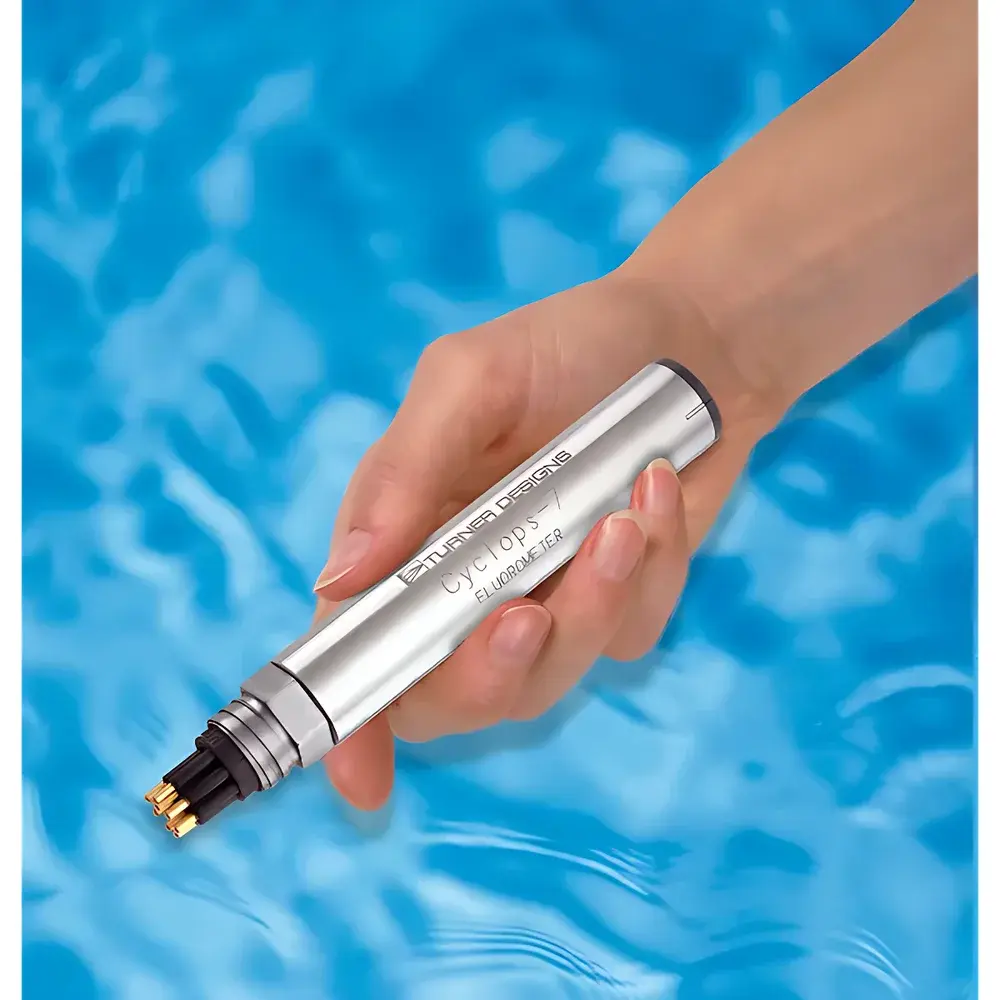
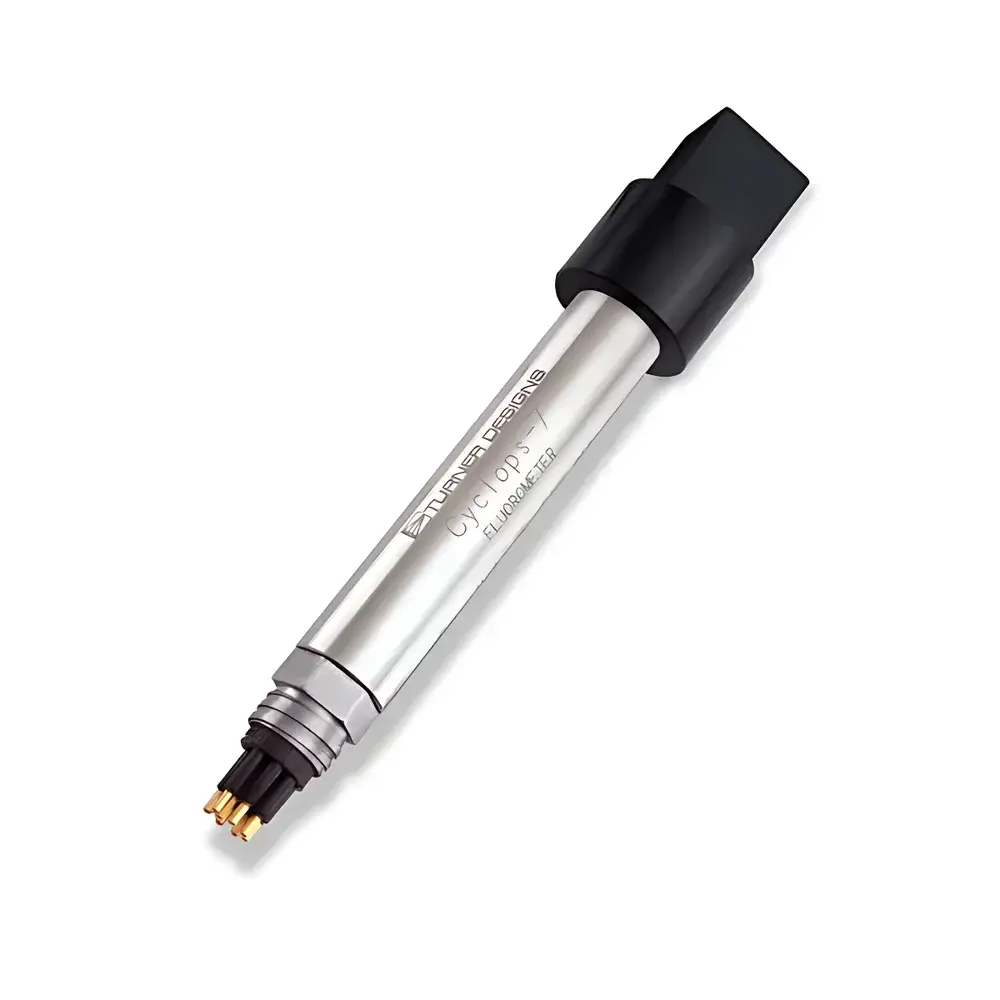
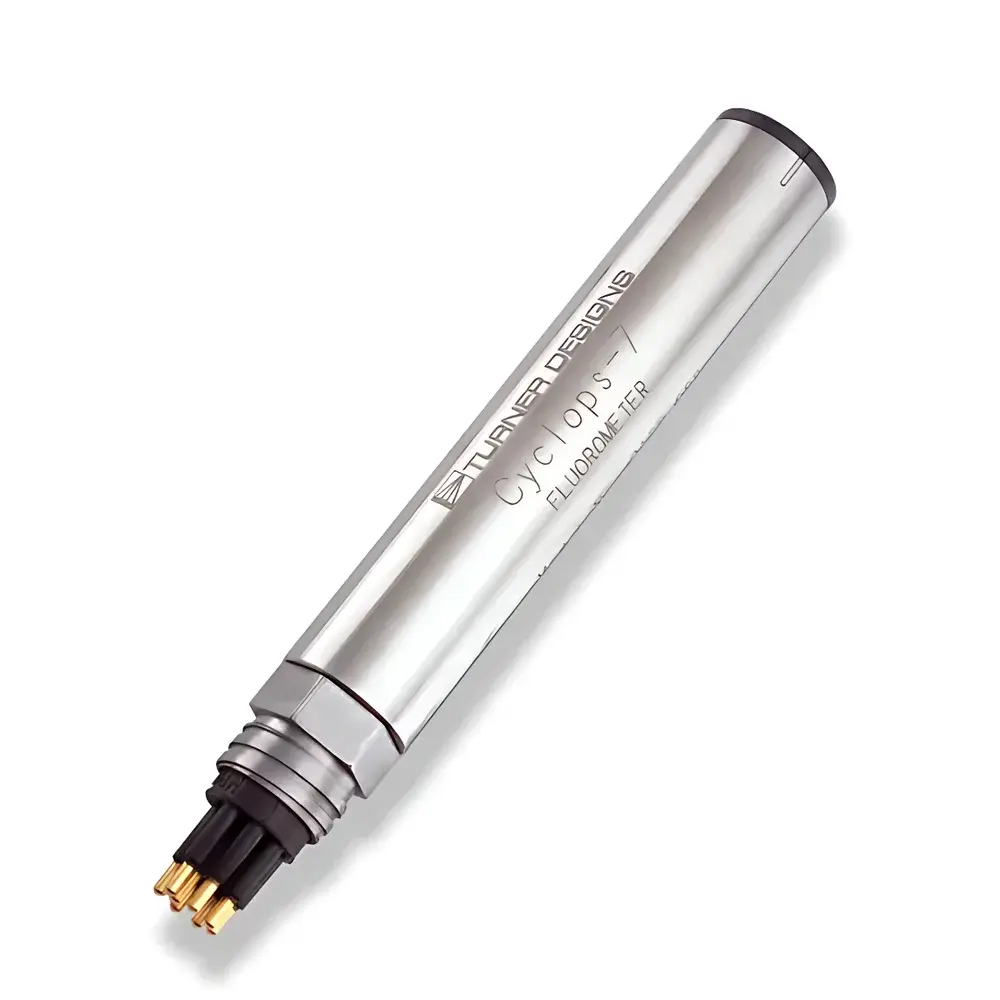
Turner Designs C7 CDOM Fluorescence Probe
| Brand | Turner Designs |
|---|---|
| Origin | USA |
| Model | C7 CDOM |
| Instrument Type | Online Water Quality Analyzer |
| Measured Parameter | Colored Dissolved Organic Matter (CDOM) |
| Detection Principle | UV-Excited Fluorescence |
| Excitation Wavelength | ~370 nm (broadband UV) |
| Emission Detection | Blue-region fluorescence (~450 nm) |
| Output Signal | Analog (4–20 mA) and/or Digital (RS-485/Modbus) |
| Operating Temperature | 0–40 °C |
| Pressure Rating | 0–10 bar |
| Cable Length | Standard 10 m (customizable) |
| Material | 316 Stainless Steel Housing, Sapphire Optical Window |
| Compliance | IP68, CE, RoHS |
Overview
The Turner Designs C7 CDOM Fluorescence Probe is an engineered, field-deployable optical sensor designed for continuous, in-situ quantification of Colored Dissolved Organic Matter (CDOM) in natural and engineered water systems. CDOM—comprising humic substances, fulvic acids, and other chromophoric organic compounds—exhibits characteristic ultraviolet absorption and subsequent blue-wavelength fluorescence upon excitation. The C7 probe leverages this intrinsic photophysical property using a stable, low-power UV LED source centered near 370 nm and a broadband optical path optimized to capture the resultant fluorescence emission peak between 440–470 nm. Unlike absorbance-based methods, fluorescence detection provides high sensitivity (sub-ppb equivalent CDOM concentration resolution), minimal interferences from turbidity or suspended solids, and real-time response without reagents or sample extraction. Its robust stainless steel housing, sapphire optical window, and IP68-rated construction ensure long-term stability in rivers, estuaries, wastewater outfalls, reservoirs, and coastal monitoring networks.
Key Features
- UV-excited fluorescence detection specifically calibrated for natural CDOM spectral signatures
- Broadband optical filter design accommodates variability in CDOM source composition (terrestrial vs. marine vs. anthropogenic)
- Simultaneous analog (4–20 mA) and digital (RS-485 Modbus RTU) output for seamless integration with SCADA, PLC, or data loggers
- No consumables, reagents, or moving parts—designed for unattended operation over 12+ months
- Temperature-compensated signal processing to maintain accuracy across 0–40 °C operational range
- Low power consumption (<1.5 W), suitable for solar-powered remote stations
- Factory-calibrated against reference CDOM standards traceable to NIST-traceable spectrofluorometric protocols
Sample Compatibility & Compliance
The C7 CDOM probe operates directly in situ—fully submersible in freshwater, brackish, and seawater matrices without filtration or pretreatment. It is validated for use in turbidities up to 100 NTU and salinities up to 35 ppt. While not a regulatory compliance instrument per se, its measurement principle aligns with EPA Method 415.3 (for dissolved organic carbon estimation via UV absorbance) and supports data collection consistent with ISO 10523 (water quality — determination of pH) and ASTM D5905 (standard practice for fluorescence spectroscopy of natural waters). Data integrity meets GLP-aligned field documentation requirements; optional timestamped output enables audit-ready logging for environmental reporting frameworks including US EPA NPDES and EU WFD monitoring programs.
Software & Data Management
Turner Designs provides the free C7 Configuration Utility (Windows/macOS) for probe setup, zero/span calibration, linearization coefficient adjustment, and firmware updates. Raw fluorescence intensity values are output as normalized relative fluorescence units (RFU), convertible to CDOM-equivalent concentrations (e.g., QSU or mg/L DOC proxy) using site-specific empirical calibrations. When integrated with third-party platforms (e.g., Campbell Scientific LoggerNet, OSIsoft PI, or Ignition SCADA), the probe supports automated QA/QC flagging, drift correction algorithms, and time-series visualization. All communication adheres to Modbus RTU protocol—enabling interoperability in multi-sensor networks without proprietary gateways. Audit trails, calibration history, and diagnostic logs are retained locally on host controllers compliant with 21 CFR Part 11 if paired with validated data acquisition systems.
Applications
- Real-time tracking of terrestrial organic matter loading in riverine and estuarine systems
- Detection of wastewater effluent plumes via CDOM fluorescence “fingerprints” distinct from background signals
- Supporting satellite ocean color validation campaigns (e.g., matching in-situ CDOM with MODIS or Sentinel-3 OLCI reflectance bands)
- Early warning of phytoplankton bloom collapse or bacterial respiration shifts linked to DOM lability
- Long-term trend analysis in climate-sensitive watersheds where CDOM serves as a proxy for permafrost thaw or peatland degradation
- Process control in drinking water treatment plants—monitoring raw water CDOM to optimize coagulant dosing
FAQ
How does the C7 differ from laboratory fluorometers?
The C7 is optimized for rugged, continuous field deployment—not benchtop precision. It uses fixed optical geometry and factory calibration for stability over time, rather than adjustable slits or monochromators.
Can it distinguish between humic-like and protein-like FDOM components?
No—its broadband detection integrates total blue fluorescence. For spectral deconvolution, lab-based EEMs (excitation-emission matrices) or multi-wavelength probes (e.g., Turner’s Cyclops-7 series) are required.
Is temperature compensation automatic?
Yes—integrated thermistor and embedded algorithm correct fluorescence yield drift across the specified operating range.
What maintenance is required?
Annual cleaning of the sapphire window with isopropyl alcohol and soft lens tissue; biannual verification against a stable reference standard is recommended for critical applications.
Does it comply with drinking water regulations?
It does not measure regulated contaminants directly but provides surrogate data used in risk-informed decision-making under US EPA Guidance for Source Water Monitoring and WHO Water Safety Plans.







