
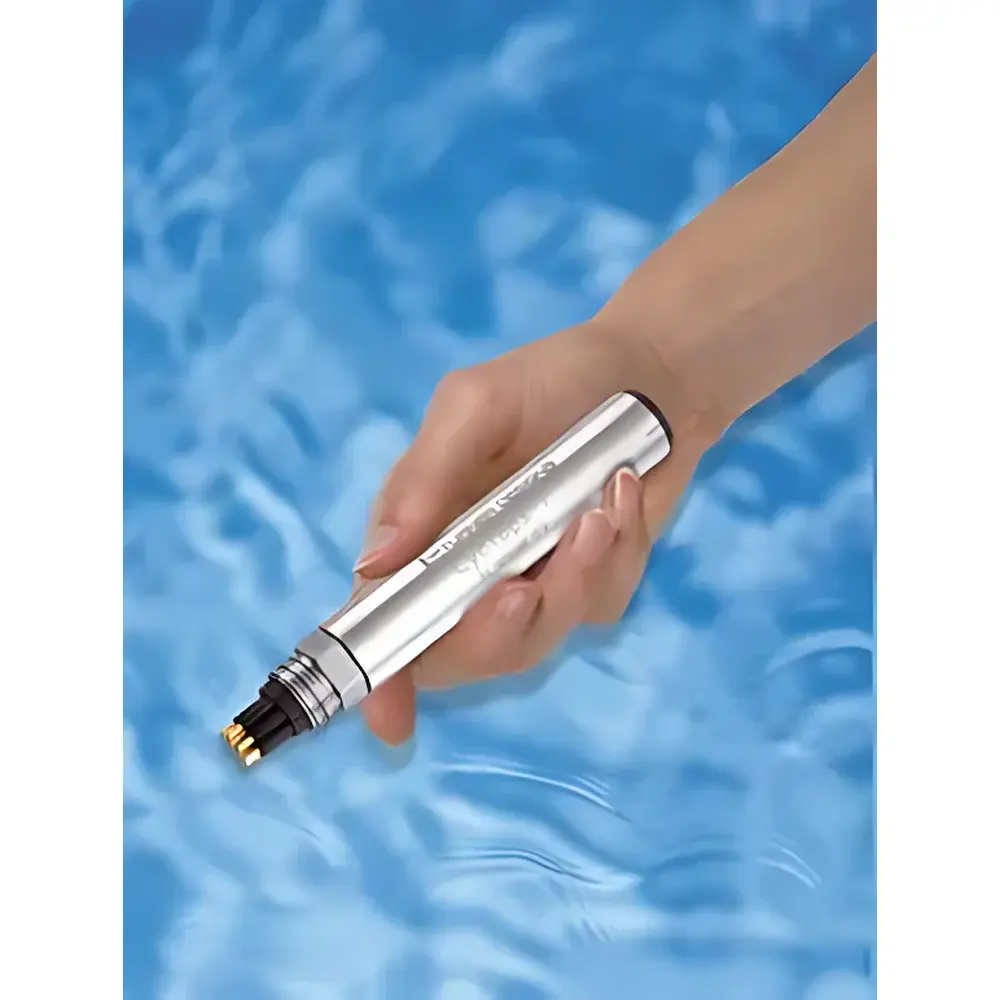
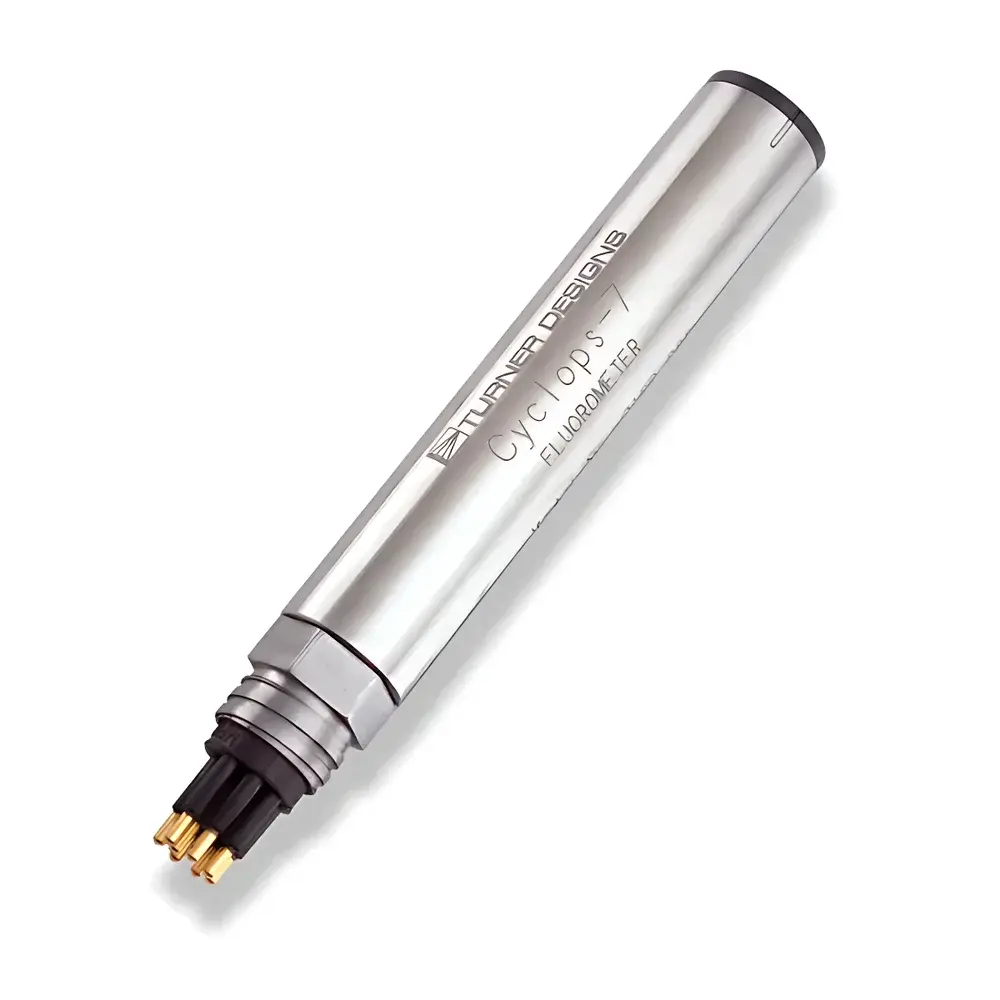
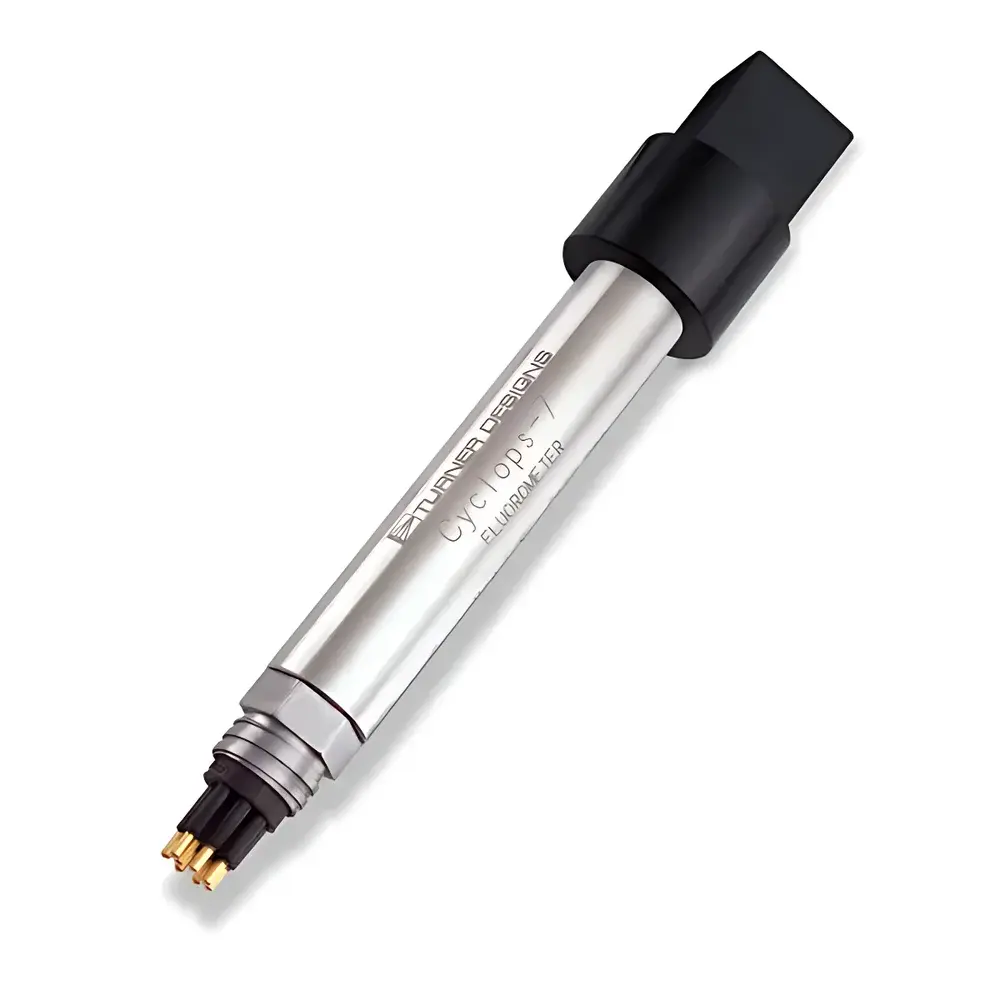
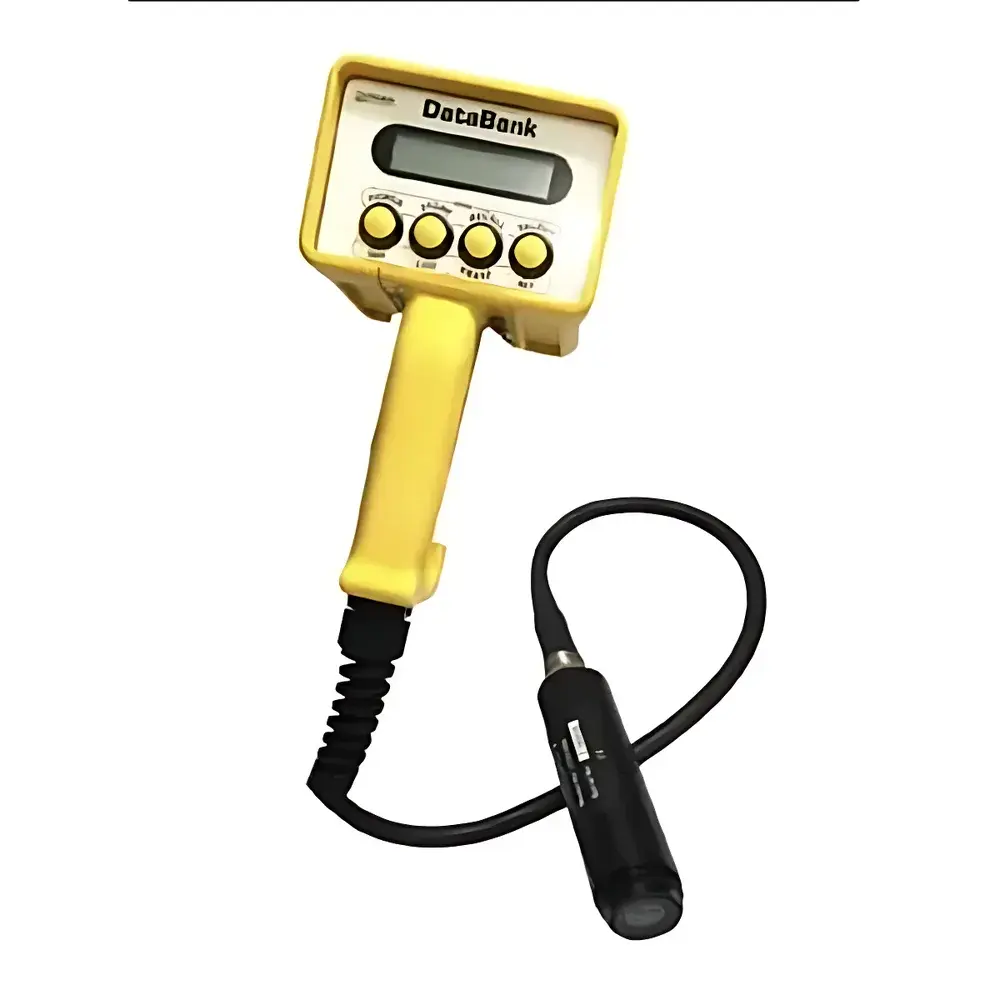
Turner Designs Cyclops-7 Chlorophyll a and Algal Pigment Fluorescence Sensor
| Brand | Turner Designs |
|---|---|
| Origin | USA |
| Model | C7 |
| Output Signal | 0–5 VDC |
| Operating Voltage | 3–15 VDC |
| Power Consumption | < 300 mW |
| Dimensions | 14.48 × 2.23 cm |
| Weight | 160 g |
| Depth Rating | 600 m |
| Temperature Range (Ambient) | 0–5 °C |
| Temperature Range (Water) | −2–50 °C |
| Turbidity Interference Rejection | Yes |
| Linear Correlation Coefficient (R²) | ≥ 0.99 |
| Detection Limits & Ranges | Chlorophyll a: 0.025–500 µg/L |
| Cyanobacteria | 150–150,000 cells/mL |
| Rhodamine WT | 0.01–1000 ppb |
| Fluorescein | 0.01–500 ppb |
| Crude Oil (quinine sulfate equivalent) | 0.2–2700 ppb |
| Refined Oil (1,5-naphthalenedisulfonic acid disodium salt) | 2–10,000 ppb |
| CDOM (quinine sulfate) | 0.15–1250 ppb |
| CDOM (quinine bisulfate) | 0.5–5000 ppb |
| Fluorescent Whitening Agents (quinine sulfate) | 0.6–15,000 ppb |
| Turbidity | 0.05–3000 NTU |
Overview
The Turner Designs Cyclops-7 Chlorophyll a and Algal Pigment Fluorescence Sensor (Model C7) is a compact, submersible in-situ fluorometer engineered for high-fidelity detection of naturally occurring and tracer fluorescent compounds in aquatic environments. Based on pulsed LED excitation and synchronous fluorescence detection, the sensor employs wavelength-specific optical filters and temperature-compensated photodiode detection to deliver quantitative, interference-resistant measurements across multiple analytes—including chlorophyll a, phycocyanin, phycoerythrin, CDOM (colored dissolved organic matter), rhodamine WT, fluorescein, petroleum hydrocarbons, and refined oil tracers. Its solid-state optical architecture eliminates moving parts and ensures long-term stability in demanding field deployments—from coastal oceanography and limnological monitoring to wastewater effluent tracking and dye-tracing studies.
Key Features
- Submersible design rated to 600 meters depth, with pressure-balanced housing and corrosion-resistant 316 stainless steel end caps
- Low-power operation (< 300 mW) enabling extended battery-powered deployment or integration into low-power telemetry platforms
- Three programmable gain settings to optimize signal-to-noise ratio across broad concentration ranges without manual recalibration
- Digital temperature compensation algorithm integrated into firmware to correct for thermal drift in fluorescence quantum yield
- Optical path geometry and spectral filtering engineered to minimize turbidity-induced scattering artifacts—validated per ASTM D5848-19 for suspended solids interference mitigation
- Standard 0–5 VDC analog output compatible with industry-standard data loggers, SCADA systems, and multi-parameter sondes (e.g., YSI EXO, In-Situ Aqua TROLL)
- Compact cylindrical form factor (14.48 cm × 2.23 cm; 160 g) facilitating mounting on buoys, profilers, AUVs, and fixed-platform moorings
Sample Compatibility & Compliance
The Cyclops-7 C7 sensor is validated for direct immersion in natural freshwater, marine, estuarine, and treated wastewater matrices. Its optical configuration meets ISO 10260:2021 requirements for in-situ fluorometric determination of chlorophyll a in phytoplankton-rich waters. For regulatory applications involving tracer studies (e.g., EPA Method 1600 for microbial source tracking), the rhodamine WT and fluorescein channels comply with USGS TWRI 3-A12 protocols for dye dilution analysis. The sensor’s analog output linearity (R² ≥ 0.99 across all calibrated ranges) satisfies data quality objectives outlined in EPA QA/G-5S and ASTM D7212-18 for field-deployable fluorescence sensors. No sample filtration or pretreatment is required—real-time measurement occurs within the native water column.
Software & Data Management
While the C7 operates as a stand-alone analog sensor, it is fully interoperable with Turner Designs’ Cyclops Configuration Utility (Windows-based) for gain setting, zero calibration, and spectral channel selection. Raw voltage outputs are traceable to NIST-traceable fluorescence standards (e.g., quinine sulfate dihydrate in 0.1 M H2SO4). When integrated into GLP-compliant monitoring networks, the sensor supports audit-ready data logging when paired with compliant dataloggers featuring time-stamped, tamper-evident storage and 21 CFR Part 11–enabled electronic signatures. Firmware updates preserve backward compatibility and include embedded diagnostic flags for lamp intensity decay and detector saturation events.
Applications
- High-frequency chlorophyll a profiling in eutrophication studies and harmful algal bloom (HAB) early warning systems
- In-situ quantification of cyanobacterial biomass via phycocyanin fluorescence (excitation 620 nm / emission 650 nm)
- CDOM mapping for watershed carbon flux modeling and dissolved organic carbon (DOC) estimation
- Real-time tracking of hydrocarbon spills using crude oil and refined fuel fluorescence signatures (excitation 370 nm / emission 420 nm)
- Validation of numerical dispersion models using rhodamine WT or fluorescein dye injection experiments
- Long-term biofouling resistance assessment in intake monitoring for power plant cooling systems
FAQ
Is the Cyclops-7 C7 suitable for continuous unattended deployment?
Yes—the sensor is rated for continuous submersion at temperatures from −2 °C to 50 °C and depths up to 600 m. Its low power draw and sealed optical path support multi-month deployments when paired with appropriate power management and antifouling strategies.
How is turbidity interference mitigated in natural waters?
The C7 uses dual-wavelength referencing and optimized excitation/emission bandpass filtering to distinguish true fluorescence signal from broadband scattering. Validation testing per ASTM D5848-19 confirms minimal bias (< ±5%) up to 3000 NTU in representative sediment-laden waters.
Can the sensor be calibrated in the field?
Zero calibration is performed in situ using dark-water reference or deionized water; span calibration requires traceable standard solutions (e.g., chlorophyll a in acetone, rhodamine WT in deionized water) and is typically conducted pre-deployment or during maintenance cycles.
What data validation protocols apply to regulatory reporting?
When used with compliant dataloggers, raw voltage outputs meet EPA SW-846 Method 8015M and ISO 17025 documentation requirements. Calibration certificates, drift checks, and environmental metadata must be archived per project-specific QA/QC plans.
Does the C7 support digital communication protocols such as SDI-12 or RS-485?
No—the C7 provides only analog 0–5 VDC output. For digital integration, users deploy external analog-to-digital converters or select Turner Designs’ Cyclops-7 variants with embedded SDI-12 or Modbus RTU interfaces.
Related Products







