
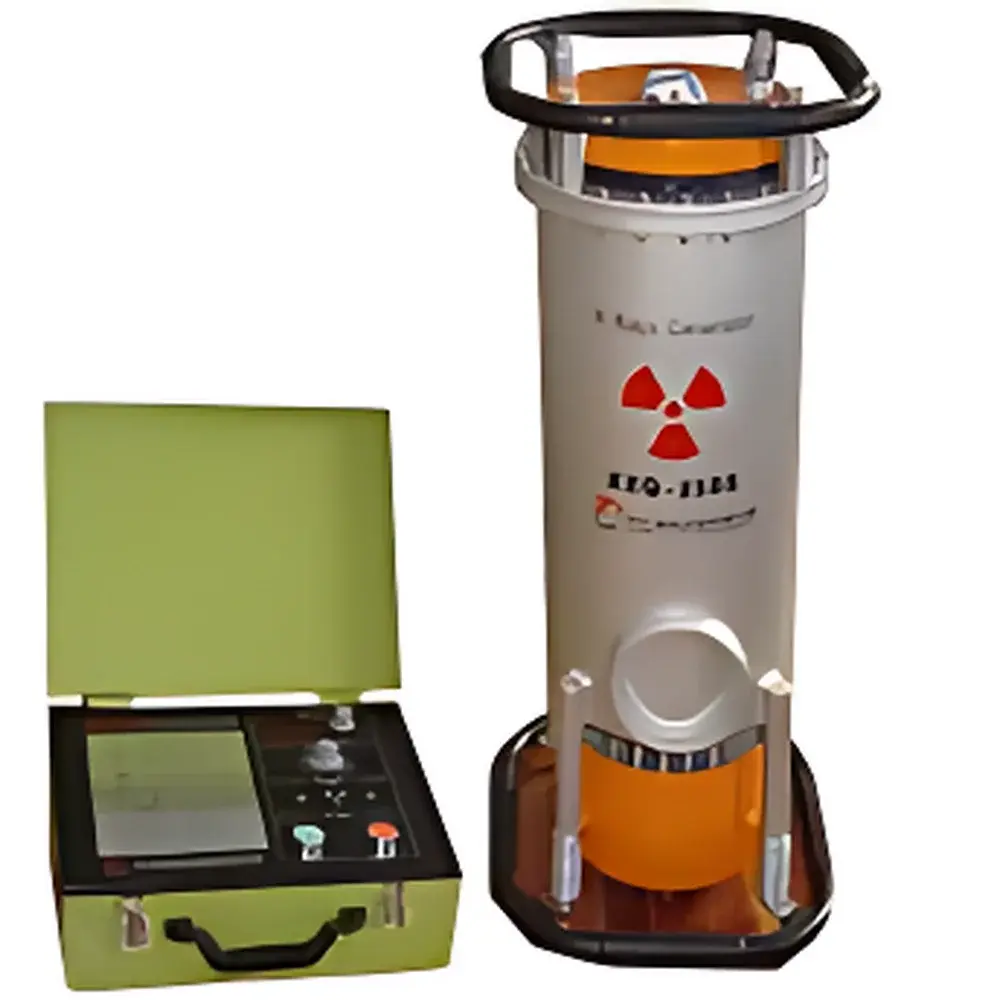
Tongda XXQ-Series Portable X-ray Radiographic Inspection Systems
| Brand | Tongda |
|---|---|
| Model Series | XXQ-1005, XXQ-1605, XXQ-2005, XXQ-2505, XXQ-3005, XXQ-3205, XXQ-3505 |
| X-ray Tube Voltage Range | 50–350 kV |
| Power Input | 1.2–3.4 kW |
| Focal Spot Size | 0.8×0.8 to 3.5×3.5 mm |
| Radiation Beam Angle | 40° or 40°+5° |
| Max Penetration in A3 Steel | 8–60 mm |
| Generator Weight | 11.1–47 kg |
| Generator Dimensions (L×W×H) | 190×190×520 to 345×345×830 mm |
Overview
The Tongda XXQ-Series Portable X-ray Radiographic Inspection Systems are compact, field-deployable radiographic units engineered for non-destructive evaluation (NDE) of welds, castings, and structural components in situ. Based on pulsed or continuous DC high-voltage X-ray generation, these systems operate on the principle of differential X-ray attenuation—where variations in material density and thickness produce contrast on radiographic film or digital detectors. Designed for use in fabrication yards, pipeline maintenance sites, shipyards, and aerospace repair facilities, the XXQ-Series delivers consistent beam quality and geometric sharpness across its voltage range (50–350 kV), enabling reliable detection of volumetric discontinuities—including porosity, slag inclusions, lack of fusion, and internal cracks—in ferrous and non-ferrous materials such as mild steel (A3), aluminum alloys, and rubber-reinforced composites.
Key Features
- Modular portable architecture: Separated X-ray tube head and high-voltage generator enable flexible positioning and access to confined or elevated inspection zones.
- Adjustable kV output: Seven model variants (XXQ-1005 to XXQ-3505) provide scalable energy levels—optimized for varying wall thicknesses and material densities without requiring system replacement.
- Precision focal spot control: Focal sizes from 0.8×0.8 mm (XXQ-1005) to 3.5×3.5 mm (XXQ-3205/3505) balance spatial resolution and heat dissipation for sustained duty cycles.
- Fixed-beam geometry: 40° nominal radiation angle (with ±5° tolerance on higher models) ensures repeatable exposure field coverage and minimizes scatter-induced image fogging.
- Ruggedized mechanical design: Aluminum alloy housings, IP54-rated enclosures, and shock-absorbing mounting interfaces support operation in ambient temperatures from –10°C to +45°C and relative humidity up to 85% non-condensing.
- Integrated safety interlocks: Automatic beam shutdown upon cable disconnection, overtemperature sensing, and real-time kV/mA monitoring comply with IEC 61331-1 and GBZ 13790 occupational radiation safety guidelines.
Sample Compatibility & Compliance
The XXQ-Series is validated for radiographic inspection of metallic and composite specimens conforming to ASTM E94/E1742 (Standard Guide for Radiographic Examination) and ISO 5579 (Non-destructive testing — Radiographic testing of metallic materials using film and X- or gamma-rays). It supports both film-based (ASTM E1815 Class II/III) and digital detector array (DDA) workflows per EN 14784-1. Penetration capability in A3 carbon steel ranges from 8 mm (XXQ-1005 at 100 kV) to 60 mm (XXQ-3505 at 350 kV), with typical sensitivity ≤2% under standard IQI (Image Quality Indicator) conditions per ASTM E1025. Units meet Chinese national standards JB/T 9402 (Industrial X-ray Equipment) and are CE-marked for EMC and low-voltage directive compliance.
Software & Data Management
While the core XXQ-Series operates as a hardware-only radiographic source, it is fully compatible with third-party digital radiography (DR) acquisition software—including D-Tect Systems’ DRView, Varex Imaging’s XpressDR, and Nikon Metrology’s CT Pro—enabling DICOM-compliant image capture, contrast enhancement, measurement annotation, and audit-trail logging. When integrated with GLP/GMP-regulated environments, optional USB-connected dosimetry loggers and time-stamped exposure records support 21 CFR Part 11–compliant data integrity requirements. All generator parameter settings (kV, mA, exposure time) are retained in non-volatile memory and can be exported via RS-232 or USB-C interface for traceability in QA documentation.
Applications
- Field weld inspection in pressure vessels, boilers, and ASME Section VIII / API 1104–certified piping systems.
- In-service assessment of railcar underframes, bridge gusset plates, and offshore platform nodes where disassembly is impractical.
- Quality assurance of aluminum die-cast housings, turbine blade root attachments, and rubber-metal bonded joints in automotive and aerospace MRO operations.
- Educational use in NDT training centers for hands-on radiographic technique development per ISO 9712 Level 2 syllabi.
- Emergency response scenarios requiring rapid defect localization in disaster-damaged infrastructure (e.g., post-earthquake building assessments).
FAQ
What radiation safety certifications apply to the XXQ-Series?
All models are type-tested per GBZ 13790 and IEC 61331-1; individual unit certification requires site-specific shielding verification and local regulatory registration.
Can the XXQ-Series be used with computed radiography (CR) phosphor plates?
Yes—compatible with all industrial-grade CR readers operating within ANSI N42.45 exposure latitude specifications.
Is remote kV/mA control available?
Standard configuration includes manual front-panel adjustment; optional external control module (Tongda RC-2000) enables programmable exposure sequencing via 0–10 V analog or Modbus RTU interface.
What is the recommended maintenance interval for the X-ray tube?
Annual vacuum integrity check and filament resistance test are advised; typical tube service life exceeds 5,000 hours at rated power with proper cooling and handling protocols.
Does the system support real-time radiography (RTR)?
No—the XXQ-Series is optimized for static or step-and-shoot exposures; real-time imaging requires separate fluoroscopic equipment with intensified detectors.
Related Products



