
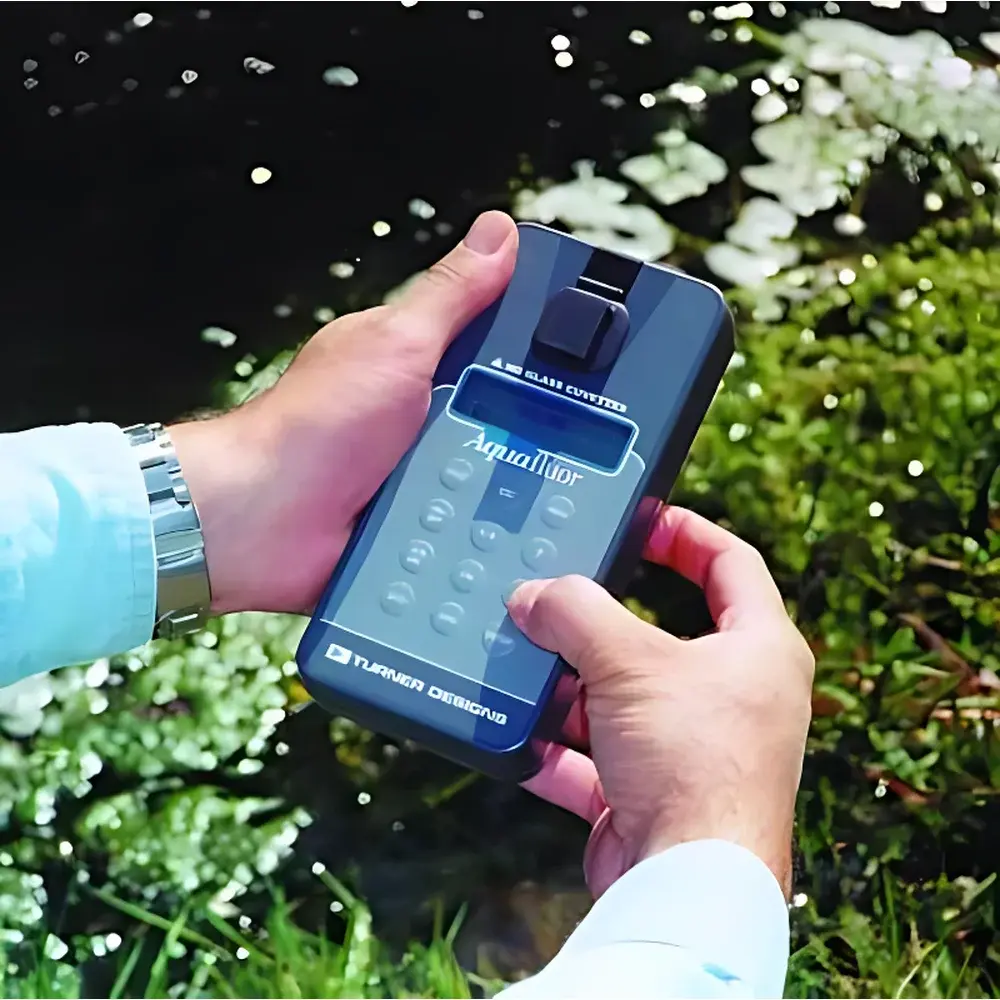
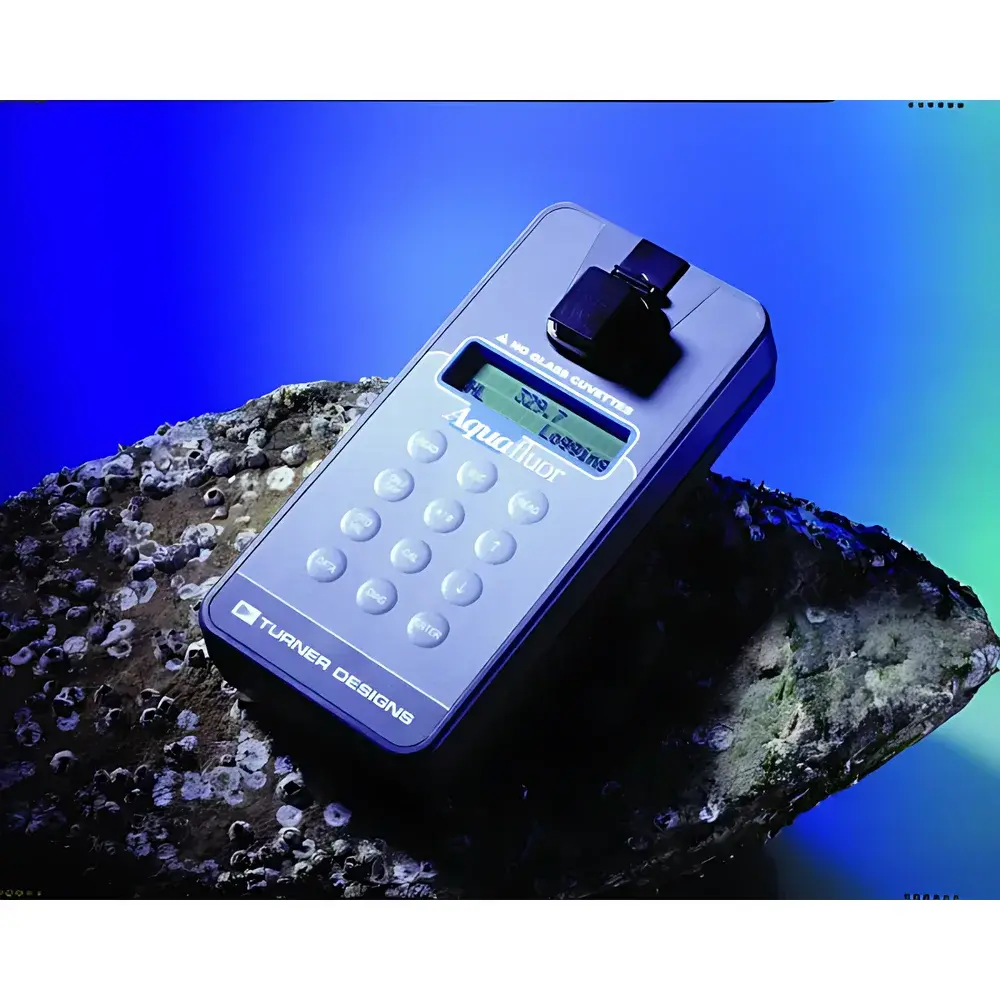
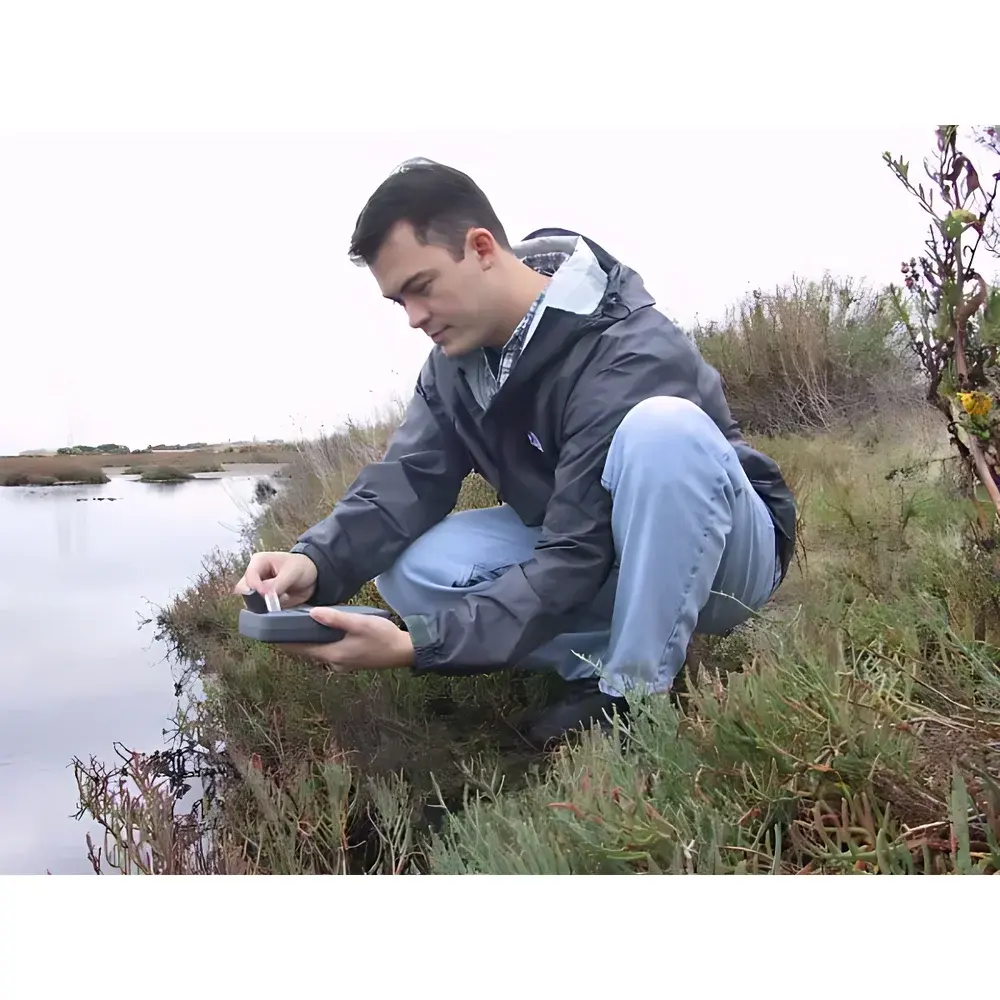
Turner Designs Aquafluor Handheld Fluorometer
| Brand | Turner Designs |
|---|---|
| Model | Aquafluor |
| Origin | USA |
| Type | Portable Dual-Channel Fluorometer and Turbidimeter |
| Detection Channels | Live Chlorophyll a, Extracted Chlorophyll a, Phycocyanin (Cyanobacteria), Phycoerythrin (Red Algae), Rhodamine WT, Fluorescein, Ammonium, CDOM, Optical Brighteners, Turbidity |
| LODs | Chlorophyll a (live): 0.3 µg/L |
| Chlorophyll a (extracted) | 0.5 µg/L |
| Ammonium | 0.1 µmol/L |
| CDOM | 0.1 ppb |
| Cyanobacteria | 150 cells/mL |
| Turbidity | 0.5 NTU |
| Range | Chlorophyll a up to 300 µg/L |
| Resolution | 12-bit |
| Dynamic Range | 3-digit |
| IP Rating | IP67 |
| Operating Temperature | 5–40 °C |
| Dimensions | 4.45 × 8.9 × 18.4 cm |
| Weight | 0.4 kg |
| Power | Two AAA batteries |
| Warm-up Time | <5 seconds |
Overview
The Turner Designs Aquafluor Handheld Fluorometer is an engineered field-deployable instrument designed for rapid, in-situ quantification of fluorescent and turbidimetric analytes in natural and treated waters. Based on solid-state optical architecture and dual-channel excitation/emission detection, the Aquafluor employs calibrated LED sources and matched photodiode detectors to deliver reproducible fluorescence intensity measurements traceable to NIST-standard reference materials. Its core measurement principle relies on the intrinsic fluorescence quantum yield of target compounds—such as chlorophyll a (excited at 460 nm, emitted at 685 nm), phycocyanin (620/650 nm), or fluorescein (490/520 nm)—while simultaneously correcting for optical interferences via concurrent turbidity measurement at 850 nm. This dual-channel capability enables real-time compensation for scattering effects, enhancing accuracy in variable-matrix field samples without requiring dilution or filtration.
Key Features
- Dual-Channel Simultaneous Measurement: Independent optical paths allow concurrent fluorescence and turbidity readouts from a single sample aliquot—critical for correcting scattering-induced quenching in algal biomass estimation.
- Ruggedized Field Design: IP67-rated housing ensures full dust ingress protection and submersion tolerance up to 1 meter for 30 minutes, validated per IEC 60529 standards.
- Low-Power, Rapid-Deployment Architecture: Powered by two standard AAA alkaline batteries with <5-second warm-up time; no external charger or docking station required.
- High-Fidelity Signal Processing: 12-bit analog-to-digital conversion and three-decade dynamic range support quantitative analysis across orders-of-magnitude concentration gradients.
- Modular Channel Configuration: Pre-calibrated factory settings for eight application-specific modes—including live vs. extracted chlorophyll a, cyanobacterial phycocyanin, ammonium (via o-phthalaldehyde derivatization), CDOM, rhodamine WT, fluorescein, optical brighteners, and ISO 7027-compliant turbidity.
- Ergonomic Portability: Compact form factor (4.45 × 8.9 × 18.4 cm) and 400 g mass enable one-handed operation and pocket carry—optimized for boat-based surveys, stream transects, and wastewater effluent monitoring.
Sample Compatibility & Compliance
The Aquafluor is validated for use with unfiltered or lightly filtered aqueous matrices, including freshwater lakes, estuarine systems, drinking water distribution networks, activated sludge supernatants, and coastal seawater (with salinity correction applied post-measurement). It complies with ASTM D7573–19 for field fluorometric determination of chlorophyll a and EPA Method 445.0 for in vivo algal pigment analysis. While not intended for GLP-regulated release testing, its stable calibration retention (<±2% drift over 8 hours) and non-volatile memory support audit-ready data collection under ISO/IEC 17025-aligned quality systems. Turbidity measurements meet ISO 7027:2016 optical requirements for ratio-based NIR detection at 850 nm.
Software & Data Management
Data are displayed in real time on the integrated LCD screen with user-selectable units (µg/L, cells/mL, NTU, ppb, etc.) and stored internally for up to 1,000 readings. Optional USB-C connectivity (via AquaLink cable) enables direct export to CSV or Excel-compatible formats for integration into LIMS platforms or statistical analysis workflows. Firmware updates preserve calibration coefficients and maintain traceability logs compliant with FDA 21 CFR Part 11 requirements when used with validated electronic record procedures. No proprietary cloud dependency—data sovereignty remains fully under user control.
Applications
- Real-time assessment of phytoplankton biomass and cyanobacterial bloom dynamics during limnological field campaigns.
- Wastewater treatment plant monitoring of nitrification/denitrification efficiency via ammonium trend analysis.
- Drinking water source protection programs tracking CDOM as a surrogate for dissolved organic carbon (DOC) loading.
- Oil-in-water detection in stormwater runoff using rhodamine WT spike recovery validation.
- Educational laboratory exercises demonstrating fluorescence quenching, inner-filter effects, and matrix interference correction.
- Regulatory compliance sampling where portable, battery-operated instrumentation is mandated by protocol (e.g., USACE ERDC guidelines).
FAQ
Is the Aquafluor suitable for seawater applications?
Yes—calibration offsets for salinity-induced refractive index shifts can be applied manually; recommended for salinities ≤35 ppt.
Can it measure chlorophyll a in preserved or frozen samples?
Only live chlorophyll a mode is optimized for intact cells; extracted chlorophyll a requires acidification and acetone solvent extraction prior to measurement.
How often does the instrument require recalibration?
Factory calibration is stable for 12 months under normal field use; annual verification against certified reference standards (e.g., Sigma-Aldrich chlorophyll a in acetone) is recommended.
Does it support custom excitation/emission wavelengths?
No—optical filters and LEDs are fixed per preconfigured channel; hardware modification voids warranty and calibration validity.
Is turbidity compensation automatic during fluorescence measurement?
Yes—turbidity-corrected fluorescence values are computed in real time using the dual-channel algorithm and displayed alongside raw NTU readings.
Related Products







