
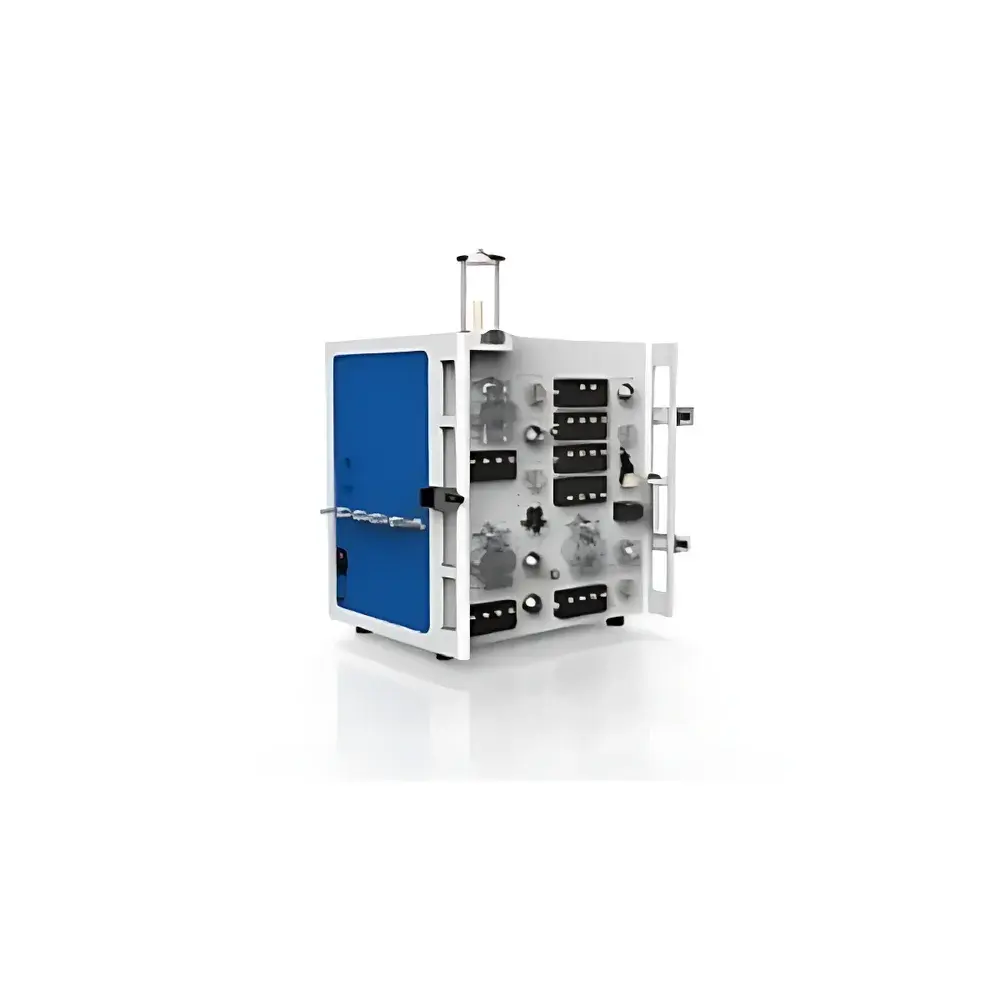
Flash Spectrum ClearFirst-4500 Medium-Pressure Protein Purification System
| Brand | Flash Spectrum |
|---|---|
| Origin | Shanghai, China |
| Model | ClearFirst-4500 |
| Flow Rate (System Pumps) | 0–1200 mL/min |
| Flow Rate (Sample Pump) | 0–600 mL/min |
| Pressure Range | 0.01–2 MPa (20 bar) at ≤600 mL/min |
| UV Wavelength Range | 190–850 nm |
| Wavelength Accuracy | ±1 nm |
| Wavelength Repeatability | ±0.2 nm |
| Optical Path Length | 2 mm |
| Conductivity Range | 0–999.9 mS/cm |
| Detection Channels | Quad-wavelength UV-Vis + Conductivity + Optional pH/Pressure |
| Collection Ports | 12-position fraction valve |
| Compliance | Designed for GLP-compliant protein purification workflows under ISO 22367 and USP <1058> analytical instrument qualification guidelines |
Overview
The Flash Spectrum ClearFirst-4500 is a medium-pressure, fully modular protein purification system engineered for high-reproducibility preparative chromatography of biomolecules—including recombinant proteins, monoclonal antibodies, viral vectors, plasmid DNA, and vaccine antigens. It operates on the principle of liquid chromatography under controlled pressure gradients, integrating dual high-precision piston pumps to generate stable, low-pulsation solvent delivery across four independent buffer channels. Unlike low-pressure peristaltic systems or passive gradient mixers, the ClearFirst-4500 employs active gradient formation with real-time flow and pressure feedback, enabling precise control over elution profiles in affinity, ion exchange, hydrophobic interaction, and size-exclusion chromatography. Its architecture supports both analytical-scale method development and process-scale purification (up to 100 mL column volumes), with full compatibility with standard FPLC-compatible resins (e.g., Sepharose, Capto, SOURCE, and POROS media). The system is validated for use in environments requiring documented instrument performance—meeting foundational requirements for IQ/OQ protocols per ASTM E2500 and supporting audit-ready data integrity under FDA 21 CFR Part 11 when deployed with appropriate software configuration.
Key Features
- Dual high-accuracy piston pumps (A/B) delivering 0–1200 mL/min with pulse dampening and pressure monitoring at pump outlet, column inlet, and column outlet—enabling proactive column protection and gradient fidelity.
- Quad-wavelength UV-Vis detector based on grating monochromator optics, offering selectable simultaneous detection at any four wavelengths between 190–850 nm; wavelength repeatability ±0.2 nm ensures consistent peak identification across batches.
- Integrated conductivity detector with 0–999.9 mS/cm range and temperature-compensated calibration—matching the transduction principle and signal-to-noise performance of leading commercial systems.
- Optional temperature-corrected pH sensor with ±0.02 pH unit accuracy and automatic electrode diagnostics—designed for real-time buffer pH monitoring during gradient transitions.
- 12-port fraction collection valve with programmable volume-, time-, or peak-triggered collection logic; supports direct integration with external refrigerated fraction collectors for stability-critical samples.
- Modular valve architecture including bypass, backflush, sample selection (8-channel), and buffer expansion (4-channel) manifolds—allowing flexible method reconfiguration without hardware modification.
- Large-volume sample injection module with dedicated 0–600 mL/min piston pump and high-pressure multiport injection valve—eliminating air entrapment and ensuring quantitative loading even for viscous lysates (≤5 cP).
Sample Compatibility & Compliance
The ClearFirst-4500 is constructed with bio-inert fluidic pathways (PEEK, stainless steel 316L, and fluoropolymer tubing), ensuring compatibility with common aqueous buffers—including Tris-HCl, phosphate, sodium acetate, imidazole, guanidine HCl, and low-concentration organic modifiers (≤20% ethanol or isopropanol). It supports columns from 10 mm to 50 mm ID and accommodates resin bead sizes from 10 µm to 100 µm. System validation documentation aligns with ISO 22367 (Good Chromatography Practice) and provides traceable parameters for IQ/OQ execution. When operated with audit-trail-enabled software (optional), it supports ALCOA+ data integrity principles and satisfies baseline expectations for GMP-aligned purification workflows as referenced in ICH Q5A(R2) and WHO TRS No. 1012 Annex 5.
Software & Data Management
The ClearFirst-4500 runs on the dedicated ClearFirst Workstation—a Windows-based application featuring intuitive graphical method editor, real-time chromatogram overlay, and integrated instrument self-diagnostic routines. All user actions—including method execution, parameter changes, and maintenance logs—are timestamped and attributed to individual accounts. The software includes a secure method library with version-controlled storage, electronic signature support (role-based access), and export capabilities compliant with CSV, PDF, and mzML metadata standards. Raw data files are stored in vendor-neutral HDF5 format with embedded acquisition metadata (wavelengths, flow rates, pressure traces, conductivity values), facilitating third-party analysis in tools such as Python (SciPy/Pandas) or MATLAB.
Applications
This system is routinely deployed in academic core facilities, biopharma R&D labs, and contract development and manufacturing organizations (CDMOs) for: purification of His-tagged and GST-fusion proteins using nickel-NTA or glutathione resins; polishing of monoclonal antibodies via multimodal cation exchange; removal of endotoxin and host cell proteins from bacterial expression supernatants; scalable isolation of AAV capsids by anion exchange; and high-yield plasmid DNA purification using immobilized metal affinity chromatography (IMAC) or ceramic hydroxyapatite. Its pressure and flow flexibility also enables rapid buffer exchange, column regeneration, and inline filtration validation—critical for process transfer from lab to pilot scale.
FAQ
What chromatographic techniques does the ClearFirst-4500 support?
It supports affinity, ion exchange, hydrophobic interaction, gel filtration, and mixed-mode chromatography—compatible with all major resin chemistries used in protein and nucleic acid purification.
Is the system compatible with regulatory submissions?
Yes—when configured with audit-trail software, electronic signatures, and validated installation/performance protocols, it meets foundational data integrity and traceability requirements for IND-enabling studies.
Can the system be integrated into a cold room or laminar flow environment?
Yes—the modular design allows separation of electronics cabinet from fluidic modules; optional chillers and column cooling jackets are available for temperature-sensitive separations.
Does the workstation support remote monitoring and control?
Yes—via secure RDP or web-based thin-client interface (optional license), enabling off-site method review, run initiation, and alarm notification through SMTP/SNMP protocols.
What level of technical support and service coverage is provided?
Flash Spectrum offers global field service engineering, annual preventive maintenance contracts, and certified training programs aligned with ISO/IEC 17025 competency frameworks.




