
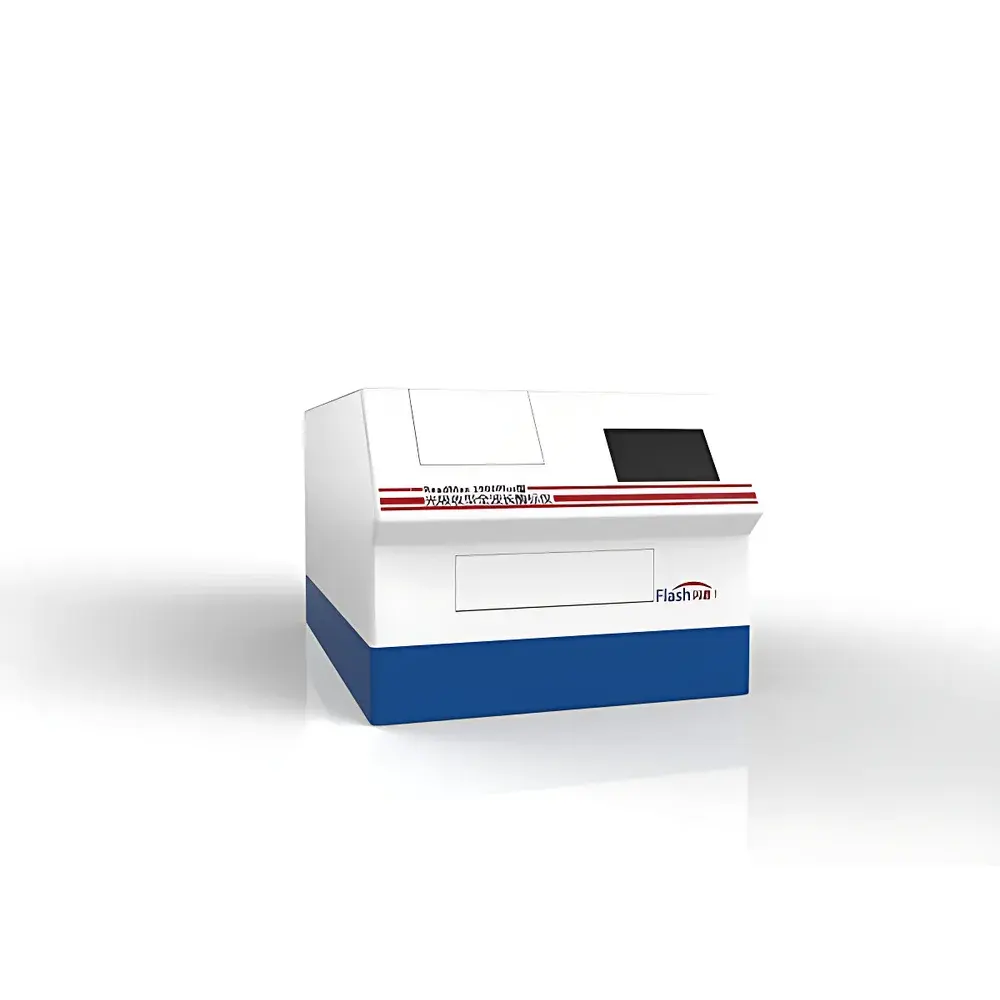
Flash Spectrum ReadMax 1900Plus UV-Vis Absorbance Microplate Reader
| Brand | Flash Spectrum |
|---|---|
| Origin | Shanghai, China |
| Model | ReadMax 1900Plus |
| Detection Principle | Absorbance (Photometric) |
| Wavelength Range | 190–1000 nm |
| Optical Density Range | 0–4.000 OD |
| Wavelength Accuracy | ±1.0 nm |
| Wavelength Repeatability | ≤0.2 nm |
| Spectral Bandwidth | 2–10 nm (configurable) |
| Temperature Control Range | Ambient to 65 °C |
| Plate Formats | Standard 96-well |
| Cuvette Mode | Integrated 1-cm pathlength cuvette port |
| Detection System | Dual photodiode detector (sample + reference) |
| Light Source | Pulsed xenon lamp |
| Kinetic & Spectral Scan Modes | Supported |
| Software Compliance | FDA 21 CFR Part 11, IQ/OQ/PQ validated, GLP/GMP-ready |
Overview
The Flash Spectrum ReadMax 1900Plus is a high-performance, grating-based UV-Vis absorbance microplate reader engineered for precision photometric quantification across life science and pharmaceutical research laboratories. Utilizing a pulsed xenon light source and a high-resolution monochromator, it delivers continuous spectral coverage from 190 nm to 1000 nm—enabling rigorous nucleic acid (A260/A280), protein (UV280, Bradford, Lowry), endotoxin (LAL), and immunoassay (endpoint ELISA/EIA) measurements with traceable wavelength accuracy (±1.0 nm) and exceptional optical stability. Its dual-detector architecture—featuring independent sample and reference photodiodes—minimizes drift and enhances reproducibility in kinetic assays and low-OD measurements. Unlike filter-based systems, the built-in grating monochromator eliminates the need for manual filter changes and supports flexible, user-defined wavelength selection at 1-nm increments. The instrument also integrates a dedicated 1-cm cuvette port, allowing direct UV-Vis spectrophotometric analysis of solution-phase samples without plate transfer—effectively functioning as a benchtop spectrophotometer while maintaining full microplate compatibility.
Key Features
- Grating-based monochromator with 190–1000 nm continuous scanning and configurable bandwidth (2–10 nm)
- Dual photodiode detection system with real-time reference compensation for improved baseline stability
- Integrated temperature-controlled incubation (ambient to 65 °C) with programmable ramping and hold profiles
- On-board orbital shaking (300–1200 rpm) with adjustable amplitude and duration for homogeneous mixing
- Cuvette-compatible optical path (1-cm fixed pathlength) enabling direct absorbance measurement of liquid samples
- Multi-mode acquisition: endpoint, kinetic, spectral scan, and dual/multi-wavelength ratiometric analysis
- Pulsed xenon lamp with >10⁹ shot lifetime and consistent intensity across UV and visible ranges
- Optical density linearity validated to 4.000 OD with <2% deviation across full dynamic range
- Automated plate recognition and auto-zeroing routines for walk-away operation
- USB 2.0 interface for instrument control, data export, and remote software updates
Sample Compatibility & Compliance
The ReadMax 1900Plus accommodates standard ANSI/SLAS-compliant 96-well microplates—including clear, white, black, and UV-transparent polystyrene plates—as well as custom formats (6-, 24-, and 384-well plates available upon request). Its optical design supports both top- and bottom-read configurations for adherent cell assays and membrane-based detection. For regulatory environments, the system meets critical compliance requirements: software validation documentation supports IQ/OQ/PQ protocols; audit trail, electronic signature, and role-based access controls conform to FDA 21 CFR Part 11; and operational parameters align with GLP and GMP principles for QC release testing in biopharmaceutical manufacturing. All optical calibrations are traceable to NIST-certified neutral density filters and holmium oxide reference standards, ensuring metrological integrity across laboratory networks.
Software & Data Management
The S-Pro Microplate Analysis Workstation provides a modular, secure, and audit-ready computing environment. It features intuitive assay template creation, automated curve fitting (linear, quadratic, 4-/5-parameter logistic, log-logit, spline), and customizable report generation compliant with ISO/IEC 17025 reporting conventions. Raw absorbance data, metadata (user ID, timestamp, plate map, instrument settings), and processing history are stored in encrypted SQLite databases with immutable audit logs. Data export options include CSV, Excel (.xlsx), PDF, and XML formats compatible with LIMS integration. The software supports multi-user management, instrument parameter locking, and firmware update tracking—all accessible via password-protected administrator mode. Validation packages—including URS, FRS, DQ/IQ/OQ/PQ test scripts and summary reports—are supplied with each system for regulated lab deployment.
Applications
The ReadMax 1900Plus serves as a core analytical platform across diverse workflows: DNA/RNA quantification and purity assessment (A260/A280, A260/A230); protein concentration determination using UV280, Bradford, Lowry, or BCA methods; endpoint and kinetic ELISA/EIA for cytokine, hormone, or antibody titer analysis; cell viability and cytotoxicity screening (MTT, XTT, resazurin); microbial growth monitoring (OD600); endotoxin quantification via chromogenic LAL assay; ADME-related metabolic stability studies (e.g., cytochrome P450 activity); and enzyme kinetics (Vmax/Km determination). Its broad spectral range further enables pigment analysis (chlorophyll, carotenoids), dye-binding assays, and redox indicator quantification (e.g., NADH/NADPH at 340 nm).
FAQ
Does the ReadMax 1900Plus support FDA 21 CFR Part 11 compliance?
Yes—the S-Pro software includes electronic signatures, audit trails, user authentication, and data integrity safeguards fully aligned with Part 11 requirements.
Can it perform spectral scans and generate full UV-Vis absorption spectra?
Yes—scanning resolution is 1 nm, with customizable start/stop wavelengths and step intervals; spectra are exportable as XY data files.
Is temperature control available during kinetic measurements?
Yes—incubation is maintained throughout kinetic runs, with real-time temperature logging synchronized to absorbance acquisition.
What calibration standards are recommended for routine verification?
NIST-traceable neutral density filters (0.3–3.0 OD) and holmium oxide solution (for wavelength verification at 241.1, 279.4, 287.5, 333.7, 360.9, 418.5, 480.0, 536.2 nm) are recommended annually.
Is third-party LIMS integration supported?
Yes—via standardized CSV/Excel exports and optional API extensions for HL7 or ASTM E1384-compliant data exchange.



