
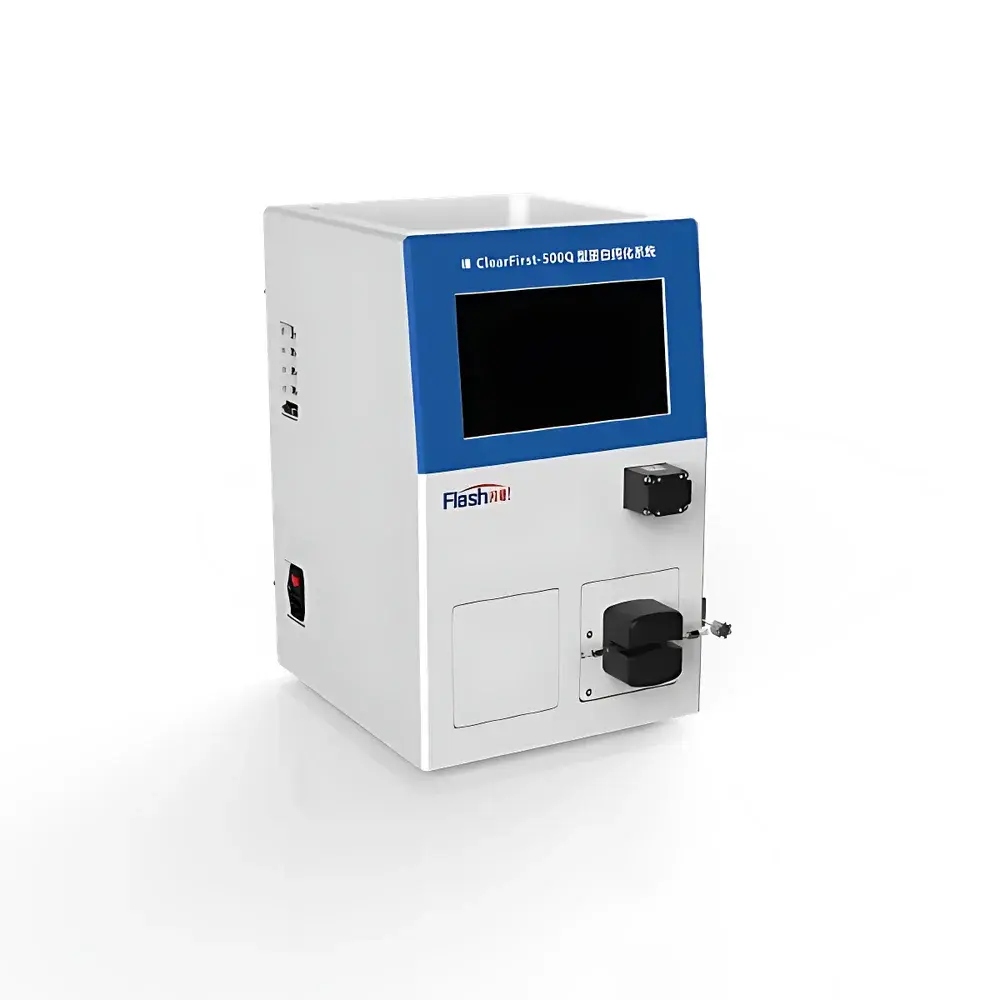
Flash Spectrum ClearFirst-500Q Protein Purification System
| Brand | Flash Spectrum |
|---|---|
| Origin | Shanghai, China |
| Model | ClearFirst-500Q |
| Flow Rate | 0–40 mL/min |
| Max Pressure | 0.2 MPa (2 bar / 30 psi) |
| UV Wavelength | 280 nm ±3 nm |
| Optical Path Length | 2 mm |
| Detector Type | LED-based Single-Wavelength UV Detector |
| Gradient Formation | Precision Three-Position Solvent Selection Valve |
| Control Interface | Embedded Android Touchscreen + Optional PC Software (ClearFirst PC Edition) |
| Sample Compatibility | Aqueous Buffers for Biomolecule Purification |
| Tubing Material | Biocompatible, Low-Adsorption, Pressure-Rated Polymer |
| Compliance | Designed for GLP-aligned workflows |
Overview
The Flash Spectrum ClearFirst-500Q Protein Purification System is an integrated, benchtop-scale liquid chromatography platform engineered for reproducible isolation and purification of proteins, nucleic acids, and other biomacromolecules under mild aqueous conditions. Based on low-pressure liquid chromatography (LPLC) principles, the system employs precise peristaltic pumping, digitally controlled gradient formation via a three-position solvent selection valve, and real-time multi-parameter detection to support affinity, ion exchange, hydrophobic interaction, and size-exclusion chromatography (SEC/GFC). Operating within a maximum pressure limit of 0.2 MPa (2 bar), the ClearFirst-500Q is optimized for soft resin media—including agarose-, sepharose-, and polymer-based matrices—commonly used in laboratory-scale purification of recombinant proteins, monoclonal antibodies, viral vectors, and vaccine antigens. Its compact footprint (W × D × H < 45 × 40 × 35 cm) enables seamless integration into cold rooms or biosafety cabinets without compromising accessibility or serviceability.
Key Features
- High-stability peristaltic pump delivering smooth, pulse-minimized flow across the full 0–40 mL/min range—suitable for both analytical scouting and small-scale preparative runs.
- Digital gradient generation using a precision three-way valve eliminates mechanical drift and air entrapment associated with traditional gradient mixer cups, enabling linear, exponential, or step gradients with ≤1% CV inter-run reproducibility.
- LED-based 280 nm UV detector with 2 mm pathlength flow cell offers high signal-to-noise ratio, long-term photometric stability (>10,000 h LED lifetime), and wavelength accuracy within ±3 nm—ideal for monitoring aromatic amino acid absorbance during protein elution.
- Modular detection architecture: optional conductivity and pH sensors feature temperature-compensated electronics, calibrated flow cells, and analog-to-digital conversion synchronized with UV acquisition for co-registered multi-signal chromatograms.
- Embedded Android-based ClearFirst workstation provides intuitive touchscreen operation, method templating, real-time chromatogram overlay, and onboard storage for ≥10,000 chromatographic runs with timestamped metadata.
- Biocompatible fluidic path constructed from PEEK, ETFE, and medical-grade silicone tubing ensures minimal protein adsorption, low extractables, and compatibility with common sanitizing agents (e.g., 0.5 M NaOH, 70% ethanol).
- Comprehensive system diagnostics—including pump calibration verification, valve actuation test, detector baseline stability check, and sensor zero/span validation—accessible directly from the main interface.
Sample Compatibility & Compliance
The ClearFirst-500Q is validated for use with standard aqueous mobile phases employed in biomolecular purification, including Tris-HCl, phosphate, acetate, and citrate buffers (pH 3–10), with or without added salts (e.g., NaCl, (NH4)2SO4) or chaotropes (e.g., urea, guanidine HCl). It accommodates column diameters from 0.5 to 2.6 cm and bed heights up to 20 cm. While not certified for GMP manufacturing, the system supports Good Laboratory Practice (GLP) workflows through role-based user management (admin/operator/reviewer), electronic signatures (via optional PC software), and immutable audit trails compliant with FDA 21 CFR Part 11 requirements when deployed with ClearFirst PC Edition and validated IT infrastructure.
Software & Data Management
The embedded ClearFirst Android OS interface supports method creation, sequence definition, real-time parameter adjustment, and immediate export of chromatograms in .csv and .pdf formats. The optional ClearFirst PC Edition software extends functionality to include advanced peak integration (tangent skim, valley-to-valley), fraction triggering logic (time-, volume-, or threshold-based), batch report generation, and LIMS-compatible data export (ASTM E1384, HL7). All raw detector signals are time-stamped at 10 Hz resolution and stored with full instrument configuration metadata, enabling retrospective analysis and regulatory documentation traceability.
Applications
- Purification of His-tagged, GST-tagged, or Strep-tagged recombinant proteins via immobilized metal affinity chromatography (IMAC) or glutathione/STREP-Tactin resins.
- Isoelectric point–based separation of antibody variants using cation- or anion-exchange chromatography.
- Removal of host-cell proteins (HCPs), DNA, endotoxins, and aggregates from therapeutic protein preparations.
- Desalting and buffer exchange of nucleic acid samples prior to sequencing or transfection.
- Process development studies supporting scale-up to medium-pressure systems (e.g., AKTA systems) via retention time and resolution correlation.
FAQ
What types of columns are compatible with the ClearFirst-500Q?
Standard disposable or reusable glass/steel columns with 1/16″ or 1/8″ fittings, packed with agarose-, dextran-, or synthetic polymer-based media (e.g., Sepharose CL-4B, Toyopearl, Capto, or SOURCE resins), up to 2.6 cm internal diameter.
Can the system be validated for regulated environments?
Yes—when operated with ClearFirst PC Edition under documented IQ/OQ protocols, the system meets key elements of ASTM E2500, ISO 9001, and ICH Q5A/Q5D for analytical method development and purity assessment.
Is remote monitoring supported?
The Android interface does not support remote desktop access, but PC Edition enables networked control and data retrieval over local Ethernet; integration with LabView or Python via TCP/IP API is available upon request.
What maintenance is required for long-term reliability?
Monthly pump tubing replacement, quarterly valve cleaning with 20% isopropanol, and annual calibration of UV and conductivity detectors using NIST-traceable standards are recommended per the maintenance logbook.
Does the system support dual-wavelength detection?
No—the current configuration uses a fixed 280 nm LED source optimized for protein quantitation; dual-wavelength capability (e.g., 260/280 nm for protein/nucleic acid ratio) requires external instrumentation or custom modification.
Related Products




