
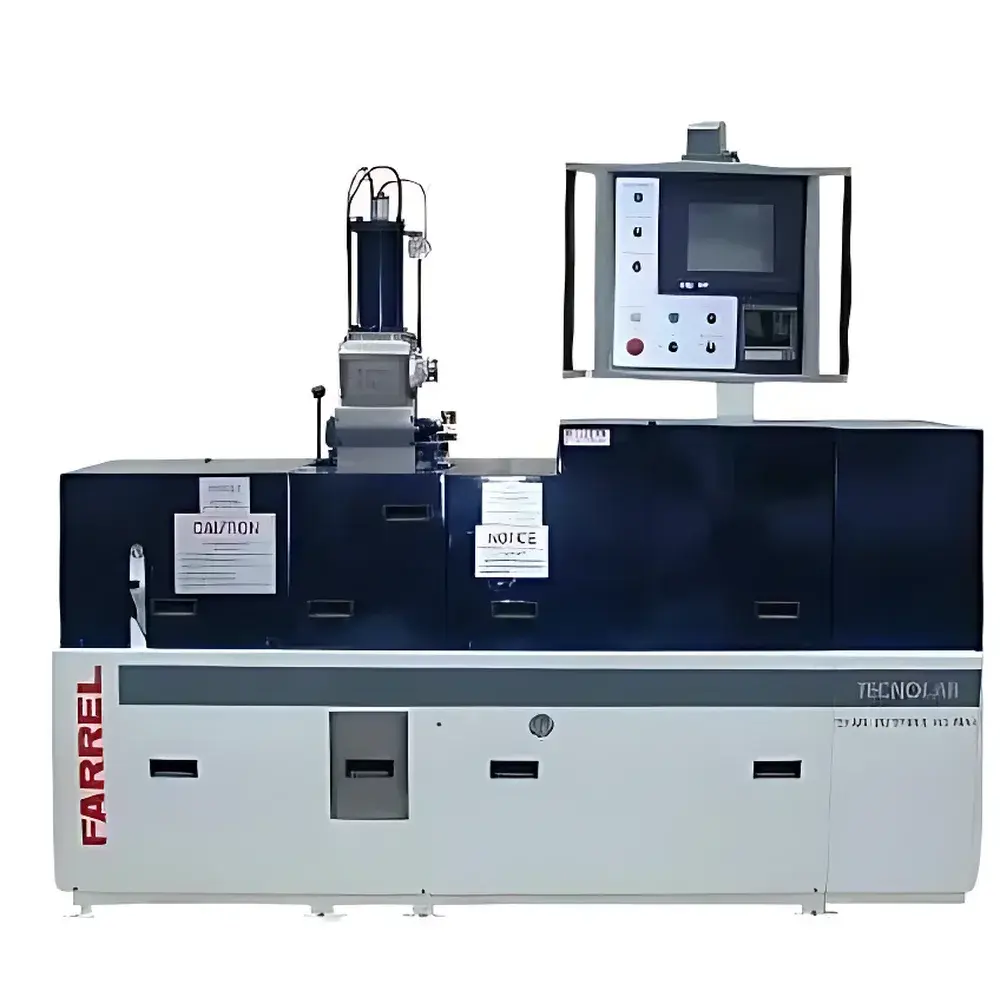
Farrel BR1600 Banbury®-Style Laboratory Internal Mixer
| Brand | Farrel |
|---|---|
| Origin | USA |
| Model | BR1600 |
| Chamber Net Volume | 160 L |
| Fill Factor | 75% (at 1.0 g/cm³ density: ~120 kg batch) |
| Rotor Type | Tangential ST™/NST™ Four-Wing Design |
| Temperature Control | Closed-Loop Water-Cooled Chamber & Rotors |
| Optional Features | Hydraulic Ram Loader, Hardened Wear-Resistant Surfaces, Customized Rotor Geometry |
| Compliance | Designed to meet ASTM D3418, ISO 6502, and rubber compounding process validation requirements for R&D and pilot-scale GLP environments |
Overview
The Farrel BR1600 is a laboratory-scale internal mixer engineered to replicate the core rheological and thermal behavior of full-scale production Banbury® mixers—without compromising on precision, repeatability, or material fidelity. Based on the foundational principles of tangential rotor dynamics and controlled shear history, this mixer employs Farrel’s proprietary ST™ (Shear-Tangential) and NST™ (Non-Shear Tangential) four-wing rotor architecture to generate defined strain rates, localized high-shear zones, and uniform energy input across the batch. Unlike open two-roll mills—which rely on surface shear and are limited in dispersion efficiency—the BR1600 operates as a closed-system, pressure-contained internal mixer where compound development occurs under controlled temperature, torque, and residence time. Its 160-liter net chamber volume supports batch sizes up to 120 kg (at 75% fill factor and 1.0 g/cm³ density), making it suitable for formulation screening, QC validation, scale-up studies, and pre-production trials in tire compounds, technical elastomers, thermoplastic elastomers (TPEs), and conductive polymer composites.
Key Features
- Farrel-engineered ST™/NST™ four-wing rotors delivering reproducible shear profiles, optimized for filler dispersion (e.g., carbon black, silica) and polymer–additive compatibility
- Closed-loop water cooling system integrated into both mixing chamber walls and rotor bodies—enabling precise temperature control within ±1.5°C across the entire batch envelope
- Hydraulic ram loader option for consistent, operator-independent feed sequencing; eliminates manual charging variability
- Hardened chamber liners and rotor surfaces (e.g., tungsten carbide overlay or nitrided steel) available for abrasive formulations containing high-loading mineral fillers or recycled rubber crumb
- Modular drive system with torque monitoring (0–5,000 N·m range), real-time RPM control (0–35 rpm), and programmable ramp profiles for multi-stage mixing cycles
- Interlocked safety guarding compliant with ANSI B11.19 and ISO 13857; emergency stop circuitry integrated with chamber door position sensors
Sample Compatibility & Compliance
The BR1600 accommodates raw and compounded elastomers including natural rubber (NR), SBR, BR, EPDM, CR, FKM, TPU, and thermoset precursors. It supports processing of highly filled systems (up to 80 phr carbon black or 120 phr precipitated silica), masterbatches, flame-retardant compounds, and nanocomposites requiring extended dwell times. All mechanical and thermal parameters adhere to ASTM D3418 (Standard Test Method for Transition Temperatures of Elastomers), ISO 6502 (Rubber—Determination of Mixing Characteristics on Internal Mixers), and ISO 289-1 (Raw Rubber—Determination of Mooney Viscosity). For regulated environments, the system supports audit-ready documentation via optional data logging modules compliant with FDA 21 CFR Part 11 (electronic records/signatures) and GLP/GMP traceability requirements—including timestamped torque, temperature, and RPM logs with user access controls.
Software & Data Management
The BR1600 integrates with Farrel’s proprietary MixView™ control software (v4.2+), providing recipe-based cycle programming, real-time parameter visualization (torque vs. time, temperature vs. time, power consumption), and automated pass/fail evaluation against predefined process windows. Raw sensor data is exported in CSV or HDF5 format for post-processing in MATLAB, Python (Pandas/NumPy), or statistical analysis platforms. Audit trails include operator ID, session timestamps, parameter overrides, and calibration event logs—fully traceable for internal QA reviews or regulatory inspections. Optional OPC UA connectivity enables integration into MES or LIMS infrastructure for centralized batch record management.
Applications
- Rubber formulation development: Optimization of curing systems, filler dispersion efficiency, and scorch safety
- Pilot-scale validation prior to transfer to production Banbury® or continuous mixers (e.g., Farrel Continuous Mixer)
- Thermal stability assessment of heat-sensitive additives (e.g., peroxides, silanes, bio-based plasticizers)
- Dispersion quality benchmarking using TEM/SEM correlation studies or bound rubber analysis
- Process mapping for DOE-driven studies (e.g., rotor speed × temperature × fill factor interactions)
- Training platform for plant engineers and process technicians on mixing kinetics and rheological response
FAQ
What distinguishes the BR1600 from an open two-roll mill?
Unlike open mills—which apply shear only at the roll surface and lack pressure containment—the BR1600 generates volumetric shear throughout the batch under controlled pressure and temperature, enabling superior filler dispersion and reduced batch-to-batch variability.
Can the BR1600 be used for thermoplastic compounding?
Yes; with appropriate rotor geometry selection (e.g., NR-type intermeshing rotors) and modified cooling protocols, it supports TPE, TPU, and PP/EPDM blends—but is not rated for high-melt-index polyolefins requiring extrusion-grade residence time distribution.
Is remote monitoring supported?
Via optional Ethernet-enabled MixView™ controller with secure TLS 1.2 API endpoints, allowing supervised remote access for cycle start/stop and diagnostic review—subject to site firewall policies and IT security review.
What maintenance intervals are recommended?
Lubrication of main drive bearings every 500 operating hours; chamber seal inspection every 1,000 hours; rotor alignment verification annually or after 5,000 cycles—per Farrel Maintenance Manual Rev. 8.3.
Does the system support ASTM D1646 Mooney viscosity correlation?
While not a Mooney viscometer, BR1600 torque curves (especially minimum torque, peak torque, and scorch time) correlate strongly with Mooney ML(1+4) values when calibrated against reference compounds per ASTM D1646 Annex A2.



