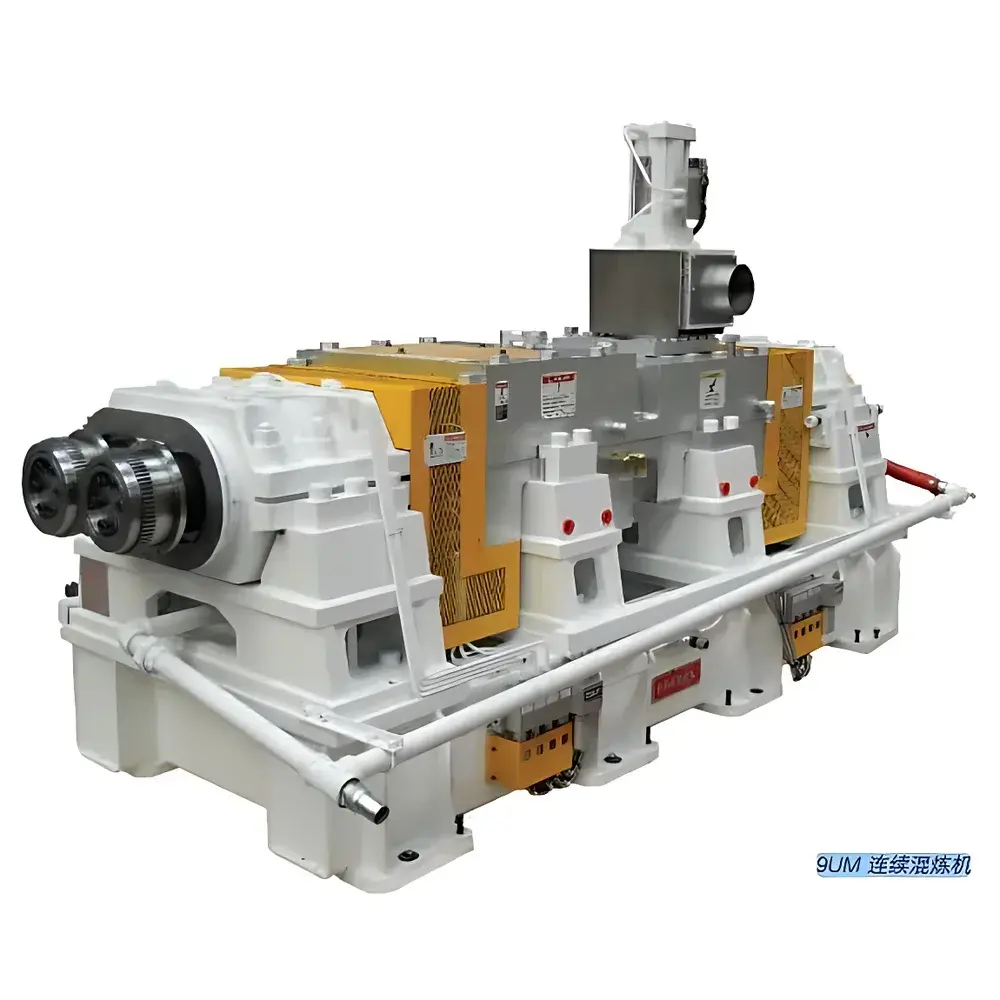
Farrel 9UM Continuous Mixer
| Brand | Farrel |
|---|---|
| Origin | USA |
| Model | 9UM |
| Type | Continuous Twin-Screw Mixer for Rubber & Thermoplastic Compounding |
| Feed Capacity | 400–40,000 kg/h |
| Rotor Configuration | Co-rotating, Intermeshing Twin-Screw |
| L/D Ratio (LCM variants) | 10:1 |
| Control System | PLC with HMI Touchscreen Interface |
| Modular Design | Yes |
| Compliance | Designed for ASTM D3765, ISO 252, and ISO 1133-compliant compound development workflows |
| Integration Ready | Compatible with Farrel FMP™ Melt Pumps and Underwater Pelletizing Systems |
Overview
The Farrel 9UM Continuous Mixer is an industrial-grade, co-rotating twin-screw compounding system engineered for high-precision, scalable rubber and thermoplastic compound development. Unlike batch-type internal mixers or open two-roll mills, the 9UM operates on a continuous volumetric feeding principle—leveraging controlled screw geometry, precise thermal management, and adjustable residence time to achieve reproducible dispersion and distribution of fillers, additives, and polymer matrices. Its core architecture follows Farrel’s proprietary FCM™ (Farrel Continuous Mixer) platform, optimized for processing polyolefins (PP, PE), polystyrene (PS), and polyvinyl chloride (PVC)-based formulations. The system is not a laboratory-scale simulation device but a production-capable unit designed for seamless transition from formulation screening (at ≤1,000 kg/h) to full-scale manufacturing (up to 40,000 kg/h), supporting both R&D validation and GMP-aligned pilot-line operations.
Key Features
- Intermeshing, co-rotating twin-screw rotor assembly with optimized flight geometry for uniform shear history and minimal thermal degradation.
- Adjustable rotor speed (typically 10–600 rpm), enabling precise control over specific mechanical energy (SME) input and residence time distribution (RTD).
- Large-diameter feed throat with gravity-assisted inlet—designed to accommodate highly filled compounds (e.g., >60 phr carbon black or calcium carbonate) without bridging or feed interruption.
- Modular barrel segments with independent zone heating/cooling (±1 °C stability), supporting multi-zone thermal profiling for staged melting, devolatilization, and homogenization.
- Wear-resistant alloy construction (Hastelloy C-276 or equivalent in high-abrasion zones), with optimized rotor-to-barrel clearance (>1.2 mm at tip) to extend service life under continuous operation.
- Integrated PLC-based control system with 10.4″ color touchscreen HMI, offering recipe storage, real-time torque/power monitoring, and alarm logging compliant with 21 CFR Part 11 audit trail requirements.
- Standardized flange interfaces for direct coupling to Farrel FMP™ melt pumps and underwater pelletizing lines—enabling closed-loop continuous compounding-to-pelletization workflows.
Sample Compatibility & Compliance
The 9UM accommodates a broad spectrum of elastomeric and thermoplastic systems, including natural rubber (NR), styrene-butadiene rubber (SBR), ethylene-propylene diene monomer (EPDM), thermoplastic elastomers (TPEs), and engineering resins such as PA6, PC, and PBT. It supports masterbatch preparation, flame-retardant compound development, conductive composites (carbon nanotube or graphene-loaded), and reactive extrusion applications (e.g., silane-grafted PE). All operational parameters—including temperature profiles, screw speed, and feed rate—are traceable and exportable for GLP/GMP documentation. The system meets mechanical safety standards per ANSI B155.1 and electrical compliance per UL 508A. For quality-critical applications, optional IQ/OQ documentation packages are available to support FDA-regulated medical device polymer processing and automotive OEM material certification (e.g., GMW14124, Ford WSS-M99P9999-A1).
Software & Data Management
The embedded control firmware provides deterministic real-time data acquisition at 100 Hz sampling frequency for torque, motor current, barrel zone temperatures, melt pressure (if equipped), and feed rate. Historical process data is stored locally on an industrial SSD with automatic daily backup to network drives via Ethernet/IP or Modbus TCP. Export formats include CSV and XML for integration into LIMS (e.g., LabWare, Thermo Fisher SampleManager) and MES platforms. Optional Farrel Compounding Suite software enables statistical process control (SPC) charting, DOE-based parameter optimization, and cross-machine recipe migration across FCM™ and LCM™ platforms (e.g., scaling from 9UM lab data to LCM230 production runs).
Applications
- Development and scale-up of high-filler-content rubber compounds for tire treads, conveyor belts, and anti-vibration mounts.
- Continuous blending of thermoplastic vulcanizates (TPVs) and dynamically vulcanized alloys (DVA).
- Production of conductive polymer compounds for EMI shielding and static-dissipative flooring.
- Reactive compounding of silane-crosslinked polyethylene (PEX-a) and peroxide-initiated graft copolymers.
- Devulcanization and reclamation of post-industrial rubber scrap using controlled shear and thermal input.
- Pre-compounding for wire & cable jacketing compounds requiring ultra-low gel content and narrow molecular weight distribution.
FAQ
What distinguishes the 9UM from traditional internal mixers or open two-roll mills?
The 9UM delivers continuous, steady-state operation with consistent SME input and residence time control—eliminating batch-to-batch variability inherent in discontinuous systems.
Can the 9UM be validated for regulated pharmaceutical or medical device polymer processing?
Yes—when configured with 21 CFR Part 11-compliant controls, calibrated sensors, and documented IQ/OQ protocols, it supports qualification under ISO 13485 and ICH Q5E guidelines.
Is retrofitting to existing Farrel LCM lines possible?
The 9UM shares identical mechanical interfaces and control architecture with LCM-series units, enabling plug-and-play integration into legacy Farrel compounding lines.
What maintenance intervals are recommended for continuous 24/7 operation?
Rotor and barrel inspection every 2,000 operating hours; bearing replacement every 12,000 hours; full gearbox oil analysis quarterly.
Does Farrel provide application engineering support for new formulations?
Yes—Farrel’s Global Applications Lab offers remote and on-site trials, including rheological characterization, dispersion analysis (via SEM/EDS), and pellet quality assessment per ISO 1873-2.