
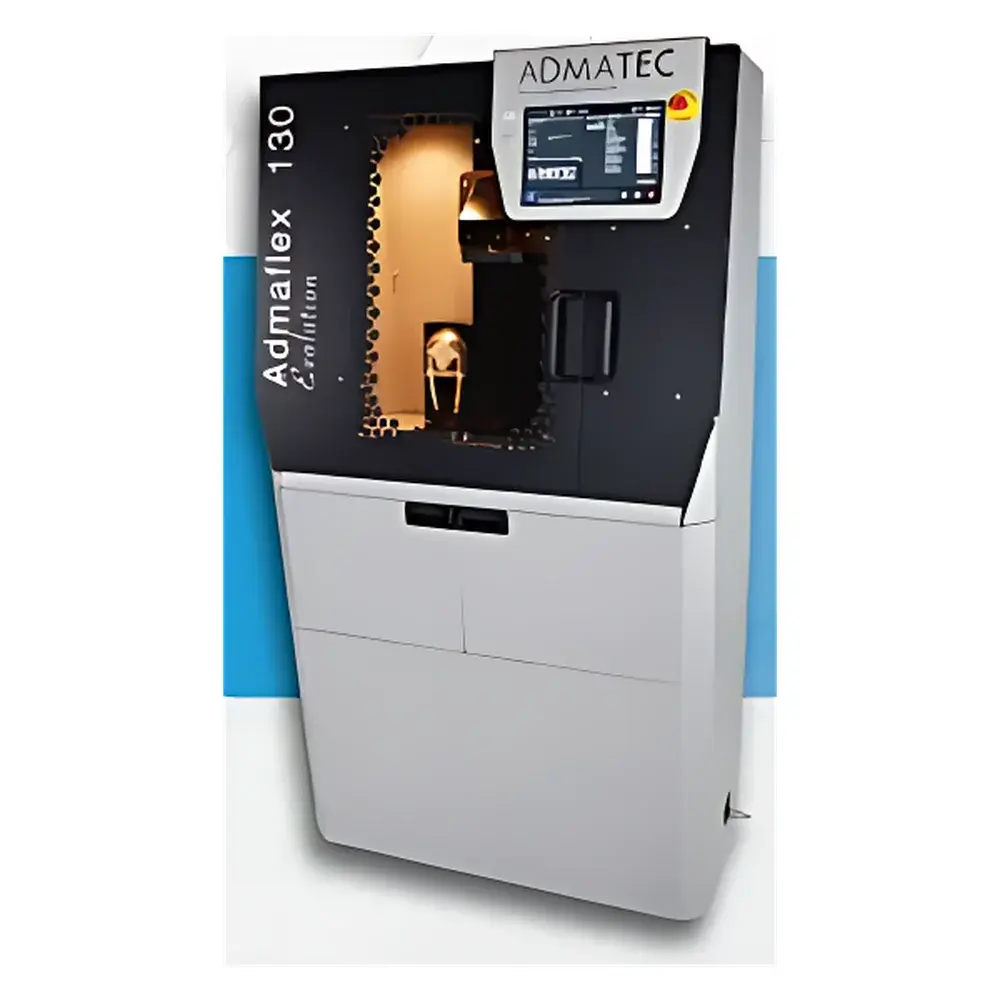
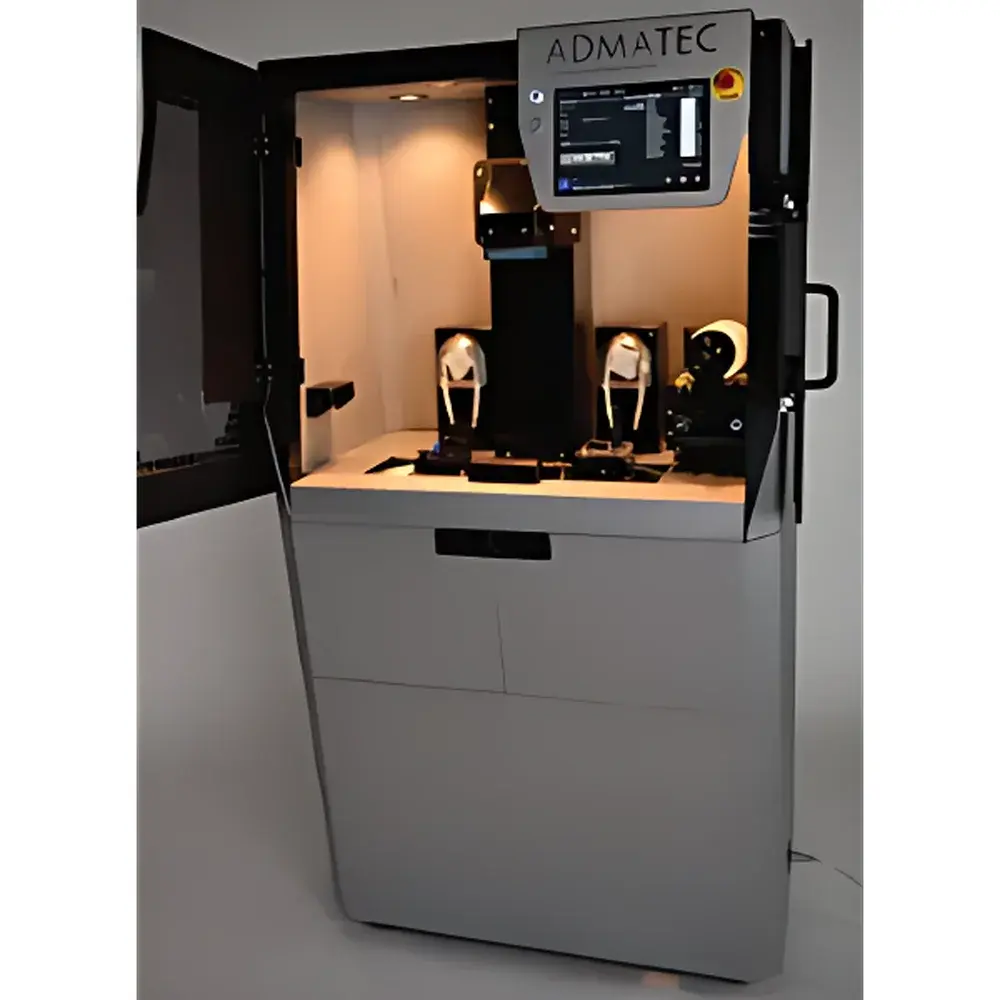
Admatec Admaflex 130 DLP-Based Ceramic and Metal 3D Printer
| Brand | Admatec |
|---|---|
| Country of Origin | Netherlands |
| Model | Admaflex 130 |
| Build Volume Options | 64 × 40 × 400 mm (25 μm layer) / 90 × 56 × 400 mm (35 μm) / 102 × 64 × 400 mm (40 μm) / 128 × 80 × 400 mm (50 μm) / 160 × 100 × 400 mm (62.5 μm) |
| Layer Thickness | 10–200 µm |
| Light Engine | DLP (WQXGA, 2560 × 1600 px) |
| Compatible Materials | Alumina, Zirconia, Fused Silica, Hydroxyapatite, Alumina-Toughened Zirconia, Stainless Steel 316L, Inconel 625, Stainless Steel 17-4PH, Copper |
| Final Part Density | >99% |
| System Dimensions | 980 × 670 × 1880 mm |
| Weight | ~300 kg |
| Operating Temperature | 22 ± 5 °C |
| Relative Humidity | <40% |
| Power Supply | 110/230 V |
| Input File Formats | STL, SLC |
Overview
The Admatec Admaflex 130 is a high-precision, industrial-grade DLP-based stereolithographic 3D printer engineered for the additive manufacturing of dense, near-net-shape ceramic and metal components. Unlike conventional powder-bed fusion systems, the Admaflex 130 employs a vat photopolymerization process—specifically digital light processing (DLP)—to selectively cure photosensitive ceramic or metal suspensions (slurries) layer-by-layer. This approach enables exceptional geometric fidelity, sub-50 µm feature resolution, and high green-body density prior to debinding and sintering. Designed for R&D laboratories and pilot-scale production environments, the system bridges the gap between prototyping agility and functional part performance—particularly for applications demanding biocompatibility, thermal stability, chemical inertness, or mechanical robustness in final sintered forms.
Key Features
- DLP light engine with WQXGA resolution (2560 × 1600 pixels), delivering uniform irradiance and pixel-level control across five selectable build platforms—supporting trade-offs between resolution (25–62.5 µm pixel pitch) and throughput (up to 20–25 mm/h z-axis build speed).
- Patented slurry recirculation and filtration system that minimizes material degradation and sedimentation, enabling consistent rheological behavior over extended print sessions and reducing raw material waste.
- Touchscreen HMI with per-layer parameterization: users define exposure time, lift speed, bottom-layer strategy, and layer-specific intensity profiles—critical for optimizing green strength and minimizing delamination in heterogeneous or high-loading slurries.
- Hermetically sealed, inert-atmosphere-compatible chamber with integrated environmental monitoring (temperature ±0.5 °C, RH <40%) to ensure stable photopolymerization kinetics and prevent premature solvent evaporation or moisture-induced cracking.
- Modular build platform design accommodating five standard configurations—from compact 64 × 40 mm to large-format 160 × 100 mm footprints—each calibrated for optical distortion compensation and Z-stage repeatability ≤±1.5 µm.
Sample Compatibility & Compliance
The Admaflex 130 supports a validated portfolio of inorganic feedstocks, including technical ceramics (Al2O3, Y-TZP, SiO2, HA) and metal alloys (316L SS, 17-4PH SS, Inconel 625, Cu). All materials are processed as highly loaded, low-viscosity photocurable slurries (<50 vol% solids typically), formulated to yield green densities >60% and final sintered densities exceeding 99% theoretical after controlled thermal processing. The system complies with CE marking requirements and meets electrical safety standards IEC 61000-6-2/6-4. While not certified under FDA 21 CFR Part 11 out-of-the-box, its audit-ready log generation (timestamped parameter sets, operator ID tagging, firmware version tracking) facilitates qualification under GLP/GMP frameworks for regulated medical device or aerospace component development.
Software & Data Management
Admatec’s proprietary slicing and job management software—compatible with Windows 10/11—imports STL and legacy SLC files, performs automatic support generation optimized for ceramic green-body fragility, and exports machine-native instruction sets with checksum validation. All print jobs are logged locally with full metadata: layer count, cumulative exposure dose, stage position history, ambient sensor readings, and user authentication records. Exportable CSV reports support traceability for ISO 9001 internal audits or ASTM F2792-12 documentation requirements. Remote diagnostics and firmware updates are delivered via secure HTTPS channel with TLS 1.2 encryption.
Applications
- Biomedical engineering: patient-specific dental crowns, orthopedic scaffolds, and porous implants fabricated from hydroxyapatite or zirconia—validated for ISO 13485-compliant preclinical workflows.
- Microfluidics and MEMS packaging: high-aspect-ratio ceramic manifolds and insulating substrates with <50 µm channels and surface roughness Ra <0.8 µm (as-sintered).
- Aerospace and energy: combustion nozzles, turbine blade cooling inserts, and thermocouple sheaths printed in Inconel 625 or alumina-toughened zirconia—capable of withstanding >1200 °C service temperatures post-sintering.
- Research infrastructure: rapid iteration of refractory tooling, catalytic monoliths, and graded-material test coupons for sintering kinetics studies under controlled atmosphere furnaces.
FAQ
What post-processing steps are required after printing?
All printed parts require thermal debinding (slow ramp to ~600 °C under N2 or air) followed by pressureless or HIP-assisted sintering. Recommended schedules are provided per material grade and geometry complexity.
Is the system compatible with third-party slurries?
Yes—open material parameters allow calibration for qualified non-Admatec formulations; however, warranty coverage applies only when using Admatec-certified slurries and following published rheology specifications.
Can the Admaflex 130 print multi-material structures?
Not natively. Material changes require manual slurry replacement, cleaning, and recalibration. Sequential printing of dissimilar ceramics in one build is possible only with rigorous cross-contamination mitigation protocols.
What maintenance intervals are recommended?
Daily: optical window inspection and wipe-down with IPA; weekly: DLP projector alignment verification and filter replacement; annually: Z-stage lead screw lubrication and photoinitiator concentration validation via UV-Vis spectroscopy.
Does the system support networked fleet management?
Yes—via optional Admatec FleetLink module, enabling centralized job queuing, remote status monitoring, and aggregated KPI reporting (uptime, material utilization, average layer success rate) across multiple Admaflex units.



