
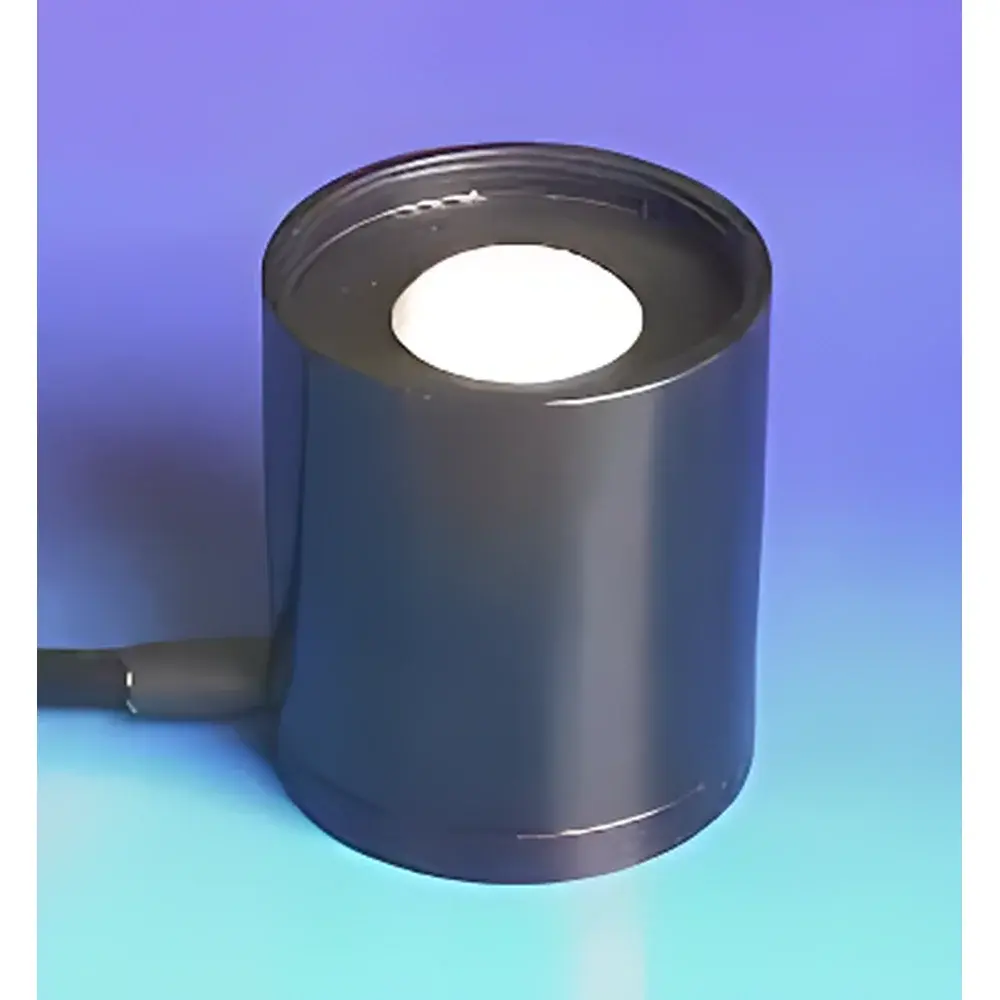
Solar Light PMA2132 Quantum (Photosynthetically Active Radiation) Sensor
| Brand | Solar Light |
|---|---|
| Origin | USA |
| Model | PMA2132 |
| Spectral Range | 400–700 nm |
| Cosine Response Error | ≤5% up to 80° incidence angle |
| Full-Scale Range | 20,000 µE·s⁻¹·m⁻² |
| Resolution | 0.1 µE·s⁻¹·m⁻² |
| Operating Temperature | −40 to +50 °C |
| Temperature Coefficient | <0.15 %/°C |
| Housing | IP67-rated sealed enclosure |
| Dimensions | 40.6 mm diameter × 45.8 mm height |
| Weight | 200 g |
| Cable | Standard 15 m (optional retractable 0.3 m) |
Overview
The Solar Light PMA2132 Quantum Sensor is a precision-calibrated photodiode-based detector engineered for accurate measurement of photosynthetically active radiation (PAR) in the 400–700 nm spectral band. Unlike broadband radiometers that report irradiance in W·m⁻², the PMA2132 delivers quantum flux density—expressed in micromoles of photons per square meter per second (µmol·m⁻²·s⁻¹, equivalent to µE·s⁻¹·m⁻²)—a biologically relevant metric directly correlated with photosynthetic photon flux (PPF) and plant photosynthetic response. Its spectral responsivity is rigorously matched to the quantum action spectrum of higher plants, ensuring high fidelity across natural and artificial light sources including LED, fluorescent, metal halide, and solar spectra. The sensor employs a silicon photodiode with optical filtering and diffuser optics optimized for uniform quantum efficiency across the PAR band, and its angular response is corrected to within ±5% up to 80° from normal incidence—critical for reliable measurements under diffuse skylight, canopy-scattered radiation, or extended-area lighting configurations.
Key Features
- Quantum-optimized spectral response aligned to the CIE/ISO-defined PAR action spectrum (400–700 nm), traceable to NIST standards via factory calibration certificate.
- Cosine-corrected optical collector with precision-ground diffuser and black-anodized housing to minimize reflectance errors and directional bias.
- IP67-rated hermetically sealed aluminum housing, enabling continuous outdoor deployment in rain, fog, high humidity, and temperature extremes (−40 to +50 °C).
- High dynamic range (0.1 to 20,000 µE·s⁻¹·m⁻²) supported by low-noise analog signal conditioning and temperature-compensated output (drift <0.15 %/°C).
- Integrated 15-meter shielded coaxial cable with BNC output; optional retractable 0.3-m cable available for portable or chamber-based applications.
- Long-term stability verified per IEC 60904-2 and ASTM E2524 protocols; typical drift <±1.5% over 24 months under field conditions.
Sample Compatibility & Compliance
The PMA2132 is compatible with all standard data loggers, DAQ systems, and PAR meters accepting 0–2.5 V or 4–20 mA analog inputs (output scaling: 1 mV = 1 µE·s⁻¹·m⁻²). It requires no external power and operates passively via photodiode-generated current. The sensor meets ISO 17025-accredited calibration requirements and is routinely deployed in GLP-compliant environmental monitoring networks. Its design conforms to ASTM E2524 (Standard Practice for Calibration of Photovoltaic Reference Cells) for quantum responsivity verification and aligns with FAO/ICID guidelines for agro-meteorological PAR monitoring. No regulatory approval is required for research or academic use; however, field-deployed installations in USDA ARS or NOAA cooperative programs must retain calibration certificates valid within 12 months.
Software & Data Management
While the PMA2132 is a standalone analog sensor, it integrates natively with industry-standard platforms including Campbell Scientific LoggerNet, Onset HOBOware, LabVIEW DAQmx drivers, and Python-based acquisition scripts (e.g., using PySerial or NI-DAQmx APIs). Raw voltage outputs are linearly proportional to quantum flux; conversion to µmol·m⁻²·s⁻¹ uses the factory-provided sensitivity factor (typically 1.00 ±0.02 mV per µE·s⁻¹·m⁻²). Audit-trail-capable data management is achieved when paired with compliant loggers supporting timestamped, checksummed storage and 21 CFR Part 11–enabled electronic signatures (e.g., Campbell CR6 with secure firmware v6.0+). Calibration history, environmental metadata, and instrument ID are embeddable in CSV/NetCDF exports for FAIR-aligned data archiving.
Applications
- Agricultural phenotyping: Real-time PAR mapping in greenhouse climate control systems and vertical farming arrays.
- Ecophysiology studies: Canopy-level quantum flux profiling in forest understory, grassland, and wetland ecosystems.
- Photobiology research: Dose-response characterization of algal cultures, cyanobacteria, and model plant species under controlled spectral LEDs.
- Meteorological networks: Long-term PAR time-series acquisition for solar resource assessment and climate modeling validation (e.g., SURFRAD, BSRN).
- Environmental education: Hands-on laboratory exercises on light energy conversion, photosynthetic efficiency, and spectral quality effects on stomatal conductance.
FAQ
Is the PMA2132 calibrated to NIST-traceable standards?
Yes—each unit ships with an individual calibration certificate traceable to NIST Standard Reference Photodiodes SRM 2252 and SRM 2253, covering the full 400–700 nm band at 5-nm intervals.
Can it be used underwater or in submerged hydroponic systems?
No—the IP67 rating applies only to splashing and temporary immersion; prolonged submersion exceeds mechanical sealing limits and alters optical path refractive index.
What is the recommended recalibration interval?
Annual recalibration is advised for research-grade applications; biennial recalibration suffices for routine agricultural monitoring where ±3% uncertainty is acceptable.
Does the sensor require temperature compensation during data processing?
The built-in temperature coefficient compensation reduces thermal drift to <0.15 %/°C; post-acquisition correction is unnecessary unless operating beyond ±50 °C.
How does it differ from a traditional pyranometer?
A pyranometer measures total solar irradiance (W·m⁻²) across 300–2800 nm, while the PMA2132 quantifies only biologically active photons (400–700 nm) in quantum units—enabling direct correlation with photosynthetic carbon assimilation rates.




