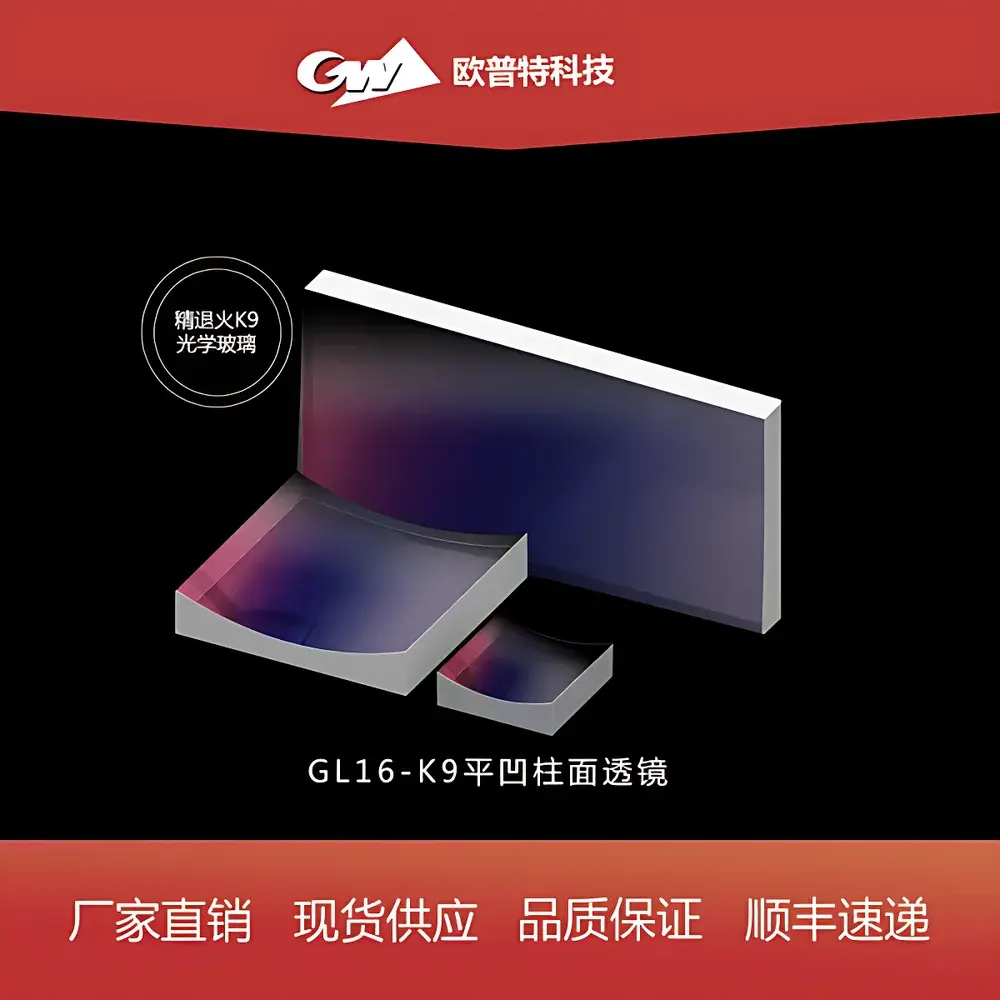
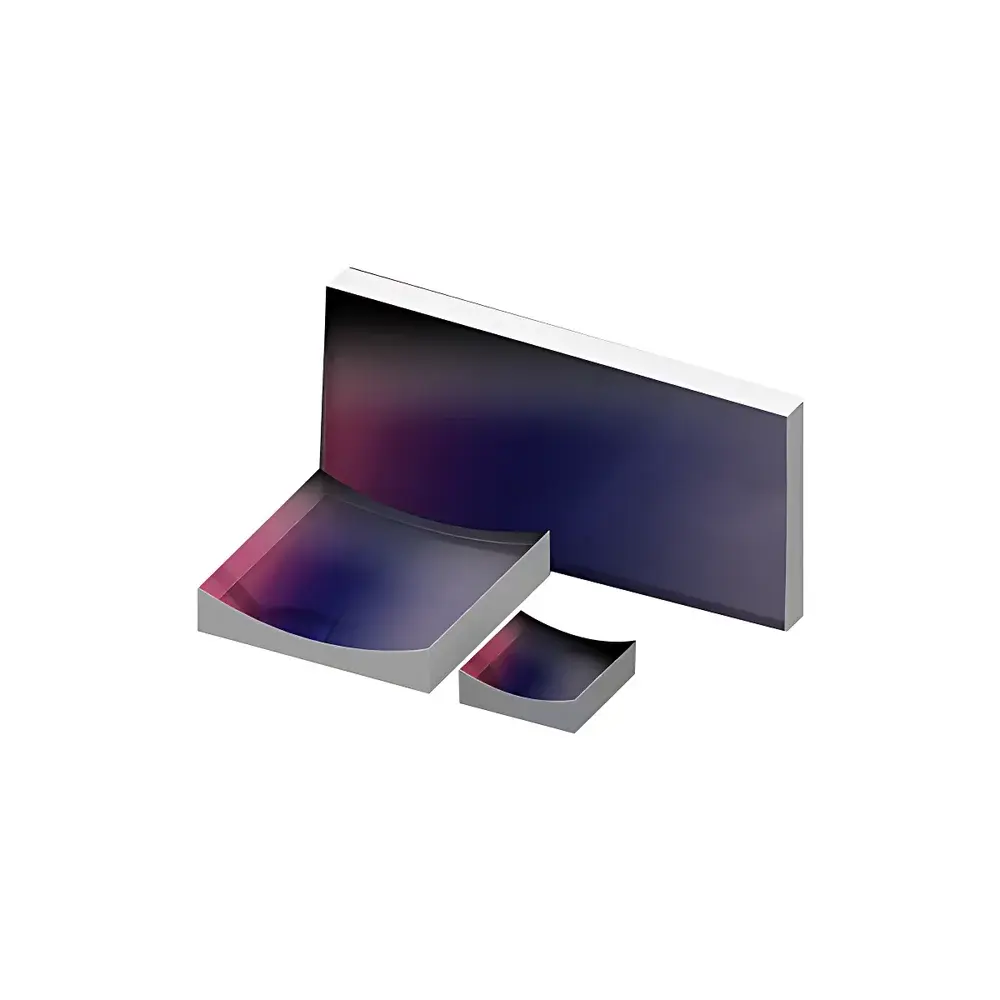
GL16-K9 Plano-Concave Cylindrical Lens (Uncoated), 8.0 × 4.0 mm, EFL –4.0 mm
| Key | Material: K9 optical glass |
|---|---|
| Surface Quality | 60-40 scratch-dig |
| Clear Aperture | ≥90% of dimensions |
| Focal Length (EFL) | –4.0 mm |
| Back Focal Length (BFL) | –5.3 mm |
| Radius of Curvature (R₁) | –2.07 mm |
| Center Thickness (T₂) | 2.0 mm |
| Edge Thickness (T₄) | 3.54 mm |
| Coating | None (uncoated) |
| Dimension (X × Y) | 8.0 × 4.0 mm |
| Tolerance on EFL | ±2% |
| Wavefront Error | λ/4 @ 632.8 nm |
Overview
The GL16-K9 Plano-Concave Cylindrical Lens (Uncoated) is a precision-ground optical component engineered for beam shaping, line generation, and astigmatic correction in visible-light optical systems. Fabricated from high-homogeneity K9 borosilicate crown glass (Schott N-BK7 equivalent), this lens features one flat surface and one concave cylindrical surface—enabling focusing or diverging of light along a single axis while preserving collimation in the orthogonal direction. Its nominal effective focal length (EFL) of –4.0 mm defines its diverging power in the curved meridian; the back focal length (BFL) of –5.3 mm accounts for physical thickness and refraction at both surfaces. Designed for integration into laser alignment setups, interferometric cavities, spectroscopic slit illumination, and custom anamorphic optics, the lens conforms to ISO 10110–1 surface form tolerances and maintains wavefront error ≤λ/4 at 632.8 nm across its clear aperture (≥90% of stated 8.0 × 4.0 mm dimensions). No anti-reflection coating is applied, preserving broadband transmission from ~350 nm to 2.0 µm—ideal for applications requiring minimal spectral bias or compatibility with UV or NIR sources where standard VIS AR coatings may degrade.
Key Features
- Precision-ground K9 optical glass substrate with refractive index nd = 1.5163 @ 587.6 nm and Abbe number νd = 64.2
- Plano-concave cylindrical geometry optimized for uniaxial beam expansion or collimation control
- Surface quality rated at 60–40 scratch-dig per MIL-PRF-13830B, verified via interferometric inspection
- Tight dimensional tolerance: ±0.1 mm on width/height, ±0.05 mm on center thickness
- Radius of curvature tolerance: ±0.5% on R₁ (–2.07 mm), ensuring predictable divergence behavior
- Edge thickness (T₄ = 3.54 mm) and center thickness (T₂ = 2.0 mm) engineered for mechanical stability during kinematic mounting
Sample Compatibility & Compliance
This lens is compatible with standard optomechanical mounts including SM1-threaded lens tubes, kinematic mirror mounts with adjustable tilt, and custom-designed lens holders using nylon-tipped setscrews to prevent surface marring. It meets ISO 9001-certified manufacturing protocols for optical component traceability and documentation. While not inherently compliant with FDA or IEC 61000 standards (as a passive component), it supports full system-level compliance when integrated into Class 1 or Class 2 laser products per IEC 60825–1:2014. The uncoated surface allows direct qualification under ASTM E1082 (measurement of optical transmission) and ISO 9211–4 (specification of coated/uncoated optical components). For GMP-regulated instrumentation, lot-specific test reports—including interferometric wavefront maps and spectral transmittance curves—are available upon request.
Software & Data Management
As a passive optical element, the GL16-K9 lens does not incorporate embedded firmware or digital interfaces. However, its geometric and material parameters are fully parameterized in industry-standard optical design software environments—including Zemax OpticStudio (file format .ZAR), CODE V (.SEQ), and FRED (.FRED)—enabling accurate ray tracing, tolerance analysis, and sensitivity studies. Manufacturer-provided STEP and SAT files support mechanical integration into CAD assemblies (SolidWorks, Creo, Fusion 360). All product identifiers (e.g., GL16-8×4-004) are structured to align with internal inventory management systems and ERP platforms compliant with ISO/IEC 17025 traceability requirements.
Applications
- Laser diode fast-axis collimation in fiber coupling and pump module assemblies
- Generation of uniform line illumination for machine vision inspection systems
- Astigmatism compensation in multi-element imaging paths (e.g., confocal microscopy scan lenses)
- Beam conditioning for Shack–Hartmann wavefront sensors
- Custom anamorphic pairs for circularization of elliptical laser beams
- Educational optics kits demonstrating cylindrical aberration and focal line formation
FAQ
Is this lens suitable for UV or NIR wavelengths?
Yes—the uncoated K9 substrate exhibits high transmission from 350 nm to 2.0 µm, making it appropriate for UV-VIS-NIR applications where standard VIS AR coatings would introduce absorption or delamination risk.
Can I specify tighter tolerances on radius or thickness?
Yes—custom tolerancing (e.g., ±0.1% on R₁, ±0.01 mm on T₂) is available under OEM agreements; lead time and minimum order quantities apply.
Do you provide spectral transmittance data?
Yes—each production lot undergoes spectrophotometric verification from 200–2500 nm; full spectral reports are supplied with bulk orders or upon request.
What mounting recommendations do you suggest?
Use low-stress, spring-loaded lens cells with elastomeric gaskets; avoid over-torquing setscrews—maximum recommended torque is 0.15 N·m for M3 hardware.
Is there a coated version available?
Yes—VIS broadband AR coating (400–700 nm, R<0.5% per surface) is offered under part number GL16-8×4-004-VIS, with LIDT >5 J/cm² at 1064 nm, 10 ns pulse width.