
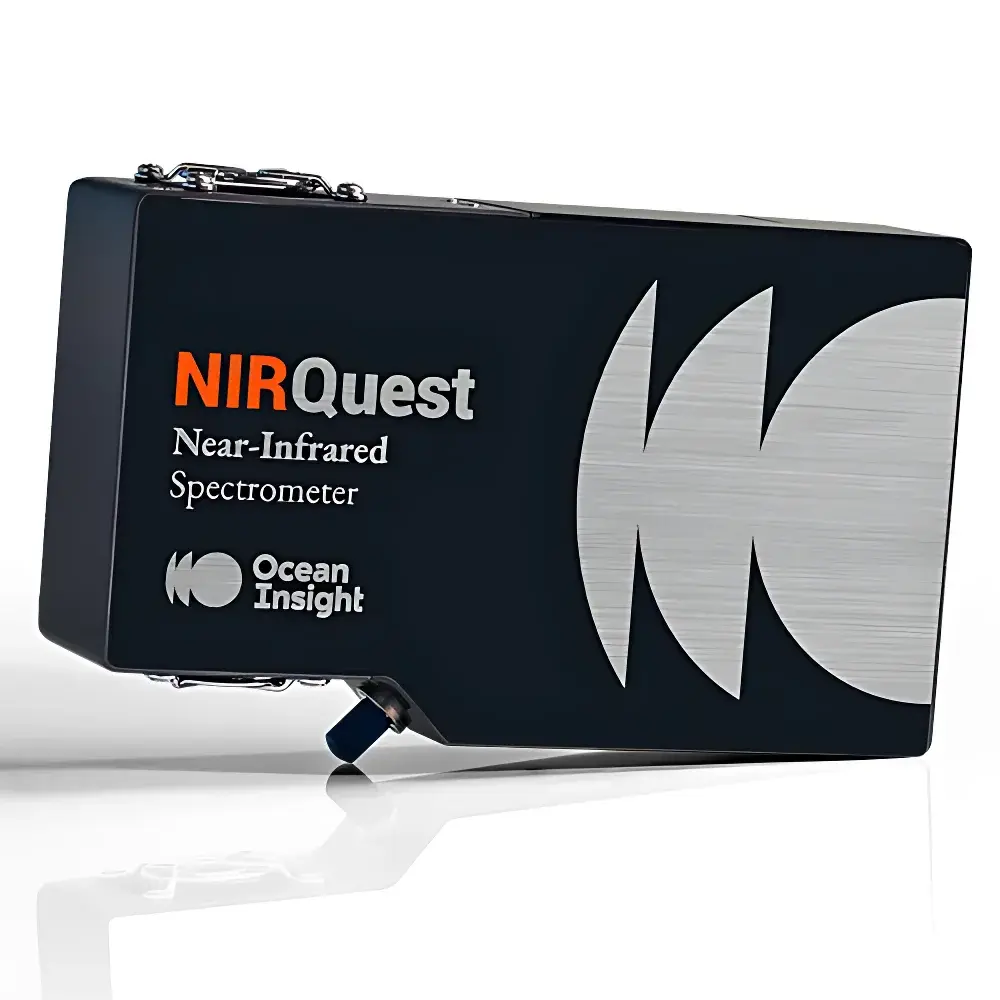
Ocean Optics NIRQuest+ High-Sensitivity Near-Infrared Spectrometer
| Brand | Ocean Optics |
|---|---|
| Model | NIRQuest+ |
| Detector | InGaAs linear array |
| Wavelength Range | 900 nm – 2500 nm |
| Optical Resolution (FWHM) | 3.13 nm (typ.), 5.47 nm (typ.), 6.25 nm (typ.) |
| Slit | 25 µm |
| Cooling | Thermoelectric to –20 °C |
| Integration Time | 1 ms – 12 s |
| Dark Noise | 6–24 RMS counts (dependent on integration time) |
| Dynamic Range | 7.5 × 10⁴ (system) |
| 10,000 | 1 (single acquisition) |
| SNR | >15,000:1 @ 100 ms |
| >13,000 | 1 @ 1000 ms |
| Dimensions | 182 × 110 × 47 mm |
| Weight | 1.18 kg (without power supply) |
| Fiber Connector | SMA 905 |
| Order-Sorting Filter | OF1-RG830 long-pass NIR filter (optional) |
| Grating Options | GRATING_#NIR1, GRATING_#NIR2, GRATING_#NIR3 |
| Spectral Configuration Options | NIRQuest+1.7 (900–1700 nm), NIRQuest+2.2 (900–2200 nm), NIRQuest+2.5 (900–2500 nm) |
Overview
The Ocean Optics NIRQuest+ is a high-sensitivity, thermoelectrically cooled near-infrared (NIR) fiber-optic spectrometer engineered for demanding quantitative and qualitative analysis in laboratory, industrial, and field-deployable environments. Based on a fixed-grating, linear InGaAs detector architecture, the NIRQuest+ operates across three calibrated spectral configurations—900–1700 nm (NIRQuest+1.7), 900–2200 nm (NIRQuest+2.2), and 900–2500 nm (NIRQuest+2.5)—enabling broad coverage of first- and second-overtone vibrational bands critical for organic compound identification and quantification. Its optical design incorporates an optimized entrance slit (25 µm), precision-aligned gratings (GRATING_#NIR1/2/3), and optional order-sorting filtering (OF1-RG830) to suppress stray light and ensure spectral fidelity. Thermoelectric cooling to –20 °C significantly reduces dark current, yielding low-noise performance essential for high-dynamic-range measurements under low-light conditions—such as diffuse reflectance from powders, transmission through turbid biological tissues, or weak emission from solar simulators.
Key Features
- Up to 2.5× higher sensitivity than prior-generation NIRQuest models, achieved via enhanced optical throughput and improved detector coupling efficiency
- Thermoelectric cooling to –20 °C ensures stable dark current (<24 RMS counts at 30 ms integration) and enables reproducible low-light measurements over extended periods
- Three preconfigured spectral ranges support application-specific optimization: NIRQuest+1.7 (900–1700 nm), NIRQuest+2.2 (900–2200 nm), and NIRQuest+2.5 (900–2500 nm)
- High signal-to-noise ratio (>15,000:1 at 100 ms integration) and wide dynamic range (7.5 × 10⁴ system-level) facilitate both rapid screening and high-precision calibration
- Compact, ruggedized housing (182 × 110 × 47 mm; 1.18 kg) with SMA 905 fiber interface supports integration into OEM systems, portable analyzers, and inline process monitoring setups
- Compatible with Ocean Insight’s full ecosystem of broadband NIR sources (e.g., HL-2000-NIR), integrating spheres, probe accessories, and calibration standards for traceable measurement workflows
Sample Compatibility & Compliance
The NIRQuest+ accommodates diverse sample geometries—including solids, liquids, pastes, and granular materials—via standardized fiber-coupled probes (reflection, transmission, or contact-based). Its spectral response is validated against NIST-traceable tungsten-halogen and deuterium lamps, supporting compliance with ISO/IEC 17025 calibration requirements. When deployed with validated chemometric models and controlled acquisition protocols, the system meets analytical data integrity expectations outlined in FDA 21 CFR Part 11 for electronic records and signatures, particularly when paired with Ocean Insight’s OceanView or Ocean HDX software featuring audit-trail logging and user-access controls. The instrument’s thermal stability and low drift characteristics also align with ASTM E1655–22 guidelines for NIR method development and validation in pharmaceutical and agricultural applications.
Software & Data Management
The NIRQuest+ is fully supported by Ocean Insight’s cross-platform software suite, including OceanView (Windows/macOS), Ocean HDX (Windows), and the Python-based Ocean Optics SDK. These tools provide real-time spectral acquisition, baseline correction, smoothing, peak detection, and export to CSV, HDF5, or vendor-neutral JCAMP-DX formats. While the spectrometer itself does not embed chemometric modeling, it delivers raw, high-fidelity spectral data compatible with third-party multivariate analysis platforms such as Unscrambler X, MATLAB PLS Toolbox, and Python’s scikit-learn—enabling users to develop, validate, and deploy robust PLS, PCR, or SVM regression/classification models. All software packages support configurable metadata tagging, batch processing, and automated report generation aligned with GLP/GMP documentation practices.
Applications
- Pharmaceutical Quality Control: Raw material identification (RMI), blend uniformity assessment, and tablet coating thickness analysis using 900–2500 nm spectral fingerprints
- Food & Agriculture: Non-destructive quantification of moisture, protein, starch, and oil content in cereals, legumes, and dairy powders
- Recycling & Polymer Sorting: Rapid classification of PET, PE, PP, and PVC based on overtone absorption features in the 1100–2300 nm region
- Biomedical Research: In vitro tissue characterization—including fat/water ratio, melanin concentration, and hemoglobin oxygenation status—using diffuse reflectance spectroscopy
- Environmental Monitoring: Soil organic carbon estimation, vegetation water content mapping, and solar irradiance spectral calibration for PV efficiency testing
- Industrial Process Analytics: Real-time monitoring of fermentation endpoints (e.g., methanol detection in ethanol production) and chemical reaction progress in continuous-flow reactors
FAQ
Is the NIRQuest+ suitable for regulated GMP environments?
Yes—when used with validated acquisition protocols, audit-trail-enabled software (e.g., Ocean HDX), and documented calibration procedures, the NIRQuest+ supports compliance with FDA 21 CFR Part 11 and EU Annex 11 requirements.
What spectral resolution options are available?
Optical resolution (FWHM) varies by grating selection and configuration: typical values are 3.13 nm (NIRQuest+1.7), 5.47 nm (NIRQuest+2.2), and 6.25 nm (NIRQuest+2.5), all measured at specified slit and integration conditions.
Can the NIRQuest+ be integrated into custom OEM instrumentation?
Yes—the device features USB 2.0 communication, TTL-compatible trigger I/O, and a comprehensive SDK with C, C#, Python, and LabVIEW drivers for seamless embedded system integration.
Does the spectrometer include factory calibration data?
Each unit ships with NIST-traceable wavelength and radiometric calibration coefficients stored in onboard memory, accessible via software for automatic correction during acquisition.
What is the recommended integration time range for routine analysis?
For most reflectance/transmission measurements, integration times between 10 ms and 1 s deliver optimal SNR and dynamic range; shorter times (1–5 ms) are viable for high-intensity sources or fast kinetic studies.
Related Products





