
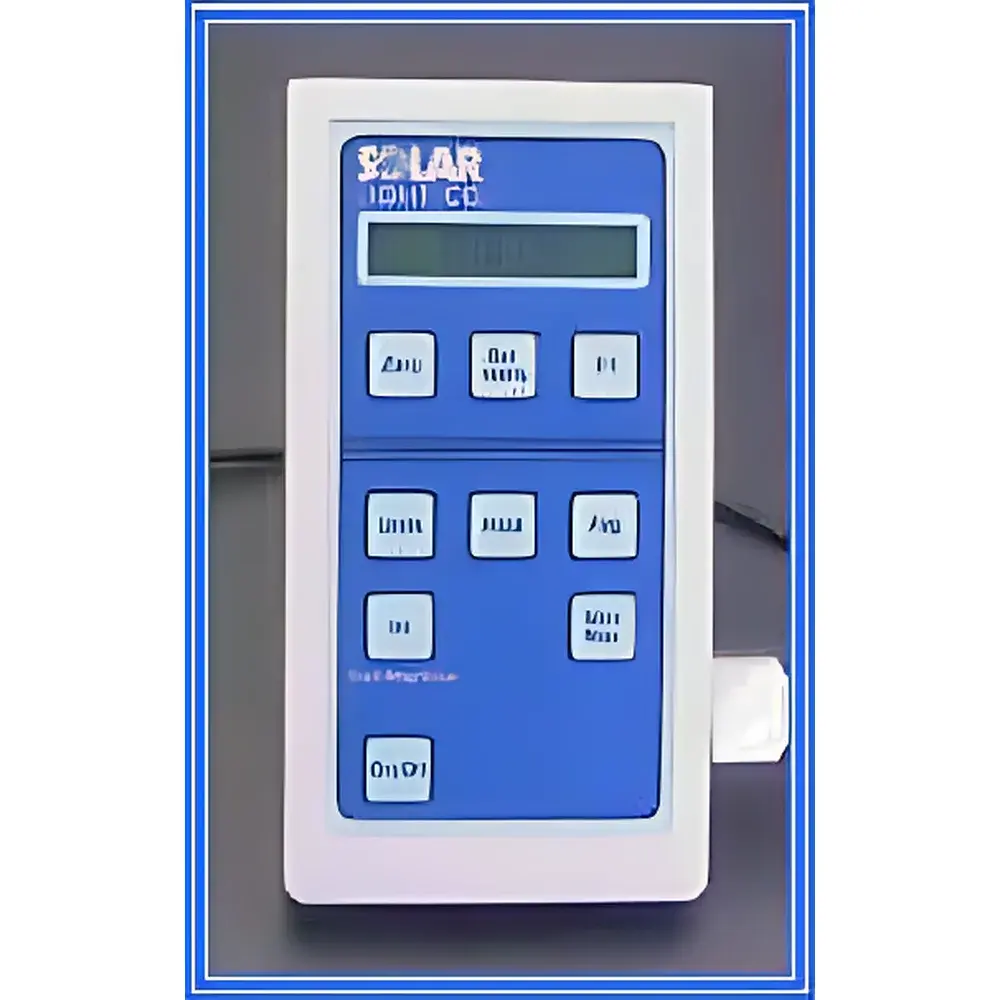
Solar Light SL-3101 Scotopic/Photopic Illuminance Meter
| Brand | Solar Light |
|---|---|
| Origin | USA |
| Model | SL-3101 |
| Detector Type | Silicon Photodiode |
| Dynamic Range | 2.6 × 10⁶ (6.5 digits) |
| Accuracy | ±0.2% FS |
| Integral Non-linearity | 0.003% |
| Temperature Coefficient | ≤50 ppm/°C |
| Sampling Rate | 3 Hz |
| Display Refresh Rate | 10 Hz |
| Operating Temperature | 0–50 °C (non-condensing) |
| Power | 4 × AA alkaline batteries (≥40 h continuous), or 9–12 V AC/DC adapter (≥100 mA) |
| Weight | 510 g |
| Dimensions | 10 × 4.35 × 19.3 cm |
| LCD Size | 6.4 × 1.3 cm |
| Keypad | 9-key programmable interface |
| Photopic Sensor (PMA2130) | Spectral Response per CIE V(λ) (400–700 nm), Angular Response ≤5% at <60°, Range: 1–150,000 lx / 0.1–14,000 ft-cd, Resolution: 1 lx / 0.1 ft-cd |
| Scotopic Sensor (PMA2131) | Spectral Response per CIE V′(λ) (400–600 nm), Angular Response ≤5% at <60°, Range: 1–150,000 lx / 0.1–14,000 ft-cd, Resolution: 1 lx / 0.1 ft-cd |
| Sensor Diameter | 40.6 mm |
| Sensor Height | 45.8 mm |
| Sensor Weight | 200 g each |
Overview
The Solar Light SL-3101 Scotopic/Photopic Illuminance Meter is a precision optical measurement instrument engineered for quantitative evaluation of lighting environments under both photopic (daylight-adapted) and scotopic (low-light, rod-dominated) visual conditions. Unlike conventional illuminance meters that rely solely on the CIE photopic luminosity function V(λ), the SL-3101 integrates dual calibrated silicon photodiode sensors—PMA2130 (photopic) and PMA2131 (scotopic)—each independently traceable to NIST standards and spectrally matched to the CIE 1924 V(λ) and 1951 V′(λ) spectral luminous efficiency functions, respectively. This dual-sensor architecture enables simultaneous acquisition of illuminance values weighted by human photopic and scotopic spectral sensitivity, facilitating calculation of the scotopic-to-photopic (S/P) ratio—a critical metric in mesopic vision research, roadway lighting design, and energy-efficient lighting specification per IES TM-12-19 and CIE 191:2010. The instrument operates on fundamental principles of radiometric detection with photometric weighting, where incident photons are converted to photocurrents proportional to spectral irradiance, then digitally scaled using stored spectral correction matrices derived from full-width half-maximum (FWHM) characterization across 400–700 nm (photopic) and 400–600 nm (scotopic) bands.
Key Features
- Dual independent sensor channels: PMA2130 (CIE V(λ)-weighted) and PMA2131 (CIE V′(λ)-weighted), both with <60° angular response deviation ≤5%, ensuring high spatial uniformity in non-collimated fields
- High-resolution 6.5-digit dynamic range (2.6 × 10⁶), enabling accurate measurement from 1 lx to 150,000 lx without manual range switching
- Calibration stability maintained via temperature-compensated analog front-end with ≤50 ppm/°C drift coefficient, validated over 0–50 °C operating envelope
- Real-time S/P ratio computation, visual efficacy (lm/Wopt), and perceptual brightness estimation based on Judd–Vos modified luminosity data
- Onboard 9-key programmable interface supporting user-defined units (lx, fc, cd/m²), averaging modes (1–60 s), and data hold functions
- Low-power architecture delivering >40 hours of continuous operation on standard alkaline AA cells; optional 9–12 V DC/AC input for lab-based deployment
- Compliant with IEC 60825-1 (Class 1 LED safety), EN 61326-1 (EMC for test equipment), and ISO/IEC 17025 traceability requirements when used with accredited calibration certificates
Sample Compatibility & Compliance
The SL-3101 is compatible with all common light sources—including incandescent, fluorescent, HID, OLED, and narrowband LEDs—without requiring source-specific correction factors, provided spectral output falls within the defined 400–700 nm (photopic) and 400–600 nm (scotopic) responsivity windows. Its cosine-corrected diffuser and optimized entrance optics minimize f-number dependency and directional error, satisfying CIE Publication 13.3 requirements for illuminance meter angular response. For regulatory and quality assurance applications, the device supports GLP-compliant data logging when paired with Solar Light’s optional PC interface software (SL-Link v3.x), generating audit-ready reports with embedded timestamps, operator ID, calibration expiry, and sensor serial traceability—fully aligned with FDA 21 CFR Part 11 electronic record integrity provisions. It is routinely deployed in facilities undergoing ISO 50001 energy management system certification and IES LM-79–2019 photometric testing workflows.
Software & Data Management
While the SL-3101 operates autonomously as a handheld meter, its RS-232/USB interface (via optional adapter) enables bidirectional communication with Windows-based SL-Link software. This application provides real-time graphing of concurrent photopic/scotopic traces, automated S/P ratio trending over time, batch export to CSV or Excel-compatible XML, and customizable report templates compliant with ASTM E308–22 and CIE S 023/E:2022 documentation guidelines. All logged datasets include embedded metadata: measurement UTC timestamp, ambient temperature, battery voltage, active sensor ID, and firmware revision. Audit trails are immutable and support role-based access control (RBAC) for multi-user laboratory environments, satisfying ISO/IEC 17025 clause 7.7.1 on data integrity and change control.
Applications
- Architectural lighting design validation per IES RP-25-22 and EN 12464-1 for interior workplaces, hospitals, and educational facilities
- Mesopic photometry studies in transportation lighting, including streetlight spectral power distribution (SPD) optimization for driver visual performance
- LED product development labs evaluating circadian stimulus (CS), melanopic EDI, and scotopic efficacy trade-offs
- Energy service companies (ESCOs) performing ASHRAE Guideline 36–2021–compliant lighting retrofits with quantified visual quality metrics
- Academic and governmental research on age-related changes in scotopic sensitivity (e.g., presbyopia modeling, retinal aging cohorts)
- Calibration laboratories maintaining secondary standards traceable to NIST SRM 2219 and PTB reference lamps
FAQ
Does the SL-3101 require annual recalibration to maintain accuracy?
Yes. Solar Light recommends recalibration every 12 months against NIST-traceable standards to ensure continued compliance with ±0.2% FS accuracy specification, particularly after exposure to thermal cycling or mechanical shock.
Can the photopic and scotopic sensors be used simultaneously during a single measurement cycle?
Yes. The instrument acquires synchronized readings from both PMA2130 and PMA2131 detectors at 3 Hz sampling rate, computing real-time S/P ratio and perceptual brightness without user intervention.
Is the SL-3101 suitable for outdoor daylight measurements?
It is rated for operation up to 50 °C in non-condensing environments but lacks weatherproofing (IP rating). For extended outdoor use, pairing with Solar Light’s PMA2130-WEATHER housing (IP65-rated) is advised.
How is traceability documented for metrological audits?
Each unit ships with a factory calibration certificate listing uncertainty budgets per ISO/IEC 17025, including contributions from spectral mismatch, linearity, temperature, and angular response—validated using monochromator-based spectral irradiance standards.
Does the device support custom spectral weighting functions beyond CIE V(λ) and V′(λ)?
No. The SL-3101 implements only the standardized CIE photopic and scotopic luminosity functions. Custom weighting requires post-processing of raw spectral irradiance data acquired via external spectroradiometers.




