
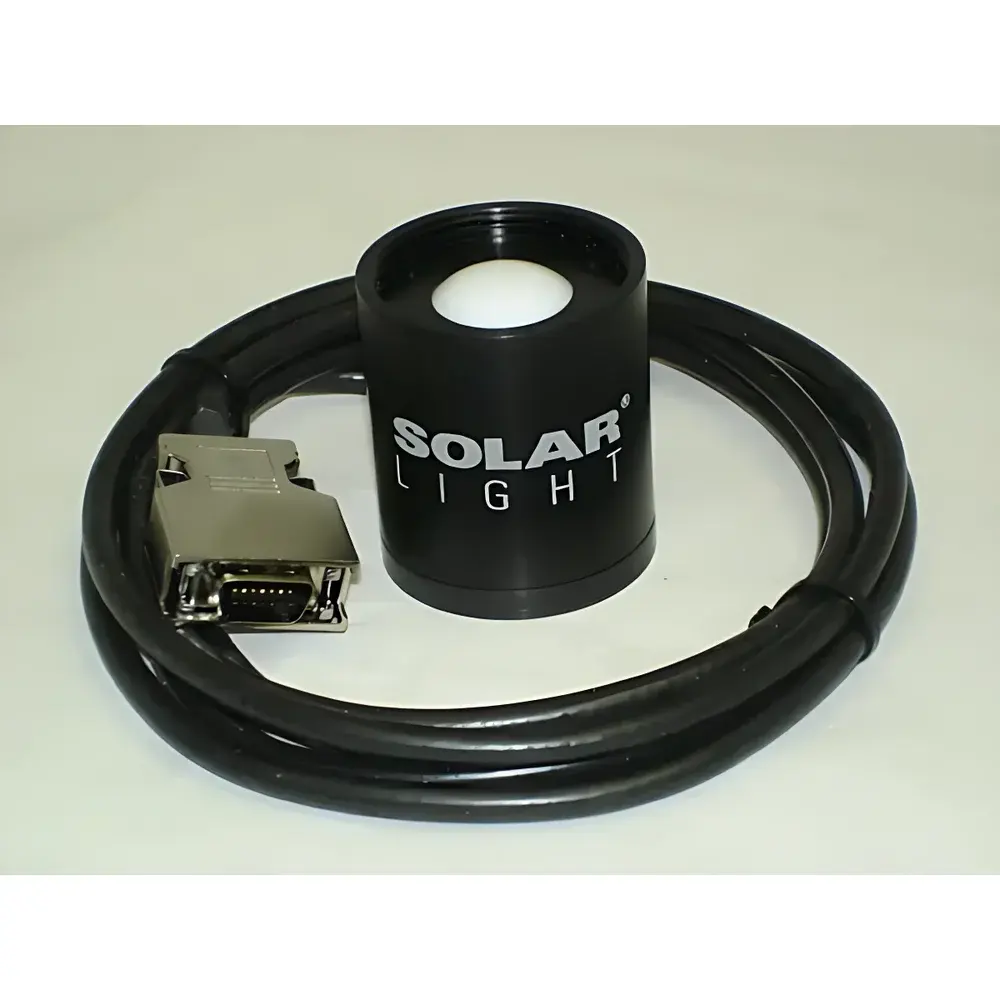
Solar Light PMA2140 Full-Spectrum Radiometer
| Brand | Solar Light |
|---|---|
| Origin | USA |
| Model | PMA2140 |
| Spectral Range | 400–1100 nm |
| Cosine Response Error | ≤5% for incident angles <60° |
| Measurement Range | 0–2000 W/m² |
| Resolution | 0.01 W/m² |
| Operating Temperature | 0–50 °C (non-condensing) |
| Detector Diameter | 40.6 mm |
| Height | 45.8 mm |
| Weight | 200 g |
| Cable Length | 0.3 m (standard), extendable to 1.5 m |
| Compliance | ASTM G173, ISO 9060:2018 Class C (reference-grade context) |
Overview
The Solar Light PMA2140 Full-Spectrum Radiometer is a precision-calibrated, silicon photodiode-based radiometric sensor engineered for quantitative measurement of broadband solar irradiance across the 400–1100 nm spectral band. Unlike thermopile-based pyranometers, the PMA2140 leverages a high-stability photodiode with spectrally optimized filtering and a rigorously characterized cosine diffuser to deliver rapid-response, low-drift irradiance data under natural and controlled illumination conditions. While its native spectral sensitivity is confined to the visible and near-infrared (VIS-NIR) region, the instrument is factory-calibrated against standard solar spectra (ASTM G173-03 reference) to report total hemispherical solar irradiance (global horizontal irradiance, GHI) in W/m² — effectively accounting for the 300–2800 nm solar spectrum via an empirically derived spectral correction factor. This approach enables accurate GHI estimation in clear-sky conditions where ~75% of total solar energy resides within the 400–1100 nm band, making the PMA2140 a technically validated, cost-optimized alternative to Class C pyranometers for applications where thermopile-level absolute accuracy across the full solar spectrum is not required.
Key Features
- Photodiode-Based Detection: Utilizes a temperature-compensated, low-noise silicon photodiode with stable responsivity and minimal long-term drift — ideal for unattended field deployments and laboratory reproducibility.
- NIST-Traceable Calibration: Supplied with individual calibration certificate traceable to the National Institute of Standards and Technology (NIST), ensuring metrological integrity and audit readiness for GLP-compliant environmental monitoring programs.
- Cosine-Corrected Optical Design: Integrated precision-ground diffuser achieves ≤±5% deviation from ideal cosine response for angles up to 60° from normal incidence — critical for accurate integration of diffuse sky radiation and extended light sources.
- Robust Environmental Rating: Rated for continuous operation between 0 °C and +50 °C in non-condensing environments; housing constructed from UV-stabilized anodized aluminum for outdoor durability and thermal stability.
- High Sensitivity & Resolution: Capable of resolving irradiance levels as low as 0.01 W/m² — suitable for low-light studies including shaded canopy measurements, indoor daylight analysis, and LED lighting characterization (with spectral correction awareness).
- Modular Interface Compatibility: Outputs analog voltage (0–2.5 V) proportional to irradiance; compatible with Solar Light’s PMA series meters, data loggers supporting 0–5 V input, and third-party DAQ systems with appropriate scaling.
Sample Compatibility & Compliance
The PMA2140 is designed for use with natural sunlight, simulated solar sources (e.g., xenon arc lamps with AM1.5G filters), and broad-spectrum artificial lighting (fluorescent, metal halide, white LEDs). Its spectral response necessitates application-specific correction when measuring non-solar sources due to inherent mismatch with their emission profiles. The instrument conforms to the functional performance criteria outlined in ISO 9060:2018 for “spectrally flat” radiometers used in solar resource assessment, and supports compliance with ASTM E892 (Standard Test Method for Spectral Match of Solar Simulators) when paired with reference spectroradiometers. It meets general requirements for environmental monitoring per IEC 61724-1 (Photovoltaic system performance — Monitoring guidelines) for auxiliary irradiance verification. While not certified for primary meteorological networks (e.g., WMO GSRN), it is widely deployed in secondary-tier solar monitoring stations, agrivoltaic trials, and HVAC commissioning protocols requiring traceable, repeatable irradiance trending.
Software & Data Management
When integrated with Solar Light’s PMA2100 or PMA2200 handheld meters, the PMA2140 supports real-time display, statistical logging (min/max/avg), and timestamped data export via USB or Bluetooth. Raw voltage output can be acquired by any programmable DAQ system; calibration coefficients (sensitivity in µV/(W/m²), spectral correction factor, temperature coefficient) are provided in the NIST certificate for custom algorithm implementation. Data files adhere to CSV format with ISO 8601 timestamps, enabling direct ingestion into MATLAB, Python (Pandas), LabVIEW, or industry-standard energy modeling platforms (e.g., PVsyst, SAM). Audit trails, user-defined averaging intervals, and calibration expiration alerts are supported in Solar Light’s proprietary LogView software — compliant with FDA 21 CFR Part 11 for electronic records where configured with role-based access control and digital signature capability.
Applications
- Meteorological & Climatological Monitoring: Long-term solar irradiance trend analysis in regional weather stations and educational observatories.
- Agricultural Photobiology: Quantifying photosynthetically active radiation (PAR)-adjacent irradiance for canopy light interception studies and greenhouse optimization.
- Solar Energy R&D: Rapid screening of PV module IV curve normalization, bifacial gain estimation, and soiling loss quantification under clear-sky conditions.
- Building Science & HVAC: Commissioning daylight harvesting controls, validating shading device efficacy, and calibrating building energy models.
- Optics & Photonics Laboratories: Reference irradiance source characterization, lamp aging studies, and optical bench alignment verification.
- Environmental Health & Safety: UV-A/visible irradiance assessment for occupational exposure evaluation (in conjunction with spectral weighting functions).
FAQ
Can the PMA2140 measure ultraviolet (UV) or far-infrared (FIR) irradiance?
No. Its spectral response is limited to 400–1100 nm. UV measurements require dedicated UV-enhanced photodiodes (e.g., PMA2101), while FIR (>1100 nm) demands thermopile or pyroelectric detectors.
Why does the PMA2140 report “total solar irradiance” if it only detects 400–1100 nm?
It applies a pre-determined spectral correction factor derived from AM1.5G solar spectral irradiance data (ASTM G173), enabling accurate GHI estimation under standard atmospheric conditions where this band dominates total energy.
Is the cosine diffuser replaceable or field-serviceable?
The diffuser is permanently bonded and optically aligned during manufacture; replacement requires factory recalibration to maintain angular response certification.
What is the recommended recalibration interval?
Solar Light recommends annual recalibration for critical applications; biennial recalibration is acceptable for routine monitoring where drift validation is performed via intercomparison.
Does cable extension affect measurement accuracy?
Signal attenuation is negligible up to 1.5 m with shielded twisted-pair cabling; beyond that, voltage drop and noise susceptibility increase — use of a signal conditioner or current-loop transmitter is advised.




