
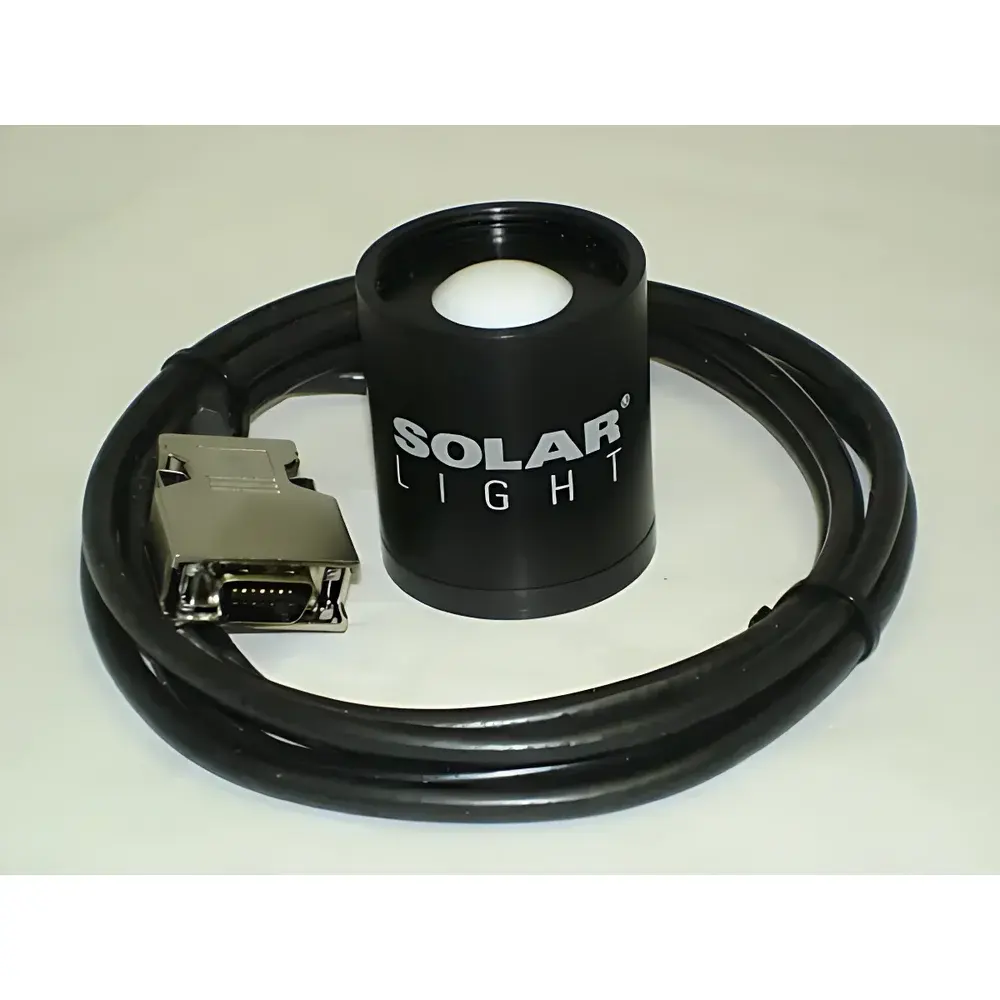
Solar Light PMA2132 Quantum Sensor for Photosynthetic Active Radiation (PAR) Measurement
| Brand | Solar Light |
|---|---|
| Origin | USA |
| Model | PMA2132 |
| Spectral Range | 400–700 nm |
| Calibration | NIST-traceable |
| Cosine Response Error | ≤5% up to 80° incidence angle |
| Measurement Range | 0–20,000 µE·s⁻¹·m⁻² |
| Resolution | 0.1 µE·s⁻¹·m⁻² |
| Operating Temperature | −40 to +50 °C |
| Cable Length | 15 m (standard), optional retractable 0.3 m |
| Dimensions | Ø40.6 mm × 45.8 mm |
| Weight | 200 g |
| Temperature Coefficient | <0.15 %/°C |
Overview
The Solar Light PMA2132 Quantum Sensor is a precision optical instrument engineered for the quantitative measurement of Photosynthetic Active Radiation (PAR) in the 400–700 nm spectral band. Unlike broadband irradiance meters calibrated to human photopic response (e.g., lux meters), the PMA2132 implements quantum-based detection—its responsivity is spectrally weighted to match photon flux density (µmol·m⁻²·s⁻¹), also expressed as µE·s⁻¹·m⁻² (micro-Einsteins per second per square meter). This alignment with plant photochemical action spectra ensures metrological relevance for agronomic, ecological, and photobiological applications. The sensor operates on the principle that photosynthetic efficiency correlates directly with incident photon count—not radiant energy—in this defined waveband. Its silicon photodiode is coupled with a custom interference filter and diffuser system to achieve flat quantum efficiency across 400–700 nm and near-ideal cosine angular response (≤5% deviation up to 80° from normal incidence), enabling accurate integration of diffuse sky radiation and non-collimated light sources typical in field canopies, greenhouse environments, and open-air climate stations.
Key Features
- NIST-traceable calibration certificate provided with each unit, ensuring compliance with international radiometric standards and supporting laboratory accreditation requirements (ISO/IEC 17025).
- IP67-rated hermetically sealed aluminum housing, rated for continuous outdoor deployment in rain, fog, dust, and high-humidity conditions without performance degradation.
- Optimized cosine correction via precision-ground diffuser and baffle geometry—validated per ASTM E892 and ISO 9060 Class A angular response specifications.
- High dynamic range (0–20,000 µE·s⁻¹·m⁻²) with 0.1 µE·s⁻¹·m⁻² digital resolution, suitable for low-light canopy understory measurements and full-sun equatorial exposure.
- Low thermal drift (<0.15 %/°C) over −40 to +50 °C, minimizing seasonal or diurnal calibration drift in uncontrolled environmental monitoring deployments.
- Standard 15 m low-noise shielded cable with BNC output interface—compatible with Solar Light’s PMA series meters, Campbell Scientific dataloggers, and third-party DAQ systems supporting ±100 mV analog input.
Sample Compatibility & Compliance
The PMA2132 is designed for direct measurement of planar PAR incident on horizontal or tilted surfaces—ideal for leaf-level microclimate studies, crop canopy profiling, algal photobioreactor monitoring, and long-term ecological observatories. It complies with widely adopted protocols in plant physiology (e.g., USDA ARS field methods), atmospheric science (NOAA SURFRAD network specifications), and controlled-environment agriculture (CEA) validation frameworks. While not an FDA-regulated device, its traceable calibration and documented uncertainty budget (±3% at 25 °C, k=2) support GLP-aligned data collection where auditability and measurement transparency are required. The sensor does not require user recalibration under normal operating conditions; annual verification against a reference standard is recommended for GMP-aligned quality assurance programs.
Software & Data Management
The PMA2132 functions as a standalone analog transducer and integrates seamlessly into existing data acquisition infrastructures. When paired with Solar Light’s PMA2100 or PMA2200 handheld meters, real-time logging, min/max tracking, and auto-ranging are enabled via embedded firmware. For networked applications, it interfaces with Campbell Scientific CR1000X, HOBO U30, or Onset RX3000 systems using standard voltage-input configurations. Raw output (0–100 mV = 0–20,000 µE·s⁻¹·m⁻²) is linear and stable, facilitating post-acquisition conversion using manufacturer-provided scaling factors. Exported time-series datasets retain native timestamping and metadata fields compatible with MATLAB, Python (Pandas/NumPy), R, and commercial platforms such as LabVIEW and DIAdem—enabling reproducible analysis pipelines compliant with FAIR data principles.
Applications
- Agricultural research: Quantifying PAR interception efficiency across cultivars, optimizing LED lighting spectra in vertical farms, and validating canopy light extinction models (e.g., Beer-Lambert law parameterization).
- Climatology & ecosystem science: Supporting FLUXNET and AmeriFlux tower networks in partitioning gross primary production (GPP) estimates and calibrating satellite-derived PAR products (e.g., MODIS PAR).
- Photobiology labs: Standardizing light dosimetry for in vitro plant tissue culture, phytochrome activation studies, and UV-B/PAR interaction experiments.
- Environmental education: Enabling undergraduate laboratories to correlate quantum yield measurements with chlorophyll fluorescence (PAM) and gas exchange (IRGA) datasets.
- Greenhouse climate control: Feeding real-time PAR inputs into automated shading and supplemental lighting algorithms governed by EN 12464-1 and ASHRAE 55 daylighting guidelines.
FAQ
What is the difference between PAR measured in µmol·m⁻²·s⁻¹ and irradiance measured in W·m⁻²?
PAR in µmol·m⁻²·s⁻¹ quantifies photon count within 400–700 nm—directly relevant to photochemistry. Irradiance in W·m⁻² measures total radiant power, including non-photoactive wavelengths. Conversion requires spectral knowledge and is not constant across light sources.
Can the PMA2132 be used underwater or submerged?
No. Although IP67-rated for rain and splashing, it is not submersible. For aquatic PAR profiling, Solar Light offers the PMA2142 submersible variant with pressure-rated housing.
Is cosine correction validated independently?
Yes. Each production batch undergoes angular responsivity testing per IEC 60904-9:2020 Annex E, with individual unit reports available upon request.
Does the sensor require periodic recalibration?
NIST-traceable calibration remains valid for 24 months under normal use. Annual verification is recommended for regulatory or publication-grade data.
How does temperature affect measurement accuracy?
The integrated temperature compensation circuit maintains <0.15 %/°C deviation across the full operating range; no external correction is needed for most field deployments.






