
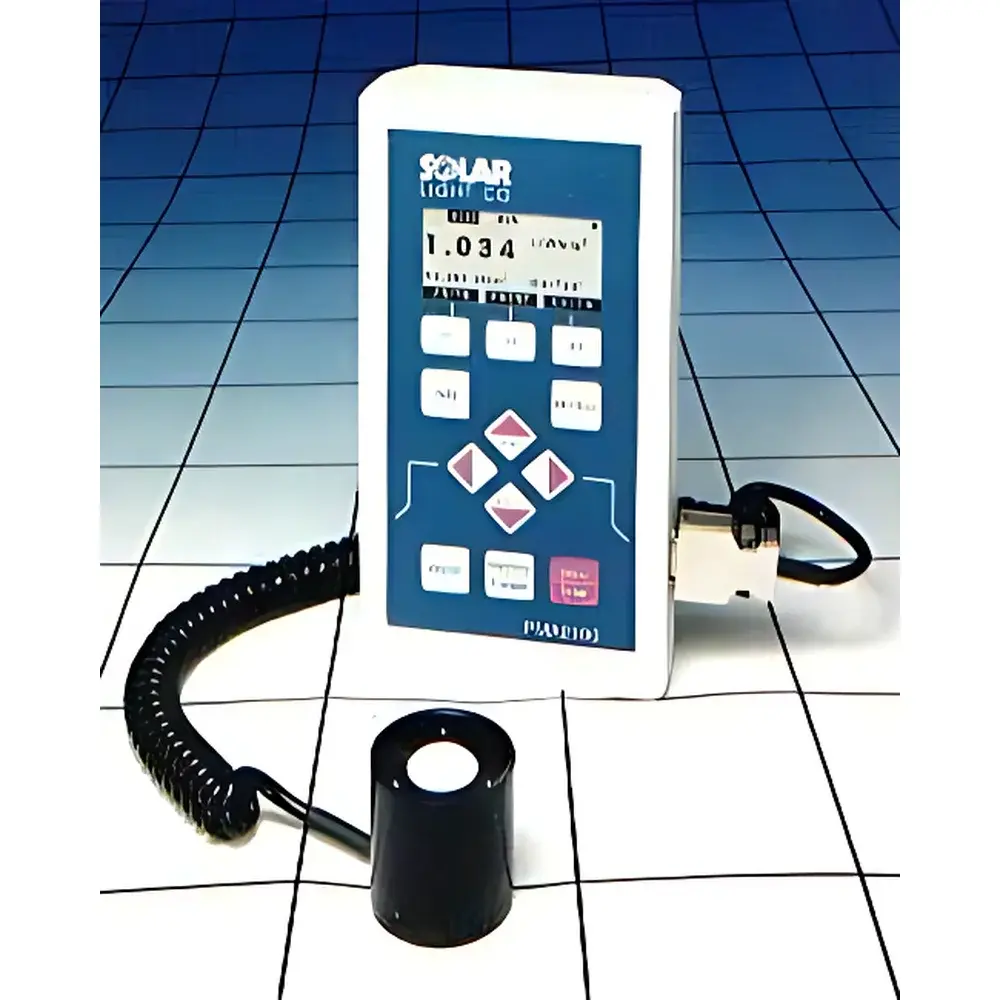
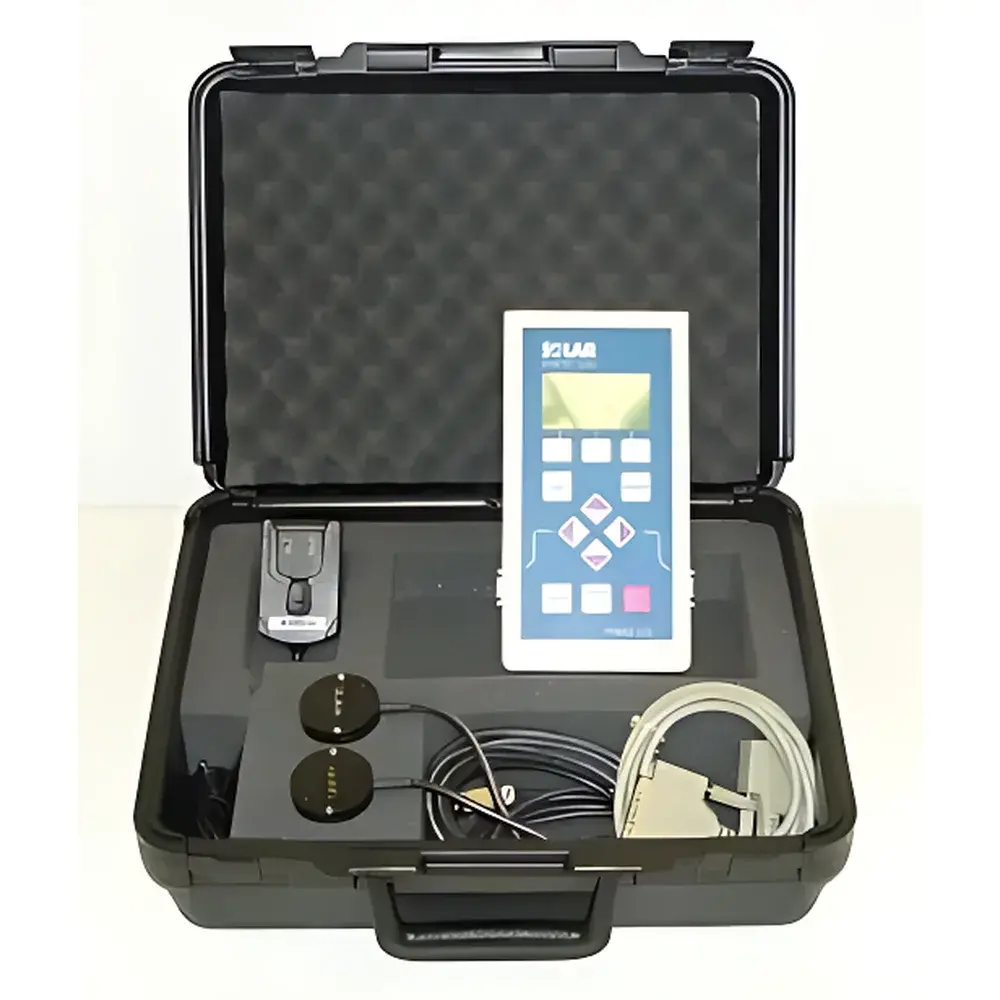
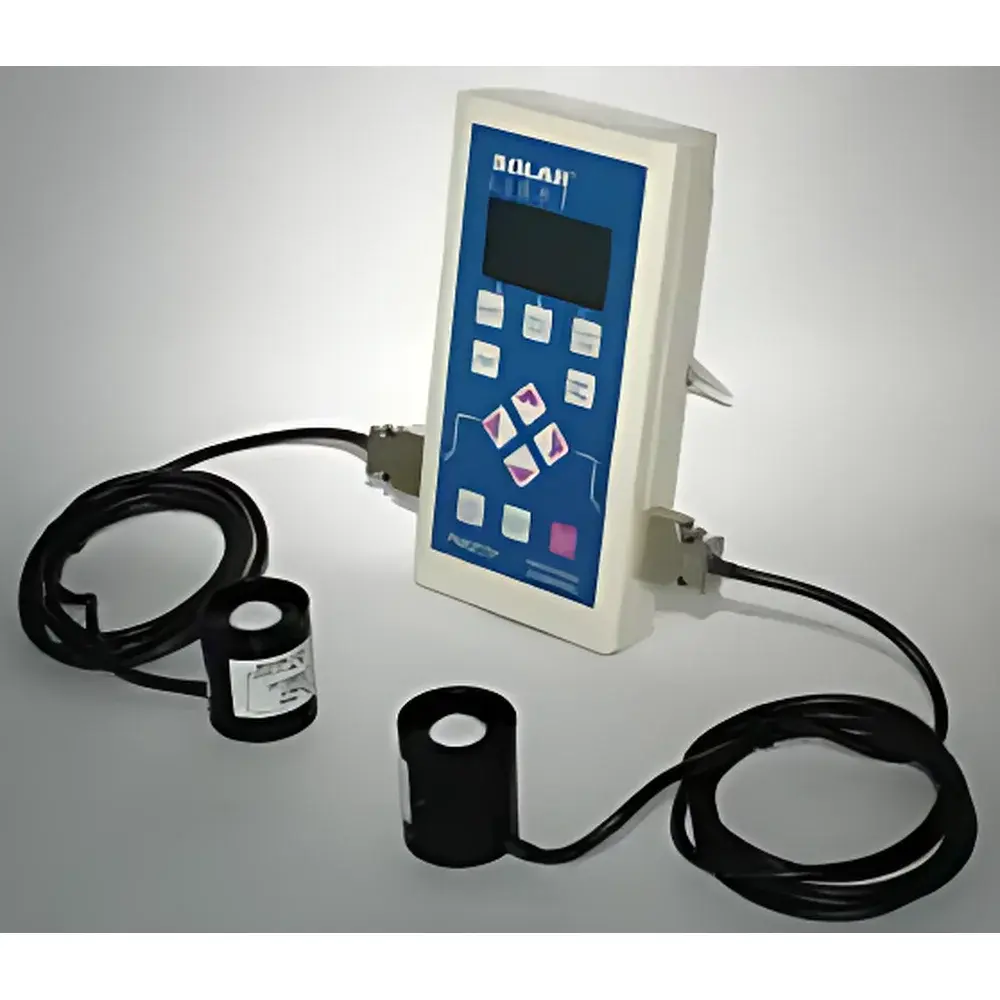
Solar Light PMA2100 Research-Grade Multi-Channel Radiometer
| Brand | Solar Light |
|---|---|
| Origin | USA |
| Model | PMA2100 |
| Detector Inputs | 2 |
| Input Ranges | ±0.4 V, ±4 V (auto-ranging) |
| Resolution (±0.4 V range) | 15 µV |
| Dynamic Range | >2×10⁵ |
| Accuracy | ±0.5% FS across all ranges |
| Nonlinearity | ≤0.02% FS per range |
| Temperature Coefficient | ≤50 ppm/°C |
| Data Memory | 1024 points |
| Operating Temperature | 0–50 °C |
| Power | 4×AA NiCd or alkaline batteries |
| Weight | 480 g (17 oz) |
| Dimensions | 10 × 19.5 × 4.5 cm (4″ W × 7.6″ H × 1.75″ D) |
| Safety Compliance | UL 61010-1 Annex DVC |
Overview
The Solar Light PMA2100 is a portable, research-grade multi-channel radiometer engineered for high-fidelity optical radiation measurement across ultraviolet (UVA, UVB, UVC), visible, and near-to-mid infrared spectral bands. Unlike single-sensor handheld meters, the PMA2100 employs a modular architecture centered on intelligent detector recognition and real-time analog signal conditioning—enabling seamless integration of over 35 interchangeable calibrated sensors without hardware modification or firmware reconfiguration. Its core measurement principle relies on precision low-noise analog front-end circuitry with auto-ranging voltage input (±0.4 V and ±4 V), digitized via a 16-bit ADC to ensure resolution down to 15 µV in the most sensitive range. Designed for traceable photometric and radiometric quantification, the instrument supports SI-traceable units including W/m², mW/cm², µW/cm², lux, W/sr·m², and J/m² (dose), with built-in algorithms for spectral weighting (e.g., erythemal, UVA-weighted, PAR) when paired with appropriate detectors.
Key Features
- Modular dual-detector interface supporting simultaneous or sequential measurement from two independently calibrated sensors
- Intelligent sensor recognition: automatic identification and loading of calibration coefficients stored in each detector’s EEPROM
- Onboard graphical LCD display with real-time waveform visualization, numeric readouts, and configurable data overlays
- Integrated data logging: stores up to 1024 timestamped measurement points internally; exportable via RS-232 serial interface
- Comprehensive real-time processing: arithmetic averaging, min/max tracking, dose accumulation (integrated irradiance over time), and programmable threshold alarms with visual/audible alerts
- Multi-unit support: direct switching between radiometric (W/m²), photometric (lux), and dosimetric (J/m²) units without recalibration
- Rugged handheld form factor (480 g) compliant with UL 61010-1 Annex DVC for laboratory and field use under Class II electrical safety requirements
Sample Compatibility & Compliance
The PMA2100 is compatible with Solar Light’s full suite of NIST-traceably calibrated detectors—including broadband UV-A/B/C radiometers, visible-light photometers (with CIE 1931 V(λ) response), PAR quantum sensors (400–700 nm), narrowband IR thermopile detectors (up to 5.5 µm), and environmental probes (temperature and relative humidity). Each detector undergoes individual spectral responsivity characterization and factory calibration against reference standards maintained at Solar Light’s ISO/IEC 17025-accredited calibration laboratory. The system meets applicable requirements for GLP-compliant environmental monitoring and clinical phototherapy validation, and its data integrity features—including immutable timestamping and non-volatile memory—support audit readiness under FDA 21 CFR Part 11 where electronic records are employed. While not inherently GMP-certified as a standalone device, it is routinely deployed in GMP-aligned settings for UV curing process qualification and sterilization validation when used with documented SOPs and periodic inter-laboratory verification.
Software & Data Management
Data acquisition and post-processing are supported via Solar Light’s proprietary PC-based software (Windows-compatible), which enables remote configuration, real-time streaming, batch export to CSV/Excel, and automated report generation with embedded calibration metadata. The software enforces version-controlled detector profiles and logs all user-initiated parameter changes with timestamps—facilitating full traceability in regulated environments. Raw voltage readings, applied calibration factors, unit conversions, and dose integrals are retained separately in exported files to allow independent verification of computational integrity. For integration into LIMS or SCADA systems, the PMA2100’s ASCII-based serial protocol provides deterministic command-response structure with checksum validation, ensuring robust machine-to-machine communication in industrial QA/QC workflows.
Applications
- UV disinfection system validation and routine monitoring (UVC 254 nm, far-UVC 222 nm)
- Photocatalytic reactor characterization and solar simulator spectral matching
- Clinical phototherapy dosimetry (psoralen-UVA, narrowband UVB)
- Museum lighting conservation: cumulative UV exposure assessment for artifact degradation modeling
- Agricultural photobiology: PAR mapping in growth chambers and greenhouse spectral profiling
- Industrial UV curing process control: real-time irradiance feedback for ink, coating, and adhesive polymerization
- Environmental health & safety: occupational UV index monitoring and skin/eye hazard assessment per ACGIH TLVs®
- Sensor intercomparison and transfer calibration in metrology labs
FAQ
Does the PMA2100 require recalibration after swapping detectors?
No—each detector contains embedded calibration coefficients readable by the PMA2100 upon connection; no manual entry or instrument recalibration is needed.
Can the PMA2100 log data autonomously without a connected PC?
Yes—it stores up to 1024 measurements with timestamps in internal memory, retrievable later via serial interface.
Is the PMA2100 suitable for outdoor solar UV monitoring?
It is designed for controlled and semi-controlled environments; for long-term unattended outdoor deployment, a weatherproof enclosure and temperature-stabilized mounting are recommended.
What spectral bandwidths are supported by available detectors?
Detectors span 200–5500 nm, including UVC (200–280 nm), UVB (280–315 nm), UVA (315–400 nm), visible (380–780 nm), NIR (780–1400 nm), and MIR (2–5.5 µm) configurations.
How is measurement traceability maintained?
All detectors ship with NIST-traceable calibration certificates issued by Solar Light’s ISO/IEC 17025 accredited lab; certificates include uncertainty budgets, spectral responsivity curves, and calibration dates.





