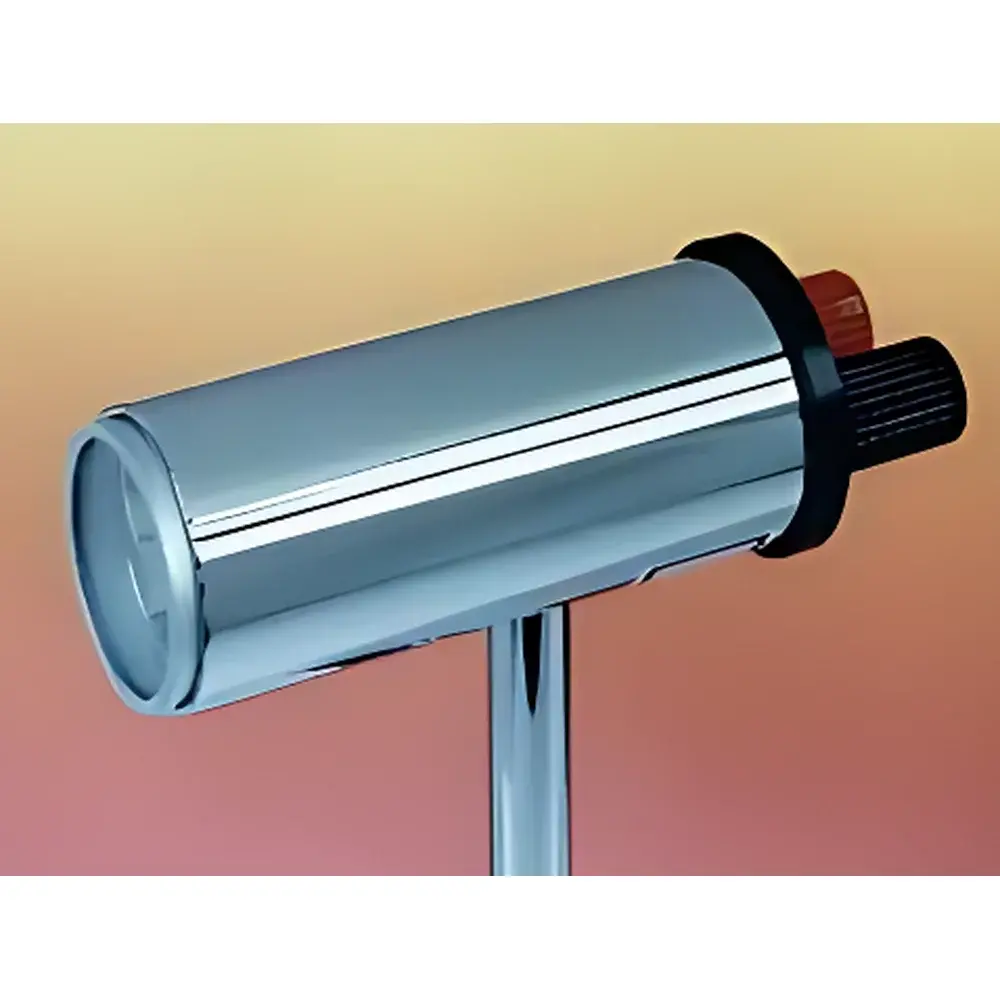
Solar Light PMA2143 Thermopile Radiometer
| Brand | Solar Light |
|---|---|
| Origin | USA |
| Model | PMA2143 |
| Spectral Response | 0.2–50 µm (unwindowed), 0.3–3 µm (with quartz window) |
| Field of View | 10° |
| Sensitivity | 20–40 µV/(W/m²) with window, 0.1 µV/µW on absorber, 1.10× higher without window |
| Max Irradiance | 2000 W/m² |
| Absorber Diameter | 12 mm |
| Response Time | 30 s |
| Operating Temperature | −40 to +80 °C |
| Nonlinearity | ≤3% (at 50 mV output) |
| Housing Diameter | 37.6 mm |
| Length (excl. connectors) | 101.6 mm |
| Weight (with 160 mm mounting rod) | 500 g |
| Cable Length | 5 m |
Overview
The Solar Light PMA2143 Thermopile Radiometer is a precision-calibrated, broadband thermal radiation sensor engineered for absolute measurement of spectral irradiance and radiant flux across an exceptionally wide wavelength range—from deep ultraviolet (0.2 µm) to far-infrared (50 µm). Unlike photodiode-based detectors whose responsivity varies significantly with wavelength, the PMA2143 employs a high-stability blackened thermopile absorber that converts incident radiant power into a proportional thermoelectric voltage via the Seebeck effect. This fundamental operating principle ensures spectrally flat response—critical for applications requiring traceable, wavelength-agnostic radiometric quantification. The detector’s 10° full field-of-view (FOV) enables reproducible cosine-corrected measurements under divergent or collimated illumination conditions, while its hermetically sealed, weather-resistant housing supports continuous outdoor deployment in ambient environments ranging from −40 °C to +80 °C.
Key Features
- True broadband spectral response: 0.2–50 µm (unwindowed); optional fused silica window extends UV durability while limiting transmission to 0.3–3 µm
- High-fidelity black-body absorber (12 mm diameter) with uniform emissivity >0.95 across full spectral band
- Thermopile architecture eliminates photovoltaic drift, polarization dependence, and saturation effects common in semiconductor detectors
- Integrated temperature-compensated electronics minimize thermal offset errors during long-term monitoring
- Robust stainless-steel and anodized aluminum housing rated for outdoor use; IP65-equivalent sealing against dust and moisture ingress
- Real-time min/max tracking and integrated dose accumulation (W·s/m² or J/m²) for time-resolved exposure analysis
- Portable form factor (37.6 mm × 101.6 mm, 500 g with mounting rod) compatible with tripod, mast, or handheld operation
Sample Compatibility & Compliance
The PMA2143 is designed for direct measurement of planar irradiance on surfaces exposed to natural solar radiation, industrial thermal sources (e.g., furnaces, IR heaters), calibration lamps (tungsten-halogen, blackbody), and laboratory broadband emitters. Its unwindowed configuration meets ASTM E892 and ISO 9060:2018 Class C specifications for secondary standard pyranometers when used with appropriate cosine diffusers. With quartz window installed, it complies with ASTM E1137/E1137M for UV-A/B irradiance monitoring in photostability testing per ICH Q1B and USP . All units are NIST-traceably calibrated at three discrete wavelengths (254 nm, 550 nm, 3.9 µm) and supplied with individual calibration certificates indicating spectral responsivity curves, linearity deviation, and temperature coefficients. The device supports GLP-compliant data acquisition workflows when paired with Solar Light’s PMA2100 or PMA2200 controllers featuring audit-trail logging and 21 CFR Part 11–ready firmware.
Software & Data Management
The PMA2143 operates as a passive analog sensor (mV output) but is fully interoperable with Solar Light’s ecosystem of digital readouts and PC-based acquisition systems. When connected to the PMA2200 controller, users gain access to real-time spectral weighting (e.g., UV Index, Erythemal Action Spectrum), automatic temperature compensation, and timestamped CSV export compliant with ISO/IEC 17025 reporting requirements. Firmware-enabled features include configurable averaging intervals (1 s to 60 min), alarm thresholds for over-irradiance events, and nonvolatile memory for up to 10,000 data points. Raw thermopile output is linear within ±3% up to 50 mV—enabling direct integration with third-party DAQ systems (e.g., National Instruments, Keysight) using standard 0–10 V or 4–20 mA signal conditioners.
Applications
- Radiometric validation of solar simulators and environmental test chambers per IEC 61215 and MIL-STD-810G
- Process control in industrial thermal curing, paint drying, and polymer cross-linking systems
- Reference-grade irradiance monitoring in photobiological safety assessments (IEC 62471)
- Calibration transfer between primary standards (e.g., cryogenic radiometers) and field-deployable sensors
- Long-term climatological studies of broadband terrestrial irradiance and atmospheric transmittance
- Educational demonstrations of Planckian radiation, Stefan-Boltzmann law, and emissivity characterization
FAQ
What is the recommended recalibration interval for the PMA2143?
Annual recalibration is recommended for applications requiring metrological traceability; biennial intervals may be justified for stable indoor environments with documented stability records.
Can the PMA2143 measure pulsed or modulated radiation sources?
Due to its 30-second thermal time constant, the PMA2143 is unsuitable for transient or high-frequency modulated signals; it is optimized for steady-state or slowly varying irradiance profiles.
Is the quartz window removable for extended IR measurements?
Yes—the window is mechanically retained and can be removed to restore full 0.2–50 µm spectral coverage; however, removal voids UV-rated environmental protection and requires revalidation of cosine response.
Does the sensor require zero-point adjustment before use?
No—factory-applied thermal compensation and stable thermopile design eliminate routine zeroing; ambient temperature drift is corrected automatically in PMA2200-integrated operation.
How is cosine error characterized for this model?
Cosine response deviation is ≤±2% at 60° incidence angle and ≤±5% at 80°, verified per ISO 9060:2018 Annex D using collimated source mapping.