
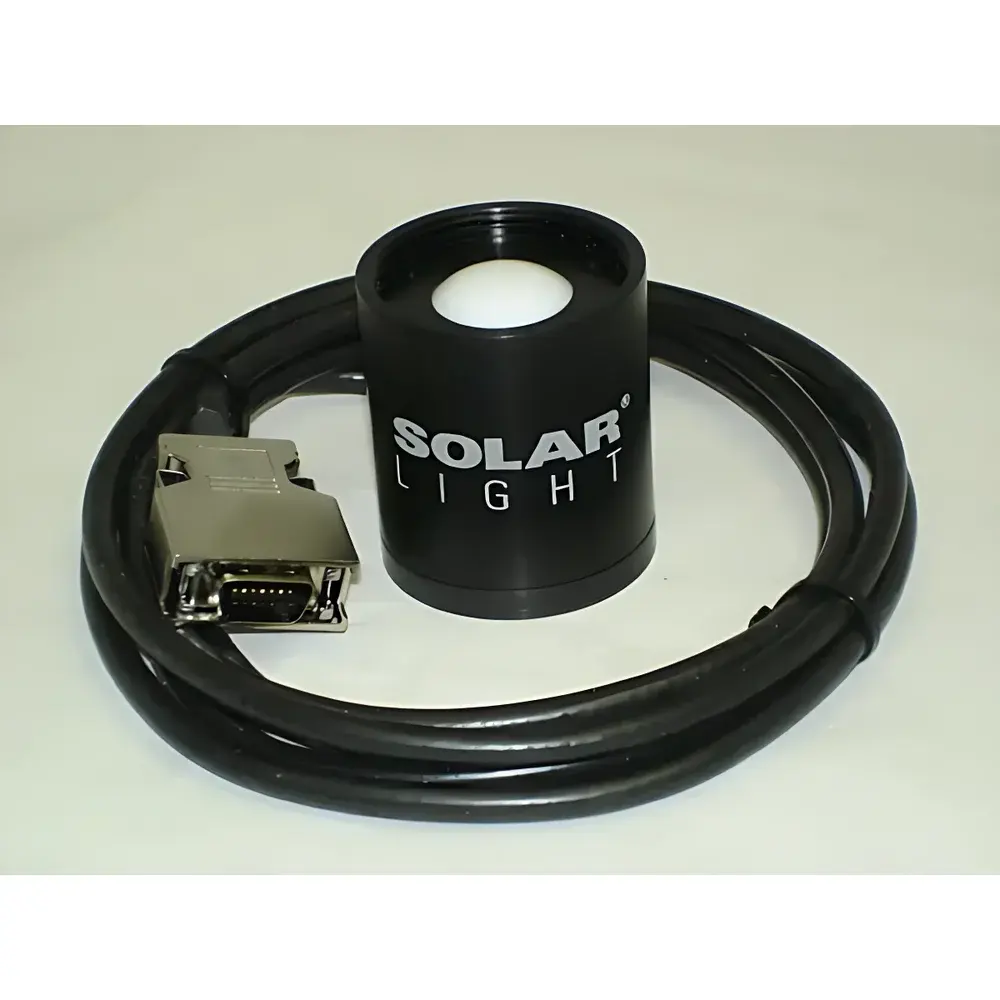
Solar Light PMA2130 Photopic Illuminance Detector
| Brand | Solar Light |
|---|---|
| Origin | USA |
| Model | PMA2130 |
| Spectral Response | CIE 1931 photopic luminous efficiency function (V(λ), 400–700 nm) |
| Cosine Correction | Integrated, ±5% up to 60° incidence angle |
| Measurement Range (PMA2130 standard variant) | 1–150,000 lx |
| Radiometric Equivalent | 0.001–220 W/m² |
| Illuminance Units | lux (lx), foot-candle (ft-cd), W/m² |
| Display Resolution | 1 lx / 0.001 W/m² / 0.1 ft-cd |
| Operating Temperature | 0–50 °C |
| Dimensions | Ø40.6 mm × 45.8 mm |
| Weight | 200 g |
| Calibration | NIST-traceable, certified per ISO/IEC 17025 accredited laboratory |
Overview
The Solar Light PMA2130 Photopic Illuminance Detector is a precision optical sensor engineered for quantitative measurement of visible light intensity in accordance with the CIE 1931 photopic luminous efficiency function V(λ). Designed to replicate the spectral sensitivity of the human eye under photopic (daylight-adapted) conditions—where luminance exceeds 0.1 lx—the PMA2130 delivers traceable, repeatable illuminance data critical for lighting validation, environmental compliance, and visual ergonomics assessment. Its core transduction principle relies on a silicon photodiode coupled with a multi-layer interference filter and diffuser assembly that collectively shape the detector’s spectral responsivity to match the standardized V(λ) curve across 400–700 nm. Unlike broadband radiometers, the PMA2130 applies photometric weighting in hardware, eliminating post-processing corrections and minimizing uncertainty introduced by spectral mismatch errors. The detector operates as a standalone probe compatible with Solar Light’s PMA series meters (e.g., PMA2100, PMA2200), enabling real-time analog output or digital logging via RS-232 or USB interfaces.
Key Features
- Photometric accuracy validated against CIE V(λ) spectral weighting, with <±3% deviation across 400–700 nm per calibration report
- Integrated cosine-corrected diffuser ensuring angular response error ≤±5% for incident angles up to 60° from normal—critical for uniform surface illumination mapping
- NIST-traceable calibration certificate supplied with each unit, compliant with ISO/IEC 17025 requirements for metrological traceability
- High dynamic range: 1–150,000 lx (standard variant), supporting applications from ambient indoor lighting to high-intensity solar simulation environments
- Multi-unit display capability: simultaneous readout in lux, foot-candles, and irradiance (W/m²) enables cross-standard reporting without unit conversion errors
- Compact, handheld form factor (Ø40.6 mm × 45.8 mm; 200 g) with retractable 0.3–1.5 m shielded cable for flexible deployment in confined or elevated locations
- Stable long-term performance: <±2% drift over 12 months under continuous operation at 25 °C, verified per IEC 60825-1 Annex D stability protocols
Sample Compatibility & Compliance
The PMA2130 is optimized for planar, diffuse, and collimated visible-light sources emitting within the photopic spectral band. It is routinely deployed in settings requiring conformance with occupational health standards (e.g., OSHA 1910.141, EN 12464-1), museum conservation guidelines (CIE S 014/E:2021), and clinical lighting protocols (IES RP-27.3). The detector’s V(λ)-matched response ensures compatibility with photometric metrics defined in CIE Publication 15:2018 and ASTM E308-23. All units undergo factory calibration against reference standards maintained at a signatory laboratory of the Mutual Recognition Arrangement (MRA) under the International Laboratory Accreditation Cooperation (ILAC). Device firmware and calibration metadata support audit-ready documentation for GLP and ISO 17025 quality systems.
Software & Data Management
When paired with Solar Light’s PMA Logger software (Windows-compatible), the PMA2130 supports time-stamped data acquisition at user-selectable intervals (100 ms–60 s), statistical analysis (min/max/avg/std dev), and export to CSV, Excel, or PDF formats. Raw analog output (0–5 V or 4–20 mA) permits integration into SCADA or LabVIEW-based monitoring platforms. Calibration coefficients—including spectral correction factors and temperature compensation parameters—are embedded in device EEPROM and automatically applied during data reduction. Software-generated reports include full metrological metadata: calibration date, uncertainty budget (k=2), reference standard ID, and environmental conditions during verification—ensuring compliance with FDA 21 CFR Part 11 electronic record requirements when configured with audit trail and electronic signature modules.
Applications
- Architectural lighting design validation and LEED EQ Credit 8.1 daylighting verification
- Museum and archival storage environment monitoring per ICOM-CC Lighting Guidelines (2022)
- OSHA-compliant workplace illumination surveys in manufacturing, laboratories, and cleanrooms
- Clinical phototherapy setup verification and circadian lighting research
- Film set lighting consistency control per SMPTE RP 167-2020
- Solar simulator uniformity mapping in PV module testing per IEC 61215-2 MQT 03
- Calibration transfer between primary and secondary photometric standards in metrology labs
FAQ
Does the PMA2130 measure scotopic or mesopic light levels?
No. The PMA2130 is strictly photopic-weighted per CIE V(λ). For scotopic (rod-dominated) or mesopic (mixed rod-cone) assessments, Solar Light offers the PMA2135 detector, which implements the CIE scotopic luminous efficiency function V′(λ).
Is the cosine correction validated per ISO/CIE standards?
Yes. Angular response characterization follows CIE 127:2007 and ISO 19906 Annex B procedures. Measured deviation remains within ±5% up to 60°, documented in the individual calibration report.
Can the PMA2130 be used outdoors under direct sunlight?
Yes—within its specified operating temperature range (0–50 °C) and provided the probe is not exposed to precipitation or condensation. For extended outdoor deployment, use with a ventilated radiation shield (e.g., Solar Light Model RS-1) is recommended to minimize thermal drift.
How often should recalibration be performed?
Annual recalibration is recommended for routine quality assurance. Laboratories operating under ISO/IEC 17025 must establish recalibration intervals based on historical stability data, usage frequency, and risk assessment—typically 6–12 months.
Is the NIST-traceable calibration certificate sufficient for FDA-regulated environments?
Yes, provided the certificate includes measurement uncertainty, coverage factor (k=2), and compliance statement per ISO/IEC 17025. When integrated into a validated software system with 21 CFR Part 11 controls, the PMA2130 supports regulated photometric data capture in pharmaceutical and medical device facilities.




