
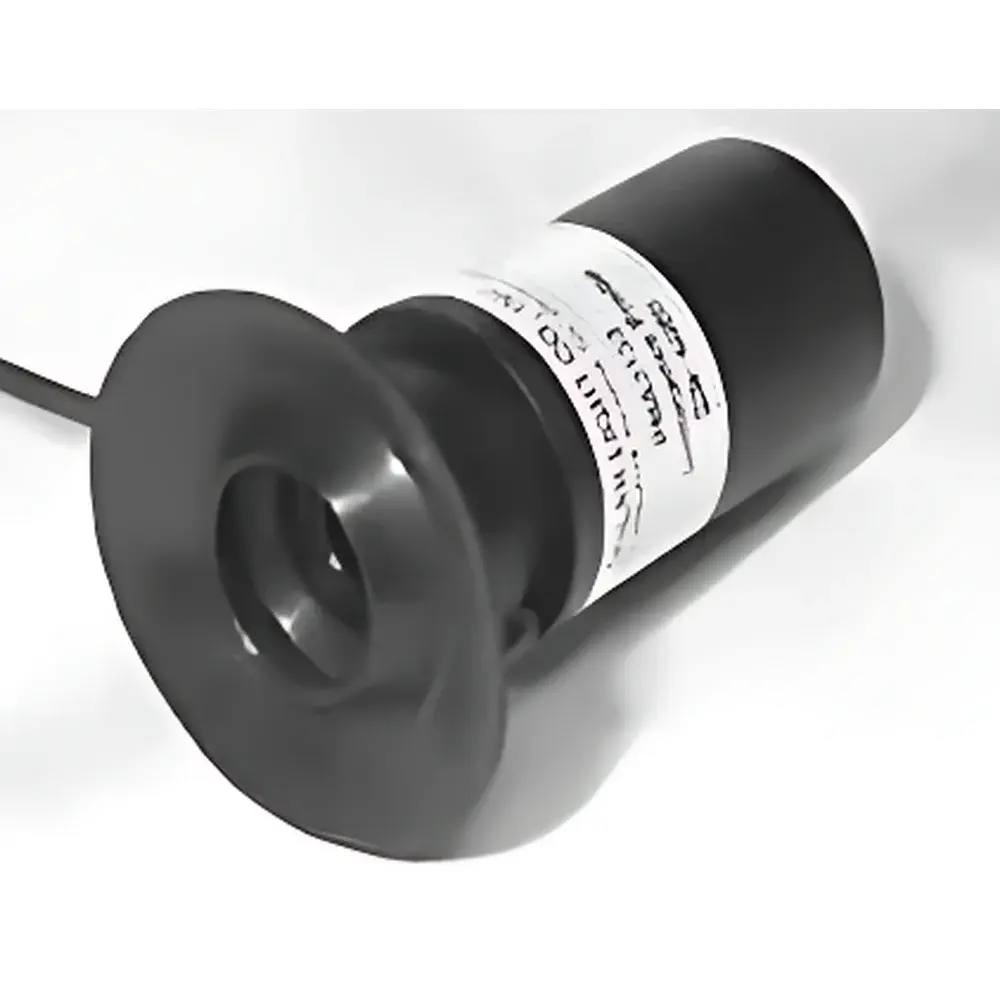
Solar Light PMA2133 Portable Luminance Meter
| Brand | Solar Light |
|---|---|
| Origin | USA |
| Model | PMA2133 |
| Spectral Response | CIE Photopic Luminosity Function (400–700 nm) |
| Field of View | 8° |
| Measurement Range | 0–6,800 cd/m² (0–2,000 fL) |
| Resolution | 0.01 cd/m² or 0.01 fL |
| Operating Temperature | 0–50 °C |
| Cable Length | 1.5 m |
| Detector Diameter | 40.6 mm |
| Height | 81.3 mm |
| Weight | 110 g |
| Calibration | NIST-traceable cosine-corrected photometric calibration |
Overview
The Solar Light PMA2133 Portable Luminance Meter is a precision photometric instrument engineered for traceable, repeatable measurement of luminance—defined as luminous intensity per unit projected area in a given direction. It operates on the fundamental principle of photometry, utilizing a silicon photodiode sensor optically filtered to conform precisely to the CIE 1931 photopic luminosity function V(λ), which models the spectral sensitivity of the human eye under daylight-adapted (photopic) conditions. With peak responsivity normalized at 555 nm and full spectral compliance across 400–700 nm, the PMA2133 delivers photometrically accurate readings in cd/m² (candela per square meter) or fL (foot-lambert), supporting direct conversion between units (1 fL = 3.426 cd/m²). Its compact, handheld form factor integrates a cosine-corrected input optic with an 8° field-of-view aperture, minimizing angular response error in real-world surface brightness assessments.
Key Features
- NIST-traceable calibration: Each unit ships with a documented calibration certificate referencing National Institute of Standards and Technology (NIST) standards, ensuring metrological integrity for laboratory and production QA environments.
- Cosine-corrected optical design: Engineered diffuser and aperture geometry minimize directional response deviation—critical for accurate luminance evaluation of non-Lambertian surfaces such as LCDs, OLEDs, and CRT displays.
- High dynamic range: Capable of resolving luminance values from 0.01 cd/m² up to 6,800 cd/m² (equivalent to 2,000 fL), accommodating both low-light interface validation and high-brightness outdoor display testing.
- Stable long-term performance: Thermally compensated circuitry and aged-filter stabilization ensure minimal drift over time—validated through accelerated aging protocols per IEC 62471 Annex D for photometric stability.
- Portable ergonomic construction: Weighing only 110 g with a 40.6 mm detector diameter and 81.3 mm height, the PMA2133 is optimized for handheld operation in cleanroom, production line, and field service settings.
Sample Compatibility & Compliance
The PMA2133 is validated for use with flat-panel displays (LCD, OLED, microLED), cathode-ray tubes (CRT), automotive instrument clusters, aviation cockpit displays, and architectural lighting surfaces. Its 8° field of view enables targeted measurement of localized luminance regions without spatial averaging artifacts. The instrument complies with key international photometric standards including CIE Publication No. 15:2018 (Colorimetry), ISO/CIE 11664-3:2019 (CIE colorimetric observers), and ANSI/NEMA LD 3-2020 (Luminance uniformity testing for LED signage). While not a Class I laser product, it meets IEC 61000-6-3 (EMC emission) and IEC 61000-6-2 (immunity) requirements for industrial environments. Calibration documentation satisfies GLP audit requirements for traceability and uncertainty reporting.
Software & Data Management
The PMA2133 operates as a standalone meter with no embedded data logging; however, it is fully compatible with Solar Light’s optional PMA2100 Series Interface Module (sold separately), enabling analog voltage output (0–2 V) or RS-232 serial communication for integration into automated test systems. When paired with Solar Light’s PMASoft™ v4.x application (Windows-based), users can acquire time-stamped luminance sequences, generate statistical summaries (mean, min/max, std dev), and export CSV or XML datasets compliant with ASTM E308-22 Annex A3 for spectral data interchange. All calibration coefficients—including spectral mismatch correction factors—are embedded in device firmware and recalled automatically during interface handshake, preserving metrological continuity across instrument lifecycles.
Applications
- Display manufacturing QA: Luminance uniformity mapping, black-level verification, and contrast ratio validation per ISO 9241-307 for visual display terminals.
- CRT and legacy monitor recalibration: Verification of gamma curve fidelity and luminance decay tracking over operational lifetime.
- Automotive HMI certification: Testing of dashboard display legibility under simulated daylight and nighttime ambient conditions per SAE J1757-2.
- Medical imaging display compliance: Adherence to DICOM Part 14 grayscale standard display function (GSDF) luminance calibration protocols.
- Architectural lighting commissioning: Spot-checking of luminance levels on façade elements, wayfinding signage, and emergency egress markings per IES LM-79-19 Annex B.
FAQ
Is the PMA2133 suitable for measuring OLED screen burn-in degradation?
Yes—the instrument’s 0.01 cd/m² resolution and low-noise analog front-end enable detection of sub-1% luminance shifts over time, supporting quantitative tracking of pixel-level luminance decay when used with fixed-position mounting fixtures.
Does it support automatic unit switching between cd/m² and fL?
No—unit selection is manual via front-panel toggle; however, both scales are simultaneously displayed on the dual-line LCD for rapid cross-reference.
Can the cosine corrector be removed or replaced for specialized optical setups?
No—the cosine diffuser is permanently integrated and optically aligned during factory calibration; removal invalidates NIST traceability and voids warranty.
What is the recommended recalibration interval?
Solar Light recommends annual recalibration against NIST-traceable reference standards, or after any physical shock exceeding 25 g per IEC 60068-2-27, to maintain stated uncertainty specifications.
Is firmware upgradable in the field?
Firmware updates require connection to Solar Light’s authorized service center; no user-accessible bootloader or USB interface is provided on the PMA2133 hardware platform.





