
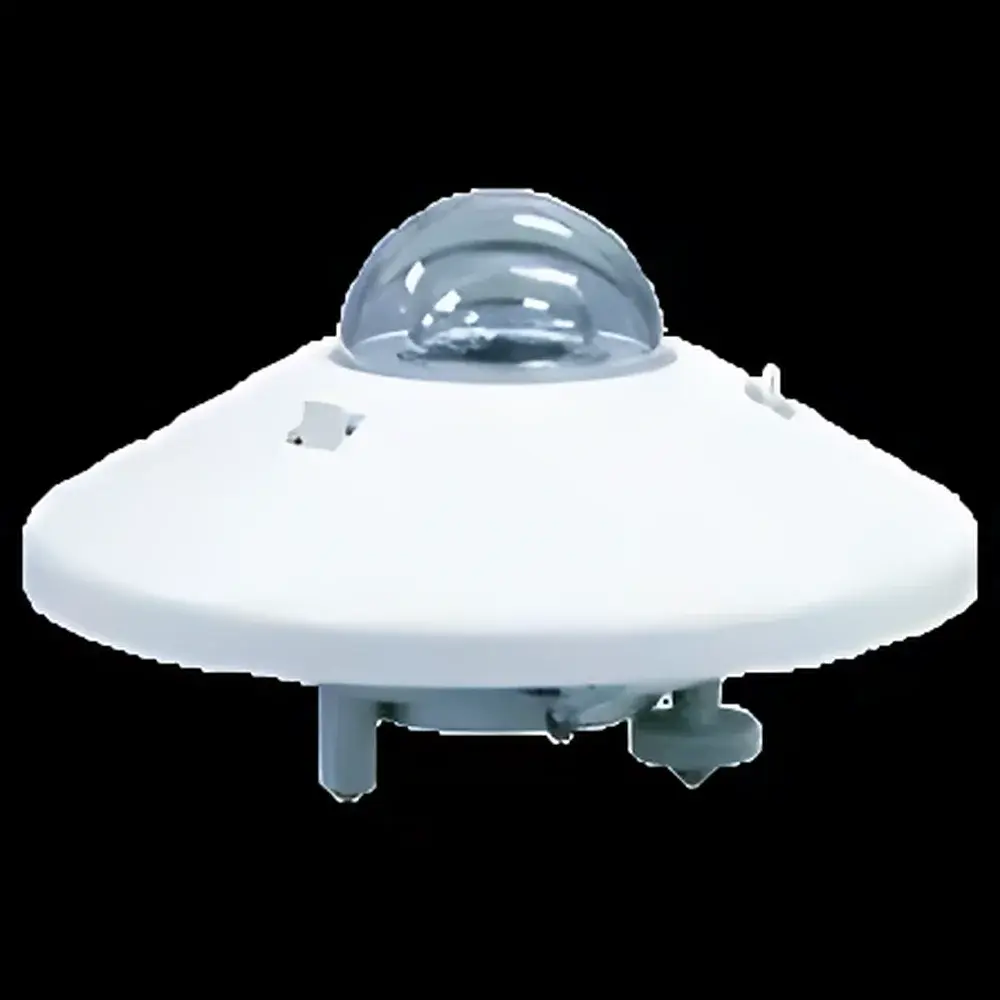
Solar Light PMA2145 Class I Pyranometer
| Brand | Solar Light |
|---|---|
| Origin | USA |
| Model | PMA2145 |
| Spectral Range | 310–2800 nm (FWHM) |
| Full-Scale Range | 2000 W/m² |
| Response Time | 18 s (95%) |
| Annual Drift | <1% |
| Nonlinearity | <1.0% (at 1000 W/m²) |
| Temperature Dependence | <2% (-10 to +40 °C) |
| Cosine Response Error | ≤1% up to 70° zenith angle |
| Zero Offset | <15 W/m² at 200 W/m² net irradiance |
| Resolution | 1 W/m² / 0.1 mW/cm² |
| Operating Ambient | -40 to +80 °C |
| Cable Length | 9 m |
| Sensor Diameter (with shade) | 60.3 mm |
| Height | 84.0 mm |
| Weight | 0.31 kg |
Overview
The Solar Light PMA2145 Class I Pyranometer is a high-accuracy, thermopile-based radiometric sensor engineered for continuous, traceable measurement of global solar irradiance (GHI) under natural and controlled conditions. Designed and manufactured in the United States, it complies fully with ISO 9060:2018 classification requirements for Class I pyranometers—the highest performance tier defined for scientific and metrological applications. Its core sensing element consists of a 64-junction thermopile mounted on a precision-machined copper base and coated with a highly stable, inorganic carbon black absorber deposited via non-organic vacuum deposition. This ensures uniform spectral absorption, minimal aging effects, and long-term signal stability. The sensor is encapsulated beneath two concentric Schott K5 optical glass domes—selected for their broad UV-to-NIR transmission (310–2800 nm FWHM), mechanical robustness, and resistance to environmental degradation. The outer dome serves as both a spectral filter and a physical barrier against wind, precipitation, dust, and thermal convection, while the inner dome minimizes thermal offset errors by reducing cavity radiation exchange.
Key Features
- ISO 9060:2018 Class I certified performance—validated for use in reference stations, calibration laboratories, and regulatory-grade monitoring networks
- Thermopile detector with 64 thermocouple junctions and NIST-traceable calibration certificate (individual serial-numbered)
- Inorganic carbon black absorber layer—engineered for spectral flatness, low reflectance (<2% across 350–1800 nm), and resistance to UV-induced degradation
- Dual Schott K5 hemispherical domes—optimized for minimal thermal offset, high transmission, and mechanical durability in outdoor deployments
- Integrated bubble level and mounting flange—enabling precise horizontal alignment per IEC 61724-1 and ASTM G173 standards
- Onboard EEPROM memory storing unique calibration coefficients and linearization algorithms—automatically loaded upon connection to compatible readout units (e.g., PMA2100)
- Low zero-offset design (<15 W/m² at 200 W/m² net irradiance) and temperature-compensated electronics—supporting reliable operation from -40 to +80 °C
Sample Compatibility & Compliance
The PMA2145 is optimized for measuring broadband solar irradiance under clear-sky, overcast, and partially cloudy conditions. It meets the angular response criteria specified in ISO 9060:2018 (cosine error ≤1% up to 70° zenith angle) and exhibits negligible azimuthal dependence. When deployed with a motorized shadow band or shading disk (e.g., Solys-2 or EKO MS-802), it supports compliant separation of direct normal irradiance (DNI) and diffuse horizontal irradiance (DHI) per ISO 9060 Annex C and BSRN protocols. The instrument is suitable for installation in accordance with IEC 61724-1 (Photovoltaic system performance monitoring), ASTM E892 (Standard Test Method for Spectral Match of Solar Simulators), and WMO Guide to Meteorological Instruments and Methods of Observation (CIMO Guide). Its NIST-traceable calibration enables compliance with GLP and ISO/IEC 17025 quality systems when used within an auditable measurement chain.
Software & Data Management
The PMA2145 operates as a passive analog sensor (output: µV per W/m²) but achieves digital intelligence through integration with Solar Light’s PMA2100 series smart meters. Upon connection, the PMA2100 automatically downloads the unit-specific calibration coefficient and embedded correction algorithm—including temperature compensation, nonlinearity correction, and cosine response adjustment—from the sensor’s onboard EEPROM. Real-time irradiance values are displayed on the LCD with resolution of 1 W/m² or 0.1 mW/cm² and logged with timestamp, ambient temperature, and diagnostic flags. Data export supports CSV and Modbus RTU protocols, facilitating ingestion into SCADA platforms, PV performance models (e.g., PVsyst), and cloud-based analytics tools (e.g., SolarAnywhere, Solargis). All calibration records and firmware versions are retained in audit-ready format compliant with FDA 21 CFR Part 11 requirements when configured with appropriate user access controls and electronic signatures.
Applications
- Meteorological observation networks requiring Class I traceability (e.g., NOAA SURFRAD, BSRN, WMO GAW)
- Solar resource assessment and bankable energy yield modeling for utility-scale photovoltaic projects
- Calibration transfer and intercomparison studies between reference cells, secondary standards, and field sensors
- Agricultural microclimate monitoring—including PAR estimation via empirical conversion and evapotranspiration modeling
- Building energy simulation and daylight harvesting system validation per ASHRAE 140 and ISO 13790
- Optical physics laboratories conducting spectral irradiance characterization, lamp output verification, and material degradation testing
- Indoor lighting R&D where broadband visible-plus-NIR irradiance quantification is required for human-centric lighting or horticultural LED validation
FAQ
Is the PMA2145 suitable for indoor artificial light measurements?
Yes—its flat spectral response from 310–2800 nm allows accurate integration of irradiance from tungsten-halogen, metal halide, fluorescent, and broad-spectrum white LEDs. However, users should verify that source spectral output falls within the sensor’s calibrated range and apply appropriate correction factors if measuring narrowband sources.
Does it require periodic recalibration?
Per ISO 9060:2018 and best practice, annual recalibration is recommended for Class I instruments used in critical applications. Solar Light offers NIST-traceable recalibration services with full uncertainty budget reporting.
Can it be used without the PMA2100 meter?
Yes—it outputs a millivolt-level analog signal (typically ~10 µV per W/m²) compatible with any data logger featuring high-resolution differential input, low-noise amplification, and cold-junction compensation. However, full utilization of its built-in corrections requires the PMA2100 or equivalent host device.
What is the impact of dome soiling on measurement accuracy?
Soiling-induced attenuation follows a near-linear relationship with transmittance loss. For Class I compliance, cleaning frequency must be determined based on local particulate load; typical drift exceeds ±1% after 7–14 days in arid/dusty environments without maintenance.
How is thermal offset minimized in the PMA2145 design?
Through symmetrical dual-dome geometry, high-emissivity blackbody cavity design, and passive thermal mass stabilization—reducing net longwave radiation imbalance and limiting zero-offset to <15 W/m² under representative operating conditions.




