
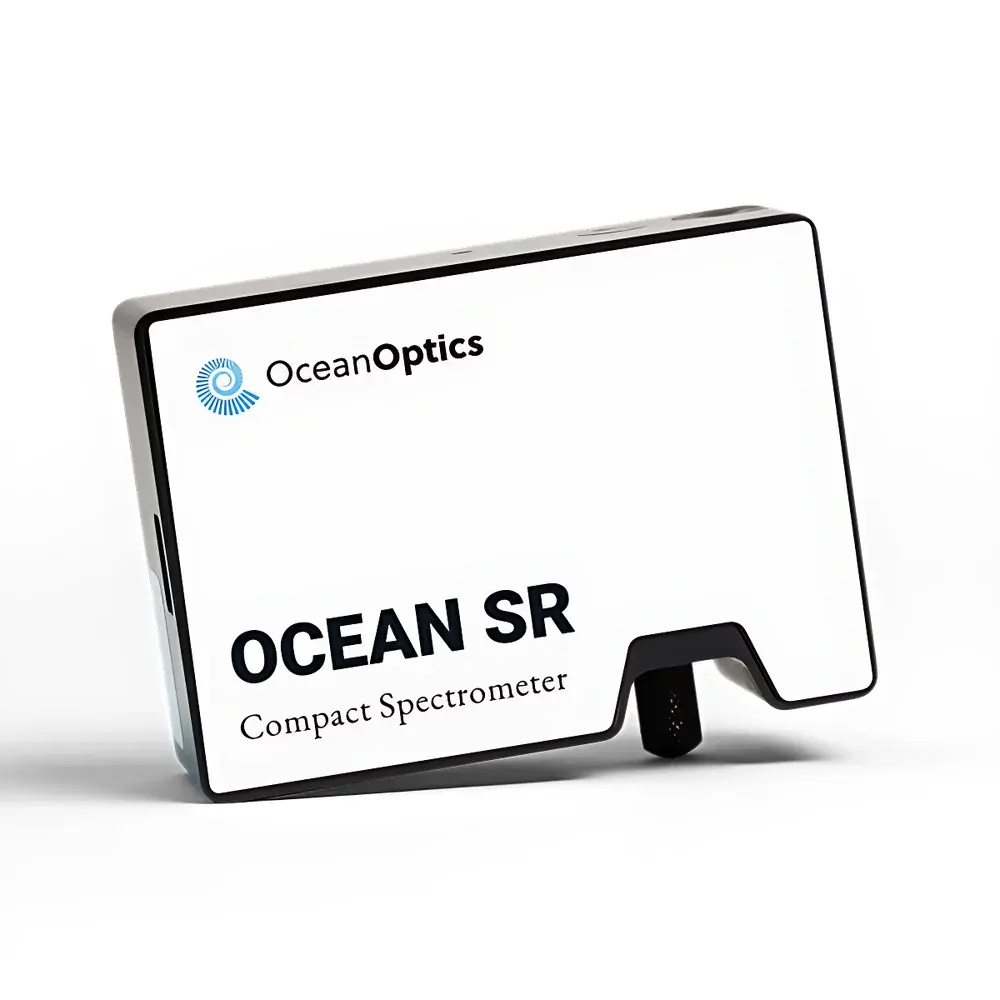
Ocean Optics Ocean SR6 Fiber Optic Spectrometer
| Brand | Ocean Optics |
|---|---|
| Origin | USA |
| Model | Ocean SR6 |
| Detector Type | CCD |
| Spectral Range | ~185–1100 nm (configuration-dependent) |
| Optical Resolution (25 µm slit) | 0.50–2.0 nm FWHM (configuration-dependent) |
| Signal-to-Noise Ratio | 3500:1 (on-board averaging mode) |
| Dynamic Range | 12,000:1 (single-scan) |
| Integration Time | 7.2 ms – 5 s |
| Thermal Stability | 0.02 nm/°C |
| Pixel Count | 2048 |
| Interface | USB Type-C, SMA 905, 16-pin Samtec TM, RS-232 |
| Operating Temperature | 0–55 °C |
| Storage Temperature | −30–70 °C |
| Dimensions | 89.0 × 63.5 × 31.3 mm |
| Weight | 275 g |
Overview
The Ocean Optics Ocean SR6 Fiber Optic Spectrometer is a high-performance, compact UV-VIS-NIR spectrometer engineered for precision spectral acquisition across demanding laboratory, industrial, and OEM integration environments. Based on a thermally stabilized optical bench and a high-quantum-efficiency linear CCD array detector, the SR6 leverages advanced optical design principles—including aberration-corrected Czerny-Turner configuration—to deliver robust spectral fidelity over a broad range of ~185–1100 nm. Its core architecture minimizes thermal drift (0.02 nm/°C), enabling reliable long-term measurements without active cooling—critical for field-deployable systems or temperature-variable production lines. Unlike conventional benchtop spectrometers, the SR6 integrates signal processing directly into its firmware, supporting hardware-accelerated on-board averaging to maximize effective SNR without host CPU overhead. This makes it particularly suitable for time-resolved spectroscopy, process monitoring, and applications requiring high reproducibility under non-ideal thermal conditions.
Key Features
- Thermally stable optical platform with 0.02 nm/°C wavelength drift, eliminating need for active cooling in most ambient environments
- High-resolution capability: 0.50–2.0 nm FWHM (dependent on grating and slit selection; standard 25 µm slit)
- Extended spectral coverage from deep UV (<185 nm) to near-infrared (1100 nm), configurable via optimized grating and detector coating options
- 2048-pixel linear CCD array with high quantum efficiency across UV-VIS-NIR spectrum
- Hardware-accelerated on-board averaging mode, delivering up to 3500:1 SNR—significantly exceeding single-scan performance (400:1 at 10 ms)
- Wide dynamic range of 12,000:1 (single-scan), supporting both low-light and high-intensity measurements without gain switching artifacts
- Flexible triggering interface (TTL-compatible) for precise synchronization with pulsed light sources, shutters, or external instrumentation
- Compact footprint (89.0 × 63.5 × 31.3 mm) and lightweight design (275 g), ideal for embedded OEM systems and portable analyzers
- Multi-interface connectivity: USB Type-C (high-speed data transfer), SMA 905 fiber input, 16-pin Samtec TM for GPIO and power, plus RS-232 for legacy control
Sample Compatibility & Compliance
The Ocean SR6 is designed for use with standard 200–600 µm core optical fibers (SMA 905 connector), enabling seamless coupling to Ocean Insight’s full portfolio of calibrated light sources, cuvette holders, integrating spheres, reflection probes, and flow cells. Its modular optical path supports interchangeable slits (5–200 µm), gratings, and filters—allowing optimization for resolution, throughput, or stray-light rejection per application. From a regulatory standpoint, the SR6 complies with CE, FCC Part 15 Class B, and RoHS directives. While not intrinsically certified for hazardous locations, its robust mechanical housing and wide operating temperature range (0–55 °C) support deployment in ISO 17025-accredited laboratories and GMP-aligned manufacturing environments. Data integrity is maintained through deterministic timing, non-volatile calibration storage, and full traceability of wavelength and intensity calibrations—key requirements for audit readiness under FDA 21 CFR Part 11 and GLP/GMP frameworks.
Software & Data Management
The SR6 is fully supported by OceanView, Ocean Insight’s flagship cross-platform spectral acquisition software (Windows, macOS, Linux), offering real-time visualization, multi-channel comparison, spectral library matching, and export to CSV, TXT, and HDF5 formats. For custom integration, OceanDirect SDK provides a comprehensive, well-documented C/C++, Python, MATLAB, and LabVIEW API with thread-safe functions for device enumeration, configuration, acquisition control, and metadata handling. OceanDirect enables deterministic trigger latency (<10 µs jitter), programmable averaging depth, and direct access to raw pixel data—essential for algorithm developers implementing chemometric models or real-time spectral classification. All firmware and calibration files are digitally signed, and software updates follow version-controlled release cycles with full backward compatibility. Audit trails, user session logging, and calibration certificate export are natively supported within OceanView for compliance-driven workflows.
Applications
- UV-Vis absorption & transmission analysis of pharmaceutical formulations, water quality parameters (NO₃⁻, COD, TOC), and semiconductor thin films
- Fluorescence and phosphorescence lifetime studies using gated acquisition and external trigger synchronization
- Color measurement and spectral radiometry in display manufacturing, LED binning, and lighting R&D
- In-line process monitoring in chemical synthesis, food processing, and polymer extrusion via fiber-coupled probe interfaces
- OEM integration into handheld analyzers, environmental sensors, and educational platforms requiring low-power, high-reliability spectral engines
- Plasma diagnostics and laser-induced breakdown spectroscopy (LIBS) where high SNR and sub-millisecond temporal resolution are critical
FAQ
What spectral calibration options are available for the Ocean SR6?
Factory-calibrated wavelength and intensity corrections are provided with NIST-traceable standards. Users may perform recalibration using OceanView’s built-in routines or import custom calibration files via OceanDirect.
Can the SR6 operate in continuous streaming mode at maximum frame rate?
Yes—USB Type-C enables sustained data throughput up to 1,000 spectra/sec (depending on integration time and packet size), with hardware buffering to prevent dropouts during high-speed acquisition.
Is the SR6 compatible with third-party fiber optic accessories?
Yes—the SMA 905 interface conforms to industry-standard dimensions and numerical aperture specifications, ensuring interoperability with most commercial fiber probes and sampling optics.
How is thermal stability achieved without thermoelectric cooling?
Through low-expansion optical materials, symmetric mechanical layout, and real-time dark-current compensation algorithms embedded in firmware—reducing thermal sensitivity to 0.02 nm/°C without added power draw or condensation risk.
Does OceanDirect support multithreaded acquisition in Python?
Yes—OceanDirect’s Python bindings are thread-safe and include asynchronous acquisition callbacks, enabling concurrent spectral capture and real-time data processing in production-grade applications.




